Seville City Council
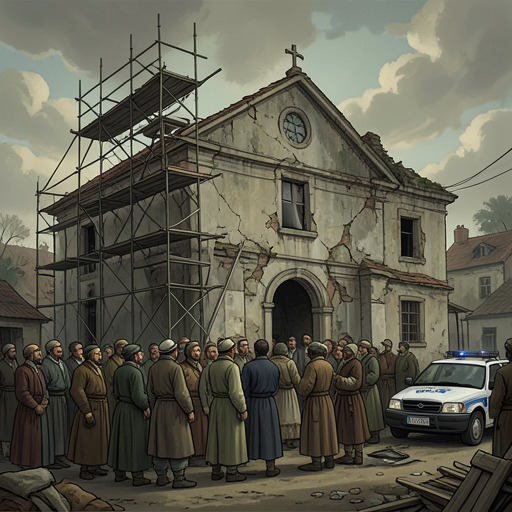
La piel del tamborSeville City Council is a municipal authority in the conflict over Nuestra Señora de las Lágrimas, the small, deteriorating Baroque church in Santa Cruz. Its support for declaring the building ruinous and clearing the site places it alongside the archdiocese and Banco Cartujano in a contested redevelopment effort, while the Bruner family’s claims and the restoration architect’s contrary technical assessment complicate the council’s position. The Council’s role shows how an official determination about a building’s condition can become a means of deciding the future of a religious and historic place.
Municipal Authority and the Church’s Future
The church’s threatened ruin and the suspension of restoration works had stirred competing interests. Seville City Council wanted to expropriate the site; an aristocratic Andalusian family connected to a bank was also reviving old rights. The dispute therefore involved more than a municipal judgment on a decaying structure: it concerned who could control valuable land in a historic district.
The archbishop described the Council as close to endorsing the cultural heritage department’s decision not to preserve the building for lack of funds. In his account, the administrative obstacles to an official ruin designation were nearly resolved, and the city’s approval would advance the process toward demolition. He called the municipal architect’s fatal accident a stroke of bad luck and said it was the reason the file had not already been closed. The description links the Council’s deliberations to the deaths surrounding the church without establishing that the city caused them.
Disputed Assessments of Structural Condition
The public case for demolition is challenged by Gris Marsala, the architect responsible for the restoration. She says the Council, the bank, and the archdiocese invoke the church’s collapse as a justification for pulling it down. Her assessment distinguishes neglect and repairable damage from structural ruin: although the building has not been cared for over the preceding century and a half, its walls and vault have no irreversible cracks.
Marsala points to the damage above the pulpit, where plaster fell and killed Father Urbizu, but treats the incident as a localized failure rather than proof that the whole church is unsound. Most damage, she explains, is to the finishes, caused by damp entering through defective roofs. The roof problem had been addressed by laying new tiles with lime, cement, and sand. She says nearly ten tons of material were carried up to a height of fifteen meters by her and Father Óscar. The hands-on work offers a practical counterpoint to the institutional language of abandonment: the building is neglected, but it has also been repaired and remains usable.
Development Interests and Political Maneuvering
The Council’s position forms one part of a larger real-estate and financial strategy. Banco Cartujano had a redevelopment operation ready, and the archbishop said the diocese would receive generous compensation, alongside funding for a church in one of Seville’s poorer districts and a foundation supporting social work among the Roma community. He presented these proposed benefits as reasons the arrangement might serve the Church even as it required the old church’s secularization and demolition.
Pencho Gavira’s plan depended on removing political and administrative obstacles to the deal. He told Octavio Machuca that the press could be bought or given more attractive material to pursue. A dossier on irregularities in Andalusian unemployment subsidies was to be released at the same time, serving as a screen. Gavira also believed the Council would offer no opposition and that the cultural heritage department was already under his influence; he regarded the ecclesiastical dimension as the remaining problem. The passage presents municipal cooperation not as a neutral background condition but as one of the anticipated steps in a coordinated effort to secure the site.
The stakes extended beyond the church itself. A Banco Cartujano internal report warned that failure of the Puerto Targa transaction could place the bank in serious difficulty, and that public knowledge of the bank’s dealings around Nuestra Señora de las Lágrimas could damage its standing with its conservative, often Catholic clientele. The church redevelopment was part of a plan to attract Saudi investors to a luxury hotel project in Santa Cruz. The Council’s anticipated assent thus mattered within a chain linking land use, bank finances, and the public credibility of the transaction.
Competing Claims and the Limits of Municipal Power
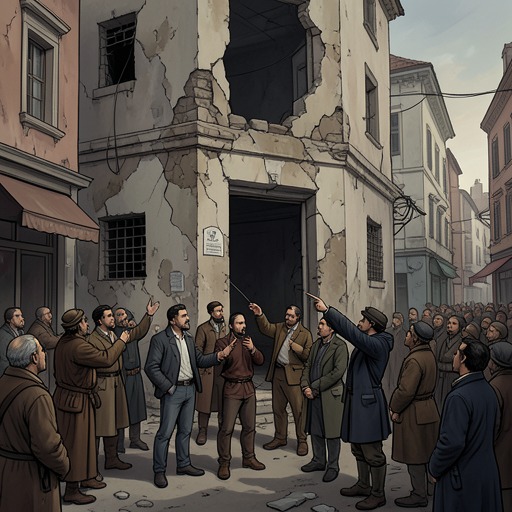
Macarena Bruner says the final decision about the site belongs to her family if the church is declared ruinous and the archdiocese authorizes demolition. Quart counters that the Council also has a say, and Macarena answers that the family would litigate. Their exchange makes clear that a municipal position does not by itself settle ownership or control: the city is an important participant in a conflict involving family claims and ecclesiastical authority as well.
The church’s legal vulnerability is further constrained by an old privilege. Under the 1687 grant described by the archbishop, Nuestra Señora de las Lágrimas was to retain its privileges so long as Mass was said there each Thursday for the soul of Gaspar Bruner de Lebrija, its benefactor. Macarena specifies that he died on a Thursday in 1709 and that the Mass is held at eight in the morning. She says that an emissary of the archbishop and a notary paid by Gavira watch each Thursday for an irregularity or omission. The Council’s redevelopment ambitions therefore depend on more than obtaining a municipal finding of ruin: ecclesiastical permission, the family’s claims, and the continuing ritual condition all bear on whether demolition can proceed.
Narrative Significance
Seville City Council’s role is defined by this gap between administrative designation and the contested reality of the building. The city is expected to help validate a claim of ruin, yet Marsala’s repairs and structural judgment dispute that claim; the Council is also anticipated to cooperate with a redevelopment plan whose financial stakes reach beyond the neighborhood. Through the conflict, municipal procedure becomes one of the mechanisms by which a historic church may be treated as disposable property, even while worship, family memory, and conservation work continue to give it a life that official plans cannot simply erase.