Society of Jesus
La piel del tamborThe Society of Jesus is represented chiefly by Jesuit priests working in the Vatican’s computer-security operation. Their watch over the central system places them in pursuit of Vísperas, an elusive hacker, and gives the order a practical role in the story’s opening and recurring cyberintrusion plot. Elsewhere, the novel’s conflicts over jurisdiction, discipline, and pastoral care make the Jesuits’ technical vigilance part of a wider portrait of church institutions under pressure.
Identity and Institutional Setting
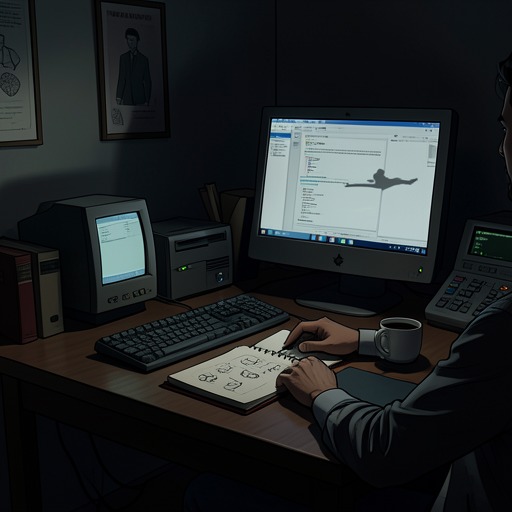
In the opening episode, a Jesuit official on night duty detects an intrusion into the Vatican’s central computer system and alerts his superior. Father Ignacio Arregui, a thin, bony Jesuit, comes from his quarters to the computer room. The alarm has followed an initial warning on a monitor; the letters HK appear on the screen, and the system’s automatic search maintains contact with the intruder’s signal. The scene establishes the Jesuits not only as clergy within the Vatican but also as personnel responsible for a technical operation.
The official on duty is Father Cooey, a young, heavyset Irish Jesuit who wears glasses. Arregui joins him as he follows the hacker’s trail. Their work is presented as familiar rather than exceptional: incursions are frequent, and hackers commonly leave messages or small viruses as evidence of their presence. Arregui’s irritation at being woken matters as much as the alarm; the institution has made a routine of guarding a system that remains exposed to repeated intrusions.
The Vatican Security Operation
The pursuit of Vísperas becomes an exhausting, organized watch. After the hacker has made his presence known, Arregui and his team of Jesuit computer experts monitor the Vatican’s central system in twelve-hour shifts. On one night, close to one in the morning, Arregui leaves the computer room to get coffee. The vending machine first takes his coins and gives him an empty cup with only a little sugar; on his second try, the coffee comes without sugar. He uses the earlier cup to sweeten it, then returns to the computers, burning his fingers through the plastic. This deliberately mundane interruption measures the human cost of a vigil carried out against a technically agile opponent.
Back in the computer room, Cooey has taken off his glasses to clean them while watching the screen, and another young Jesuit, the Italian Garofí, works at a second computer to identify and locate the intruder. One machine reproduces Vísperas’s movements; the other tries to trace him. Cooey announces that the hacker is searching for INMAVAT, and Arregui watches the red and blue icons and files moving rapidly across the display. Despite the disruption the hacker has caused, Arregui feels professional excitement at watching someone so capable at work. His response complicates the pursuit: Vísperas is a criminal, but also a skilled member of the technical world whose craft Arregui can recognize.
The Jesuits’ countermeasure is a system of traps the team calls Sadducean Traps. These are deliberately constructed computer spaces arranged like nets at a river’s mouth, intended to confuse intruders or expose identifying information. The traps laid for Vísperas form sophisticated electronic labyrinths; their progress is meant to reveal something of the hacker’s methods and make him vulnerable. The pursuit nevertheless ends without identification. Vísperas leaves charges in each loop that destroy the traces behind him when he withdraws. Garofí cannot locate him, and the intrusion ends with the signal disappearing from the screen. The team can recognize the hacker’s skill but cannot turn that recognition into an arrest or a name.
Service, Power, and Jurisdiction
The Society’s place in the Vatican’s institutional life is also framed by the Curia’s power struggles. When an investigation is assigned to the Institute for External Works, the decision is explicitly provisional: only evidence of greater gravity would transfer the matter to the Congregation for the Doctrine of the Faith. Cardinal Iwaszkiewicz’s repeated insistence that the Church no longer burns people gives that bureaucratic boundary a threatening undertone. The old language of the Inquisition may be gone, but institutional coercion remains possible in other forms.
Archbishop Spada later describes the Jesuits and liberal sectors of the Curia as groups being swept aside for the benefit of Opus Dei and other forces. He predicts that the struggle will not end in definitive victory for his side: each success is merely a postponement until the next attack. His account casts the Society not as a neutral observer of Vatican politics but as one of the institutional constituencies endangered by a shift in influence. It also links the computer investigation to a wider contest in which information, formal jurisdiction, and political survival are inseparable.
The operational work assigned to Lorenzo Quart illustrates how authority is divided and managed. The Institute for External Works sends him to Seville to identify the author of a letter, maintain prudent contact with the local church authority, and handle the matter discreetly. In Seville, the archbishop explains that demolition of Nuestra Señora de las Lágrimas requires its secularization, but a papally sanctioned privilege dating to 1687 protects the church so long as a Thursday Mass is said for Gaspar Bruner de Lebrija. When Quart asks whether the parish priest, Príamo Ferro, might be suspended, the archbishop says he has requested suspension ab officio from Rome, but that the procedure is slow. The church’s fate therefore turns on a local act of worship, diocesan discipline, and a Roman process whose delay has practical consequences.
Ministry, Ritual, and Human Consolation
The Thursday Mass is more than a legal formality. The condition requires Mass every Thursday at eight in the morning, on the day of Gaspar Bruner de Lebrija’s death in 1709. An archbishop’s representative and a notary paid by Pencho Gavira watch from the back pews, looking for a mistake or omission that could invalidate the church’s protection. The repeated rite binds the church’s survival to a precise schedule and exposes how easily religious observance can be turned into an instrument of surveillance. Yet the parish also depends on the Mass as a continuing practice, not merely as a clause in an old privilege.
Ferro explains to Quart that the parish is nearly bankrupt: his salary is small, and the Sunday collection does not pay even for candle wax. The church and its defenders face the threat of demolition while the Thursday service remains the narrow condition preserving its rights. Macarena Bruner fears that, once Father Óscar Lobato has been moved away, someone may act against Ferro. The conflict makes the local priest’s persistence a point of vulnerability as well as a form of resistance.
The novel’s reflections on faith deepen the contrast between a church as institution and a church as refuge. Ferro recalls reading ancient philosophy as a young priest and retaining only a bitter-sweet taste of melancholy and disappointment. At sixty-four, he says, what he knows of human beings is that they remember, fear, and die. For a quarter of a century he sat beside the dying, whose hands clung to his because he was their only consolation, while his prayers seemed to travel in one direction without an answer. He wonders how life’s message can be preserved in a world marked by death, where ordinary people leave no memory behind them. Faith becomes, in his account, a form of hope and consolation rather than an assured explanation of suffering.
That uncertainty does not end Ferro’s defense of the church. He argues that what matters is that those who come to it believe, and that their need justifies its existence. He describes its Baroque art—the gilded altars, sculptures, and display of passion—as a means of giving people a place of firm ground and hope. Quart objects that such consolation risks alienating people from truth. Their disagreement is not simply about doctrine: it asks whether a church’s value lies in the intellectual claims it can defend, or in the comfort its rituals and material beauty provide to people facing death.
Narrative Significance
The Society of Jesus is defined in these episodes by two kinds of vigilance. Its computer specialists keep watch over a digital system, devising traps and trying to follow an intruder who erases his tracks; the Jesuits’ place in Vatican politics, meanwhile, is described as vulnerable to institutional displacement. Both forms of vigilance are laborious and incomplete. The hacker escapes, and political victories, as Spada puts it, last only until the next attack.
The novel places this institutional uncertainty beside the parish’s fragile defense: an old privilege enforced through a weekly Mass, a priest who persists despite conflict with his bishop, and a community whose poverty makes its survival precarious. In the final image of Quart leaving the archbishop’s palace, he sees the Giralda beyond a courtyard once used by Seville’s bishops to imprison disobedient priests. He imagines that Ferro—and perhaps Quart himself—might have been confined there centuries earlier, while the archbishop sent his version of events to Rome by slow ordinary post. Modern phones have changed the speed of communication, but not eliminated the underlying struggle over discipline, information, and who gets to determine what the Church protects.