Statue of the Virgin in Nuestra Señora de las Lágrimas Church
La piel del tamborThe Statue of the Virgin in Nuestra Señora de las Lágrimas Church stands at the intersection of worship, inherited memory, and a legal contest over the church’s fate. At the center of a working but visibly damaged sanctuary, it is not merely an object of devotion: the Masses celebrated before it help preserve the building, while the pearls set into its image become a target for theft.
Appearance and Place in the Church
The statue occupies a niche above the main altar, raised about five metres above the floor and surrounded, during restoration work, by scaffolding, pipes, and platforms. Its Baroque carving presents the Virgin as a Dolorosa: her heart is pierced by daggers, and her eyes are lifted heavenward. The pearls associated with Captain Xaloc gleam on her cheeks, blue mantle, and crown of stars, making the image at once an object of religious attention and a visible repository of the church’s history.
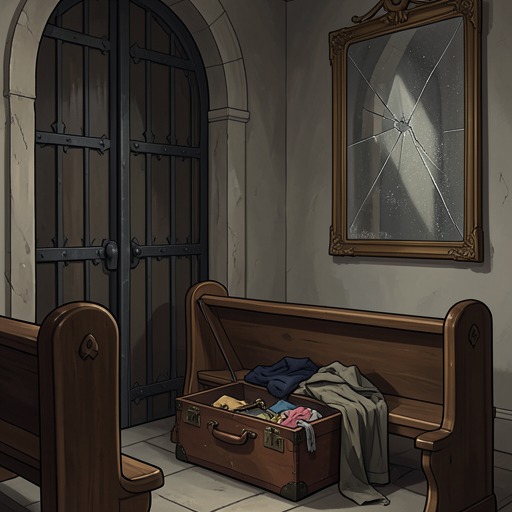
The statue’s setting emphasizes the tension between reverence and neglect. The church remains in use, but its walls are covered with scaffolding, its stained glass is incomplete, and dust lies on the ornamentation. During an evening visit, Honorato Bonafé sees the image from the nave beneath reddish dusk light, then climbs the scaffolding to examine the pearls at close range. The sacred figure is physically accessible through the very structure erected to repair the damaged church.
Ritual and the Church’s Legal Protection
The statue presides over the Masses that sustain both the parish’s religious life and its claim to remain standing. An old privilege, granted in 1687 with papal sanction, stipulates that the church will retain its privileges so long as Mass is said every Thursday for the soul of its benefactor, Gaspar Bruner de Lebrija. He died on a Thursday in 1709, and the later account specifies that the required service is at eight in the morning. The condition turns recurring worship into a practical safeguard against demolition.
Príamo Ferro goes far beyond the minimum requirement: he says Mass every day, and twice on Sundays and holy days. At the morning service, he wears the amice, an older vestment associated with practice before the Second Vatican Council, and an old guitar-shaped chasuble. He also celebrates parts of the Mass in Latin, despite the postconciliar rule that services should use each parish’s language to encourage understanding and participation. These choices mark him as a traditionalist, but the ritual’s significance is not only a matter of ecclesiastical style. Before the Virgin, his measured gestures and words give the gathered parishioners a source of consolation, while the repeated Thursday service keeps the church’s historic privilege in force.
The protection remains vulnerable because it depends on exact observance. Macarena Bruner explains that, on Thursdays, an emissary of the archbishop and a notary paid by Pencho Gavira watch from the last row for an irregularity or lapse. If a priest failed to say the Mass or omitted its required form, the church could be demolished. The statue thus stands within a devotional practice whose continuation is monitored by opposing institutional and financial interests.
The Pearl and the Attempted Theft
Bonafé approaches the image as a watcher and then as a thief. After checking the empty nave and sacristy, he looks into the crypt, returns his attention to the altar, and climbs the scaffolding. He wipes dust from the pearls with his handkerchief and studies one set into the Virgin’s mantle. With a small pocketknife, he lightly scrapes the pearl, pauses, and carefully works the blade into its setting until it comes free.
The pearl is thick, about the size of a chickpea. Bonafé keeps it in his palm before slipping it into his jacket pocket with a satisfied smile. The act converts an ornament attached to the statue into a portable object, exposed to handling, inspection, and removal. As he does so, the broken stained-glass image of Christ without a body casts red light across the church; a soft sound behind him and a slight tremor in the scaffolding interrupt the theft, leaving the moment under threat rather than securely concluded.
Devotion, Memory, and Material Stakes
The statue gathers several kinds of meaning without making them interchangeable. Its image gives the parish a focus for prayer; the pearls recall Captain Xaloc; and the Mass celebrated before it reenacts a sacred ritual whose words and gestures offer comfort to worshippers facing age, hardship, and uncertainty. At the same time, the old Bruner privilege makes continued worship a condition with consequences for the building’s survival. The sacred image is therefore embedded in a material and institutional conflict: what is revered is also watched, legally contested, restored, and vulnerable to theft.
The object’s changing visibility sharpens that conflict. During Mass, Quart watches the priest’s hands and the congregation’s faces, and comes to understand the church through the consolation its ritual offers, even as he remains skeptical. Later, Bonafé’s close inspection turns the statue’s pearls into evidence of their physical vulnerability. The Virgin remains the church’s devotional center, but the scene around the pearls shows how easily a sacred setting can become a place where memory, property, and opportunism meet.