The Thursday Mass condition at Nuestra Señora de las Lágrimas
La piel del tamborThe Thursday Mass condition at Nuestra Señora de las Lágrimas is a 1687 ecclesiastical privilege that ties the church’s protection from demolition to a recurring act of worship. A Mass for Gaspar Bruner de Lebrija must be celebrated every Thursday; the requirement gives the parish a practical defense against redevelopment, but also makes its survival depend on an exact ritual schedule and on the priest who observes it.
Origin and Terms
The Archbishop of Seville explains that an old privilege, granted in 1687 with papal sanction by his predecessor, makes the church retain its rights so long as a Thursday Mass is said for its benefactor, Gaspar Bruner de Lebrija. The weekday was chosen because Bruner died on a Thursday. The condition is therefore not simply a customary parish observance: it is the stated prerequisite that stands between secularization of the building and its demolition.
The rule is reiterated in a later account of the privilege’s terms: the Mass must take place at eight in the morning every Thursday, on the anniversary day of Bruner’s death in 1709. Its force rests on performance. The church’s protection does not depend merely on the existence of the old grant, but on the continued fulfillment of the specified obligation.
The Ritual in Practice
Príamo Ferro does more than meet the weekly requirement. The Archbishop confirms that he celebrates Mass every day of the week, except Sundays and holy days, when he celebrates twice. His daily schedule makes the Thursday obligation part of a broader, persistent priestly practice rather than an isolated legal maneuver.
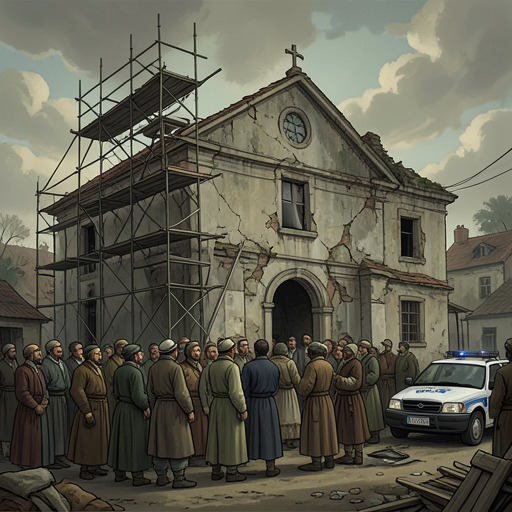
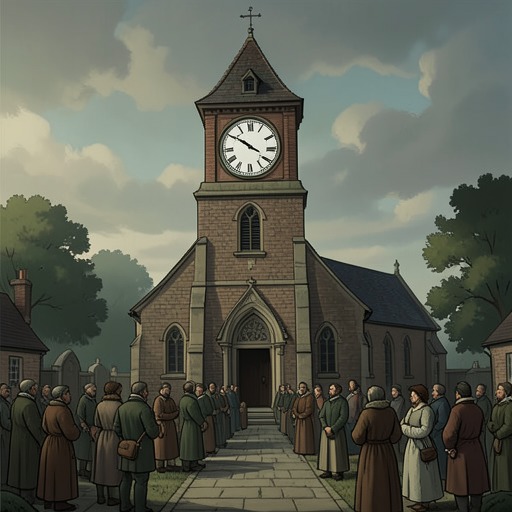
The condition is visible in the church’s liturgical life. At a morning service attended by local residents, Ferro celebrates amid restoration scaffolding and darkened paintings, wearing an old amice and a guitar-shaped chasuble associated with pre-Vatican II practice. These details situate the Thursday provision within a parish where ritual continuity is embodied in the priest’s traditionalist manner as well as secured by the repeated Mass itself.
Authority and Conflict
The privilege constrains the Archbishop’s response to Ferro. Although the Archbishop has sought Ferro’s suspension from office, he distinguishes the disciplinary dispute from the matter of authority: he cannot simply prevent a parish priest from saying Mass. He says that the Thursday service remains decisive while no order arrives from Rome. The procedure is slow, and the matter is entangled with the Vatican’s response to a computer intrusion and Lorenzo Quart’s expected report.
That delay frustrates Pencho Gavira, who reproaches the Archbishop for having referred the matter to Rome rather than acting on his own responsibility earlier. The condition thus exposes a conflict between local ecclesiastical authority, Roman procedure, and the interests seeking the church’s redevelopment. Its legal force is real, but it does not settle the wider struggle over the building.
Surveillance and Precarious Protection
The Thursday service is watched. Each week, an emissary of the Archbishop and a notary paid by Gavira sit in the last row, alert for an irregularity or lapse. The surveillance turns a recurring act of worship into a test whose performance is monitored by opposing parties: one seeking a basis to discipline Ferro, the other seeking a way to remove the church’s protection.
The danger becomes immediate when Celestino Peregil says that there can be no Mass in the church the following Thursday. Later, as Thursday approaches, Macarena Bruner recognizes the consequence: if no Mass is celebrated, the church’s privilege may be extinguished, leaving the Archbishop, the city council, and Banco Cartujano free to move against it. The condition’s power is therefore also its vulnerability. It can postpone demolition, but it cannot protect the church if the ritual on which it depends is interrupted.
Significance
The condition makes liturgy operate simultaneously as religious practice and institutional safeguard. For Macarena, the prospect that everything may depend on a missed service seems almost absurd; yet that apparent absurdity is precisely what gives the weekly rite its urgency. The Mass is a small, repeated action set against much larger pressures—church discipline, Roman delay, municipal authority, and commercial development.
Ferro’s defense of the parish also gives the ritual a human dimension beyond property law. He argues that the church matters because its parishioners have faith and need the consolation it offers, even if his own belief is uncertain. The Thursday Mass consequently preserves more than a technical privilege: it stands at the intersection of inherited obligation, communal worship, and the threatened refuge that the church represents.