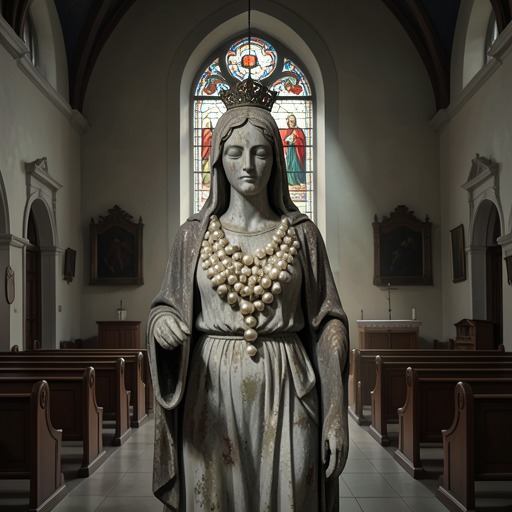
The substitution of the Virgin's pearls
La piel del tamborThe substitution of the Virgin's pearls is the hidden transaction that connects Bonafé's death, Father Ferro's financial desperation, and the stalled restoration of Nuestra Señora de las Lágrimas. The discovery that every pearl on the Virgin's image was an imitation turns an apparent murder mystery into a material trail: the missing value of the originals may have financed work the parish could not otherwise afford, while the recovered pearl in Bonafé's pocket suggests that he uncovered the substitution shortly before he died.
Discovery at the altar
The substitution enters the investigation through a small object recovered from Bonafé's body. Simeón Navajo produces a plastic bag containing a tiny nacreous ball and explains that it is one of twenty pearls set into the Virgin's face, mantle, and crown. Bonafé had carried it in his jacket pocket. At first it looks like a straightforward piece of stolen church property; Navajo's next disclosure overturns that reading: the pearl is false, as are the other nineteen.
The finding changes the apparent scale and meaning of the theft. The issue is not one missing ornament, but the replacement of the Virgin's complete set of twenty pearls with identical imitations months earlier. Their visual sameness concealed the loss: the image remained adorned, yet its apparent wealth no longer corresponded to the original objects. The counterfeit pearl in Bonafé's pocket is therefore both evidence of the substitution and a sign that he had reached the truth of it.
A trail from the pearls to the church's finances
Navajo describes an investigation that had occupied the afternoon and part of the night. His colleague, Chief Inspector Feijoo, worked late in Madrid to trace the pearls, and the police consulted reports and faxes before giving Quart the emerging account. The leads pointed again toward Francisco Montegrifo, a Madrid dealer who had served as Father Ferro's contact in the irregular sale of the Cillas altarpiece ten years earlier. Montegrifo was also believed to have put Captain Xaloc's pearls into circulation.
The identification was not proved conclusively. A description matched a batch found with a Catalan jeweller who acted as a police informant and specialized in laundering illegally acquired goods. The investigators could not establish Montegrifo's mediation as fact, but Navajo considered the indications substantial. The distinction matters: the pearl trail offers a strong working explanation, not a completed legal case against the dealer.
The suspected proceeds acquire significance when set against the parish's poverty. During the period in which the pearls were believed to have entered circulation, work at the church resumed. Building supplies were bought and machinery was rented. Suppliers contacted by Navajo's men said that the cost of those deliveries exceeded what the parish priest's salary and the church's collection box could cover. The timeline and the expense therefore suggested a connection between the substituted pearls and the restoration, even though the available account does not establish every step by which the money reached the church.
The parish's precarious bargain
The church already stood within a conflict shaped by an old privilege and a modern redevelopment plan. Aquilino Corvo tells Quart that a papally sanctioned privilege granted in 1687 protects the church's fueros so long as Mass is celebrated every Thursday for the soul of its benefactor, Gaspar Bruner de Lebrija. Macarena later specifies that the Mass takes place at eight in the morning, on the weekday of Gaspar's death in 1709. Each Thursday, an emissary of the archbishop and a notary paid by Pencho Gavira sit in the last pews, watching for a mistake or omission that might undermine the condition.
That arrangement makes the restoration more than a question of repair. Macarena explains that the parish has no money: the duchess and she have only enough to live on, Father Ferro's salary is small, and the Sunday collection scarcely pays for candles. Meanwhile, the church's survival depends on the repeated Thursday observance, and the archbishop's emissary and Gavira's notary are positioned to catch any lapse. In that context, the money apparently associated with the pearls could keep work going at a church whose legal and material protection is fragile.
The ecclesiastical dispute also has a disciplinary dimension. Corvo says Ferro disregards his pastoral instructions and refuses to fall into line; the archbishop has requested Ferro's suspension ab officio from Rome, but the process is slow. Corvo suspects that the Vatican's computer-system intrusion has made Rome wait for Quart's report. The ancient privilege, the weekly Mass, the attempted suspension, and the financial shortfall thus converge around Ferro's conduct, but they are not the same issue: observance may preserve the church's rights, while the archbishop's disciplinary procedure bears on the priest who performs it.
Bonafé, Ferro, and the competing explanations
For Navajo, the substitution supplies a possible motive and a sequence leading to Bonafé's death. He reasons that Bonafé was investigating the pearls, went to the church, and confirmed that the originals had been replaced. He may then have tried to blackmail Ferro; alternatively, Navajo allows that the priest may have surprised him before any blackmail could occur. In either version, Navajo imagines Ferro finding Bonafé at work and killing him, then locking the sacristy door and spending a couple of hours in the tower of Casa del Postigo reflecting before disappearing for a day.
Navajo's reconstruction is explicitly provisional. His hands stage the imagined encounter over a paper tray serving as a model scaffold, but the scene remains a hypothesis rather than a witnessed account. He has a forensic report and a confession from a priest he considers mentally competent, and so regards the identity of the killer as settled. Quart accepts that Ferro killed Bonafé but insists that the crucial questions are how and why. The pearl establishes a plausible connection between Bonafé and the church's hidden finances; it does not by itself establish what happened on the scaffold or whether blackmail was attempted.
Ferro's silence leaves a further gap. Navajo says that the priest has refused to explain his disappearance, and complains that Quart has not helped him fill in the account. The confession, the suspected pearl revenues, and the missing explanation therefore remain distinct strands. The recovered object narrows the mystery without resolving the priest's precise motive or the circumstances of the killing.
Significance of the counterfeit set
The imitations give the episode its central reversal: a sacred image appears intact while the valuable objects that once adorned it have been removed. The counterfeit set can be read as a sign of a church forced to maintain its outward form under material strain; in the investigation, however, the resemblance is practical as well as symbolic, because the replacements conceal the substitution long enough for the originals to be traded. The pearl in Bonafé's pocket makes that concealed difference legible at last.
The transaction also binds the church's survival to the same compromised economy threatening it. Restoration work resumes despite a parish budget that cannot pay for it, while the sale trail leads toward a dealer connected to Ferro's earlier illicit disposal of church art. The money may have served the preservation of Nuestra Señora de las Lágrimas, but the evidence does not erase the unlawful nature of the sale or prove the complete route of the proceeds. The substitution thus remains morally unsettled: it may have helped sustain the building, yet it exposes the church's vulnerability to secrecy, financial improvisation, and the very trade in sacred objects that its defenders must confront.