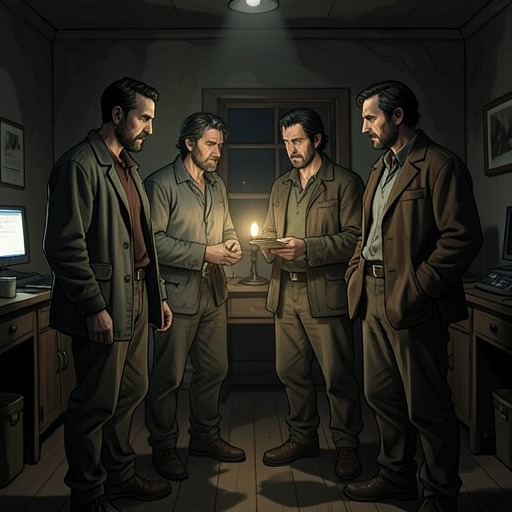
The three companions' “cause”
La piel del tamborThe three companions’ “cause” is the dream Don Ibrahim, Potro del Mantelete, and Niña Puñales discover together: to raise enough money to open a distinguished tablao in Seville and preserve Niña’s art. More than a business plan, it binds three people marked by bad luck, loneliness, and fading memories to an ideal of justice for Spanish song.
The Dream Takes Shape
Don Ibrahim presents their immediate strategy as a matter of money and opportunity. Celestino Peregil has promised three million, but Ibrahim suspects they may be able to obtain more: Peregil is said to be a banker’s fixer, and the prospective funds could provide the liquidity needed to lay the foundations of the old dream. Ibrahim borrows the language of men who keep their eyes open while dreaming, making himself the one who sustains the hope on behalf of his companions.
The destination gives that hope a name and a form. They intend to call their future establishment El Templo de la Copla, a grand tablao where Niña Puñales’s talent can finally receive the recognition it deserves and Spanish song can be kept alive. Their ambition is modest in scale but expansive in meaning: a place of their own, built from precarious circumstances, would turn an abstract wish into a home for an art they believe has been neglected.
The Three Companions
Don Ibrahim’s commitment grows from a sense of responsibility toward the two people he considers his own. He is loyal to Potro del Mantelete, whose fidelity has endured misfortune, and feels that Niña Puñales’s singing merits rescue from oblivion. He first heard her sing Capote de grana y oro after arriving in Seville, though he did not meet her until years later, when she was impoverished by alcohol and age and performing in a shabby tablao. He resolves to help her for the sake of Art, insisting to himself that hardship has not made him a contemptible man.
Potro del Mantelete gives the cause his assent in the language of collective devotion, calling it their cause. His battered face, shaped by bullfights and boxing, makes his rare smile seem an effort; when he smiles, it is with faith. Niña answers with a soft, tender ole and sings while placing her hand on Potro’s. Ibrahim suspects that Potro loves her silently, but that he does not declare it out of respect.
Their bond is sustained by different forms of longing rather than a simple shared romance. Niña remains faithful to the memory of the green-eyed man who, in her imagination, waits at the bottom of every bottle. Ibrahim’s own stories of youthful Caribbean romances are presented as unverifiable reminiscences. The companions’ friendship gathers these private solitudes into a common undertaking without requiring them to disappear.
A Friendship Made into a Cause
Chance and life bring the three together in Seville like corks drifting on a current. One night, after a quiet, prolonged bout of drinking beside the broad, calm Guadalquivir River, they discover the noble purpose they can share: the cause. Their proposed tablao transforms a friendship formed among disappointments into a practical promise—earn enough money, establish a place for Niña’s singing, and keep Spanish song alive.
The project’s poignancy lies in the contrast between its hopeful scale and the companions’ fragile circumstances. Ibrahim describes the need for liquidity and weighs what Peregil might pay, but the end they imagine is not merely financial. The money is a means to create a lasting stage for an artist whose career has declined and to make their loyalty visible in the world. In this sense, the cause is both an economic scheme and an act of cultural restitution: their dream asks whether people who have been cast adrift can still build something that outlasts their misfortunes.