Vísperas's Electronic Message to Rome
La piel del tamborVísperas's Electronic Message to Rome is the anonymous hacker’s means of turning a local church dispute into an appeal addressed to the Vatican. The messages defend Nuestra Señora de las Lágrimas and Príamo Ferro, whose last stand is being fought under the shadow of demolition and ecclesiastical discipline. Their biblical language gives the threatened building the dignity of a sacred cause; their failure to reach a responsive authority makes them signals sent faithfully into a world that may no longer understand them.
Origins and purpose
The messages originate in Cruz Bruner’s response to the neglect of Ferro’s case. The Archdiocese of Seville and the nunciature in Madrid had not listened to the priest as the dispute over Nuestra Señora de las Lágrimas grew more serious. Cruz later explains that she conceived of a way to make the complaint audible in Rome. She initially meant only to leave a message in the Vatican’s central system, hoping it might reach someone able to act; the more ambitious idea of manipulating the Pope’s computer came after she explored the system further.
The appeal had a specific institutional context. An old privilege, granted in 1687 with papal sanction, required Mass to be celebrated each Thursday for the soul of Gaspar Bruner de Lebrija, the church’s benefactor. The condition protected the church’s privileges while the observance continued, obstructing the secularization needed for demolition. But the protection depended on a priest continuing to perform the prescribed Mass: Archbishop Corvo had sought Príamo Ferro’s suspension, and those seeking the church’s removal could watch for a missed service or procedural lapse. Vísperas’s messages thus spoke not in abstraction but into a conflict where a weekly rite, an old grant, and the authority to discipline a priest all had practical consequences.
The message and its biblical claim
One message brought back from Rome declares that the temple of the Lord is God’s field and building, and warns that whoever destroys God’s temple will be destroyed by God. It identifies the church not as a disposable structure but as holy ground, and it casts the effort to demolish it as an offense with consequences beyond civic or financial calculation. Óscar Lobato recognizes the passage as First Corinthians when Quart shows him the faxed copy.
The scriptural wording fits the messages’ larger purpose. Quart comes to understand them as appeals to justice and common sense, and as a defense of an old priest fighting his last battle in a forgotten corner of the board. Their rhetoric seeks to make Rome recognize the moral stakes that local officials have failed to address. Yet the force of the words does not guarantee that their audience will hear them in that way: a biblical warning can be unmistakable as language and still fail as communication.
How the Vatican intrusion worked
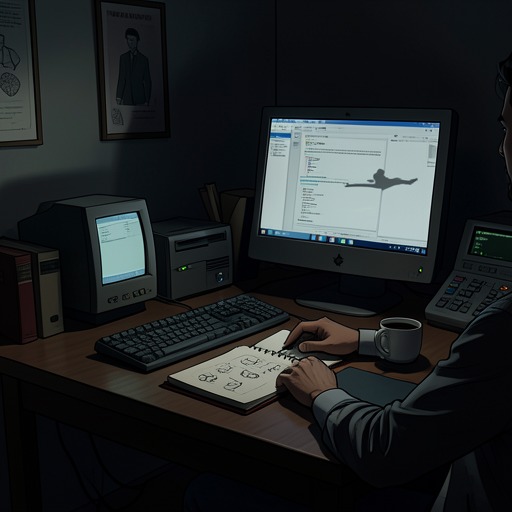
Vísperas did not simply enter the Pope’s computer by a direct, traceable route. Cruz says that a Roman contact, known as Deus ex Machina, had been exploring the system peripherally for amusement and supplied her with useful leads. She suspects the contact was a young seminarian or priest. Through this connection she encountered the Vatican system, then found the protected INMAVAT file and realized it contained something important. She tested her access and drew on more experienced hackers’ techniques before entering it.
The Vatican team responded by setting a digital trap. Its decoy areas, called Sadducean Traps, were designed as confusing network mazes that could expose an intruder or reveal information useful for identification. For the attempt to reach the Pope’s personal terminal, the team prepared a more specific diversion: an intruder coming from outside would carry an unnoticed hidden code through INMAVAT. At the threshold of VOIA, the code blocked access to the real destination and diverted the hacker to the fictitious VOIATS. Vísperas could then leave a message believing it had been placed on the Pope’s computer, while the intended recipient remained untouched.
The trap shaped the messages’ delivery without preventing their composition. During a later intrusion, Quart shows Óscar a copy of the message forwarded by fax from Rome; the hacking team had again redirected Vísperas into a parallel file. Father Garofí traced the signal to a telephone line at El Corte Inglés in central Seville, where the hacker had used an electronic loop to obscure the trail. The system could divert the message and help investigators follow its path, but it could not make the appeal reach the authority for whom it was intended.
Investigation and institutional response
Quart’s inquiry into Vísperas proceeds alongside his investigation of the church’s threatened status. In a conversation with Simeón Navajo, the police liaison reports that no one on Quart’s list had bought advanced computer equipment under their own name and tax identification number. A contact at Telefónica confirms that clandestine access to foreign networks is common among hackers, and describes Vísperas as particularly adept at moving through the Internet, using loops and programs that erase traces and frustrate detection. The absence of an obvious purchase record does not identify the intruder; the elaborate attempts to conceal a route make attribution harder still.
The Roman authorities’ response also reveals the distance between the messages’ urgency and the Church’s procedures. Archbishop Corvo says that he requested Príamo Ferro’s suspension from office in Rome, but such decisions move slowly. He suggests that, after the Vatican computer intrusion, Rome is waiting for Quart to return with his report. The messages are therefore caught between local discipline and distant administration: Corvo can press for a suspension, while Vísperas tries to circumvent the delay by addressing the Pope’s system directly.
Revelation and significance
The eventual explanation changes the meaning of the messages without making their purpose less serious. Cruz Bruner is revealed as Vísperas. She had learned to use a pirated bulletin-board system through an online contact, Mad Mike, who sometimes used the name Vizconde Valmont, and entered a wider community of computer enthusiasts. Her account locates the intrusion in a practice of anonymous exchange and experimentation, not in an inexplicable technical power. She undertook it without consulting Ferro, and did not initially tell her daughter Macarena.
Quart’s later assessment is both sympathetic and bleak: Vísperas’s motives are ingenuous, the messages appeal to justice and common sense, and the hacker is trying to defend a priest abandoned in a remote corner of the board. But Vísperas has mistaken the possibility of reaching Rome for the possibility of being understood there. The Roman authorities and the people around Quart do not inhabit the world of ideas to which the hacker appeals. The message’s repeated journey toward a protected terminal, its diversion into a false destination, and its eventual arrival as a fax embody that failure: the words survive, but the intended encounter does not. The electronic appeal becomes a fragile monument to a local cause and to an older moral language whose faithful transmission cannot restore the world that once gave it force.