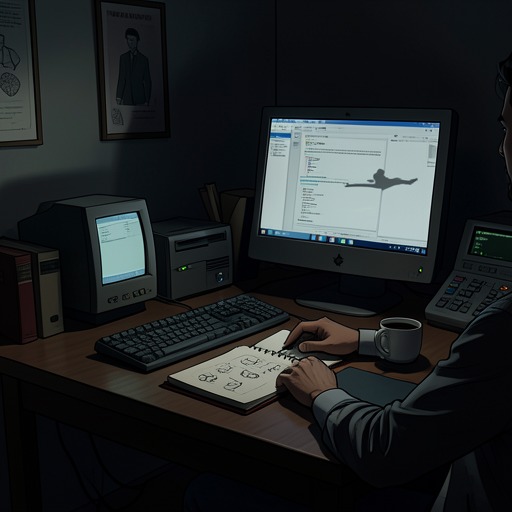
Vísperas's intrusion into the Vatican computer system
La piel del tamborVísperas’s intrusion into the Vatican computer system turns a clandestine act of hacking into both a technical contest and a plea about a threatened church. The attacker penetrates a restricted Curial archive and approaches the Pope’s personal computer, only to be diverted by a trap prepared by Jesuit specialists. The message left in the decoy is a lament for a ravaged sanctuary; the later revelation that Vísperas is Cruz Bruner connects that digital gesture to the danger facing Nuestra Señora de las Lágrimas in Seville.
The route into the Vatican
Vísperas’s path begins not with a direct assault on the Pope’s terminal but with INMAVAT, a restricted archive reserved for senior Curial officials. The hacker’s access exposes the archive on screen, while the Jesuits monitoring the attempt recognize the signature as Vísperas’s. The sequence makes the archive a threshold: penetrating it gives the intruder access to a hidden route toward the far more sensitive personal system, but also draws the attacker into a defense designed to identify and misdirect intrusions.
The operation depends on concealment and relay. Vísperas disguises the point of entry by jumping through different telephone networks, a method consistent with the complicated loops later described by the police liaison Simeón Navajo. Those loops allow the hacker to enter and leave networks while leaving behind programs that erase traces and confuse detection systems. The technical sophistication is real, but it does not make Vísperas untraceable by magic: the intrusion is a contest between methods of concealment and systems built to expose or contain them.
The trap and the failed approach
The Jesuits have spent days preparing what they call a “Sadducee trap,” a network of decoy areas intended to disorient intruders or reveal information that might identify them. Their defense at the Pope’s personal terminal is more specific. Accessing INMAVAT with an ordinary password leaves the trap inactive; an outside intruder, however, unknowingly carries a hidden code across the archive’s threshold. When that signal reaches VOIA, it blocks access to the real destination and diverts the hacker into VOIATS, a fictitious counterpart where the intruder can do no harm and may leave any new message believing it has reached the Pope.
The monitoring room becomes a scene of suspense as the cursor reaches VOIA and pauses for ten seconds. The Jesuits watch the mirrored screens, unsure whether Vísperas has entered the real file or the decoy. When the system displays the destination, Cooey reads the key aloud and recognizes that the hacker has been diverted. His growing smile registers the defense’s success: the Pope’s personal computer remains beyond reach, even though Vísperas believes the operation has reached its intended target.
Father Arregui’s relief is physical as well as professional. He praises God, having already torn a button from his cassock in the tension of the attempt, then bends over the screen to read the text. The trap has protected the computer, but it has not silenced the intruder. Instead, it has preserved the very message that makes the attempt legible as more than a technical trespass.
The message and its disappearance
The text begins with the lament, “The enemy has ravaged your sanctuary,” and continues with images of attackers roaring in an assembly, raising their own standards, and profaning the dwelling of God’s name. Its language invokes the Psalms, prompting Cooey to identify it as Psalm 63. The message gives the intrusion a pointed religious vocabulary: an image of a sanctuary under assault is carried into the institution whose attention Vísperas seeks. In the light of the later disclosure, the image also resonates with the danger confronting Nuestra Señora de las Lágrimas.
After sending the message, Vísperas cuts the connection and disappears from the screen. Garofi cannot locate the hacker. The loops leave behind what he compares to demolition charges: programs that destroy traces as the intruder departs. The failed pursuit underscores the asymmetry of the encounter. The Vatican team can redirect the hacker and keep the Pope’s computer safe, but it cannot identify or capture the person who has crossed its digital perimeter.
The person behind the alias
The later account identifies Vísperas as Cruz Bruner, whose entrance into the computer underground began when she was nearly seventy. She learned through an online contact using the names Mad Mike and, at times, Vizconde Valmont; his voice and face remained unknown to her. His pirated BBS introduced her to other enthusiasts of high technology, often young people spending long hours alone in their bedrooms, manipulating computers that belonged to others. Cruz describes the community with evident pride, as a distinctive club formed through anonymous contact and shared technical curiosity.
Her access to the Vatican system also develops through relationships within that network. A contact in Rome, Deus ex Machina, whom she suspects is a seminarian or young priest, had been exploring the system peripherally for amusement. The two became friends, and he passed her useful leads. About six or seven months before her account, the dispute over Nuestra Señora de las Lágrimas had become more serious, while the Archbishopric of Seville and the nunciature in Madrid were paying no attention to Father Ferro. Cruz decided that a message to Rome could offer another means of being heard.
She did not consult Father Ferro or her daughter before acting. At first she intended to leave a simple message in the Vatican’s central system and hoped it would reach the right hands. As she explored the network, she found the heavily protected INMAVAT archive, inferred that it held important information, and began trying to enter it. Friends with greater expertise supplied techniques; after experiments, she succeeded in getting inside and spent a week visiting the archive to understand what it contained. The eventual approach to the Pope’s computer thus grows out of a staged process of learning, assistance, exploration, and escalation rather than a single impulsive stroke.
Significance of the breach
The intrusion connects two forms of institutional boundary. INMAVAT and the Pope’s terminal are guarded by passwords, access controls, and decoy systems; the church dispute is hemmed in by offices that have failed to hear Father Ferro. Cruz’s response crosses the first boundary in order to challenge the second. Her operation does not defeat the Vatican’s defenses: the decoy works, the personal computer is protected, and the attacker escapes unrecognized. Yet the message survives, and its scriptural image turns the failed penetration into a communication whose force exceeds the hacker’s immediate technical success.
The episode also complicates assumptions about who can inhabit the hacker role. Vísperas is not simply a solitary prodigy: Cruz learns from an unseen mentor, enters an informal community through a pirated bulletin-board system, receives leads from a Roman contact, and draws on more expert associates. An elderly woman’s adoption of an anonymous identity and collaboration with younger enthusiasts unsettle the expected social profile of the intruder. Digital anonymity gives her access to a world otherwise closed to her, while the trail-erasing programs and changing telephone routes make that access difficult for authorities to follow.
The two accounts of the event therefore produce a deliberate reversal in scale and identity. During the live intrusion, the Jesuits confront Vísperas as a technically formidable and elusive adversary, and the Psalm seems to arrive from an unknown hand. Cruz’s later confession supplies the human history behind that screen: a new friendship, an underground education, and an effort to make Rome notice a local church in danger. The operation’s decisive outcome is neither access to the Pope’s real computer nor the hacker’s capture, but the creation of a message that passes through the trap and gives the threatened sanctuary a voice.