Antona Pérez
Lazarillo de TormesAntona Pérez is Lázaro de Tormes’s mother, a poor widow whose efforts to keep her children alive take her from domestic work to a condemned household and, finally, to the decision that sends Lázaro into service. Her story establishes the material pressures behind his childhood: bereavement, precarious labor, the brief relief Zaide brings, and the punishments that leave her with still fewer choices.
Identity and Early Circumstances
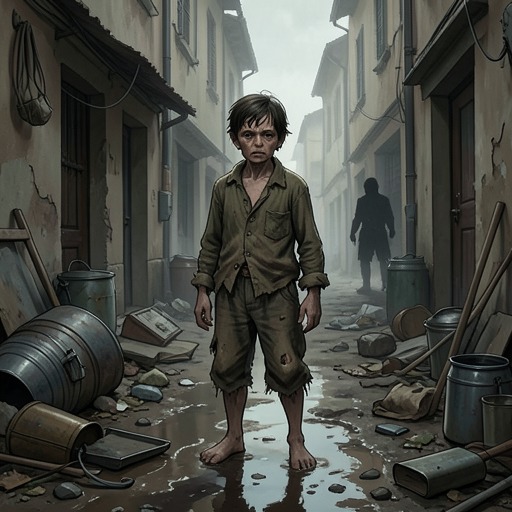
Antona Pérez came from Tejares, near Salamanca, and was married to Tomé González, a miller who worked for more than fifteen years at a mill on the Tormes River. When Lázaro was eight, Tomé was accused of tampering with the grain sacks brought to the mill. He confessed, was imprisoned, and later joined an expedition against the Moors as the muleteer of a knight. He died while accompanying his lord, leaving Antona widowed and without protection.
She moved into the city and rented a small house. To support herself, she cooked for students and washed clothes for stable boys attached to the Commander of Magdalena. This work brought her into the stables, where she met Zaide, an enslaved stable worker. Antona’s story thus locates family survival in poorly paid labor and in the opportunities, however precarious, that arose through service to wealthier households.
Zaide and the Household
Zaide visited Antona’s home, sometimes staying overnight and sometimes arriving by day under the pretext of buying eggs. Lázaro initially feared him because of his dark skin and appearance; he grew attached to him when Zaide’s presence improved the family’s meals. Zaide brought bread and pieces of meat, and, in winter, firewood. Antona and Zaide had a child together, Lázaro’s little brother, whom Lázaro remembered caring for and bouncing on his knees.
A moment between Zaide and the child gives this household’s racial difference a sharp, unsettling expression. Seeing that his mother and Lázaro were white while Zaide was not, the little boy fled to Antona and pointed at Zaide, calling him a bogeyman. Zaide answered with a joking insult. Lázaro, still a child, reflected that many people flee from others because they cannot see themselves. The episode belongs to Lázaro’s account of his own early understanding, while Antona’s household is shown through the material and familial bonds that make it a refuge before it becomes a target of official punishment.
Prosecution and Its Consequences
The household’s fragile security collapsed when the relationship between Antona Pérez and Zaide came to the attention of the stable administrator. An investigation found that Zaide had stolen half the barley allotted to the animals, along with bran, firewood, currycombs, aprons, and horse blankets he reported as lost; when nothing else was available, he took horseshoes. These goods helped Antona raise the child. Lázaro’s retrospective account sets Zaide’s theft beside the thefts of clerics and friars, suggesting that love and need, no less than religious hypocrisy, could drive people to take what they could not otherwise provide.
The authorities questioned Lázaro under threat. Frightened, he disclosed what he knew, including that he had sold horseshoes to a blacksmith at his mother’s instruction. Zaide was flogged and had hot fat poured over his wounds. Antona was sentenced to a hundred lashes and forbidden both to enter the Commander’s house and to receive Zaide in her own. The punishment therefore struck at more than the adults: it cut off Antona from her work at the stables and forbade the household arrangement that had helped feed her children.
Work, Separation, and Lázaro’s Departure
Antona endured her sentence and, to avoid further danger and malicious gossip, entered service at the Solana inn. She continued raising her younger son there through his first steps and kept Lázaro with her until he was an alert boy old enough to run errands, fetching wine and candles for guests and carrying out whatever else they ordered. Her labor changed setting, but remained organized around other people’s needs and the uncertain shelter and income available to a poor family.
When a blind man staying at the inn asked to take Lázaro into service as his guide, Antona entrusted her son to him. She described Lázaro’s dead father as a good man who had died in an expedition at Gerba, urged the new master to treat the orphan well, and received his assurance that he would care for the boy as a son rather than a servant. Antona and Lázaro parted in tears. She blessed him, told him to strive to be good, and reminded him that she had raised him and placed him with a good master, before urging him to look after himself. The parting ends her direct role in his childhood narrative, while making clear that her final act of care is also a transfer of him into service.
Prosecution and Its Consequences
The household’s fragile security collapsed when the stable administrator learned of Antona Pérez’s relationship with Zaide. An investigation found that Zaide had stolen half the barley allotted to the animals, as well as bran, firewood, currycombs, aprons, and horse blankets he had reported as lost; when nothing else was available, he took horseshoes. The stolen goods helped Antona raise her younger child. Lázaro’s retrospective account places Zaide’s theft beside thefts committed by clerics and friars, measuring the household’s desperate need against the religious hypocrisy the narrative repeatedly exposes.
Authorities questioned Lázaro under threat. Frightened, he disclosed what he knew, including that he had sold horseshoes to a blacksmith at his mother’s instruction. Zaide was flogged and hot fat was poured over his wounds. Antona was sentenced to a hundred lashes and forbidden both to enter the Commander of Magdalena’s house and to receive Zaide in her own. The penalties thus threatened the means of subsistence as well as the relationship: Antona lost access to the stable household where she had worked, while the family was barred from the arrangement that had helped feed the children.
Work, Separation, and Lázaro’s Departure
Antona endured her sentence and, to avoid further danger and malicious gossip, entered service at the Solana inn. She continued raising her younger son there until he could walk, and kept Lázaro with her until he was an alert boy who could fetch wine and candles for guests and perform other errands. Her work shifted from cooking for students and washing stable boys’ clothes to serving inn guests, but the family’s survival remained tied to labor performed for others.
A blind man lodging at the inn asked Antona to place Lázaro in his service as a guide. She presented the boy as the son of a good man who had died on an expedition at Gerba, asked the stranger to treat the orphan well, and received his assurance that he would take Lázaro not as a servant but as a son. After the family had spent several days in Salamanca, the blind man decided to leave because his earnings were insufficient. Antona and Lázaro parted in tears. She blessed him, urged him to be good, and reminded him that she had raised him and placed him with a good master before telling him to take care of himself. The farewell closes Antona’s direct part in Lázaro’s childhood narrative, but its assurance of protection is shadowed by the practical fact that she is sending her son away into service.
The Household in the Book’s Social Critique
Antona Pérez’s brief appearance is framed by a narrative in which survival repeatedly depends on service to wealthier households and the laboring poor are punished when they take resources to sustain themselves. She cooks for students, washes the stable boys’ clothes, and later serves at an inn; Zaide’s thefts of feed, firewood, and equipment help keep her children alive, yet the same acts bring both adults before the authorities. The contrast is not presented as an abstract defense of theft: Lázaro recounts the family’s deprivation alongside a bitter comparison with clerics and friars who also steal, exposing the unequal moral scrutiny applied to need and religious status.
The prosecution also reveals how official punishment reaches beyond the accused. Antona is barred from the Commander of Magdalena’s house, cutting her off from the stable work that had brought her into contact with Zaide, and is forbidden to receive him at home. Her move to the Solana inn is both a response to the sentence and an effort to avoid further danger and gossip. What remains is a narrower but persistent form of care: she raises both children there, then places Lázaro with the blind man when the boy is old enough to serve as a guide. Her blessing and instruction to look after himself mark the tenderness of their farewell, while the transfer into service makes clear how little room poverty leaves for a mother to protect her child by keeping him beside her.