Cortes of Toledo
Lazarillo de TormesThe Cortes of Toledo are the public assembly that supplies the final historical date in Lazarillo de Tormes and fixes the moment when Lázaro claims to have reached the height of his good fortune. Their appearance is brief but consequential: against the ceremonial arrival of the emperor and the city’s festivities, the narrator places a prosperity built on a royal appointment, a marriage shadowed by rumors, and his decision to live peacefully without confronting those rumors. The reference also opens a historical puzzle, since the assembly cannot be identified with certainty as either of two convocations under Charles V.
Nature and Historical Setting
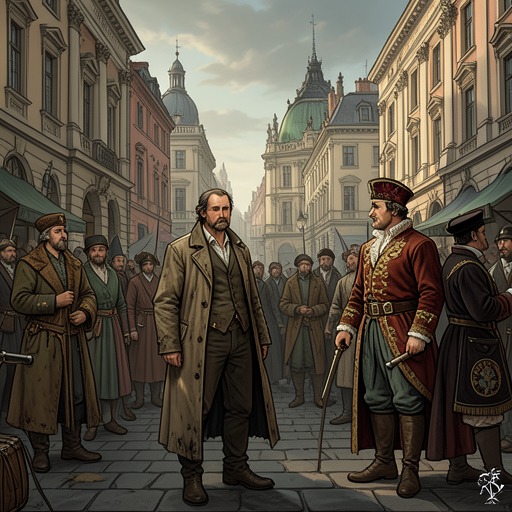
The book invokes the Cortes as an assembly held in Toledo during the reign of Charles V. In the closing account, Lázaro says that the events he has just described occurred in the same year that the emperor entered the distinguished city to hold the Cortes. The city’s festivities make the occasion publicly visible, contrasting with the private compromises through which Lázaro defines his own advancement.
The reference is one of two principal historical markers in the work. The other is the Battle of Djerba, mentioned in the opening account of Lázaro’s family. Each marker has two possible historical referents: the battle took place in 1510 and 1520, while the Cortes met in Toledo in 1525 and 1538–39. Because the narrated span of Lázaro’s life has been estimated at roughly fourteen to seventeen years, identifying one reference helps determine which of the other’s dates could fit the chronology. The clues constrain one another, but do not settle the matter.
The Assembly in Lázaro’s Ending
The Cortes enter at the point when Lázaro explains the “case” that prompted his written account. After a short and dangerous period serving an alguacil, he secures, with help from influential friends, a position as a public crier in the king’s service. He announces wines for sale and lost property, and accompanies people pursued by justice as their crimes are proclaimed. The post gives him an income and a measure of security, though the book presents it as a lowly occupation rather than an unambiguous social triumph.
His work brings him into contact with the archpriest of San Salvador, who persuades him to marry a woman in the archpriest’s service. Lázaro describes the marriage as a source of happiness and accepts the archpriest’s gifts and repeated invitations as signs of his good fortune. Yet the arrangement is accompanied by persistent talk: people call his wife the archpriest’s lover and claim that she had given birth three times before marrying Lázaro. Those rumors constitute the “case” his correspondent has asked him to explain.
Lázaro answers the suspicions not by resolving them but by insisting that his wife is the best woman in all Toledo and declaring himself ready to fight anyone who says otherwise. He tells those who might repeat the rumors not to trouble him with them, and says that nobody now does so; he can therefore live in peace at home. The account’s ending links this chosen silence to the date of the Cortes: in the year of the emperor’s visit and the public celebrations, Lázaro declares himself at the height of his prosperity and fortune. The grand civic occasion lends historical scale to a conclusion whose promised success rests on not pursuing the truth of his domestic circumstances.
Historical Ambiguity and Chronology
The date behind the closing reference remains unresolved. If the Battle of Djerba in Lázaro’s family history is the 1510 campaign, the relevant Toledo assembly would be the 1525 Cortes. If the allusion is instead to the 1520 battle, the closing date would point to the 1538–39 Cortes. The estimated fourteen-to-seventeen-year span of the story makes each pairing possible, so neither allusion independently supplies a decisive date.
The uncertainty matters beyond the chronology of the fictional life: the identification would also bear on the date when the novel was composed. Although scholars have argued for particular solutions, the historical evidence described in the introduction does not establish either the battle or the Cortes conclusively. The reference should therefore be read as a specific historical anchor with an unsettled date, not as proof of one exact year.
Narrative and Social Significance
The contrast between the imperial ceremony and Lázaro’s claim of personal prosperity sharpens the ending’s irony. The account places his modest royal employment and disputed marriage alongside a moment associated with public authority and celebration, without suggesting that he shares in the grandeur of imperial power. His “fortune” is local and precarious: it consists in having enough security to keep a household and in no longer being forced to answer every rumor.
That contrast also supports the book’s wider representation of an unofficial Spain, populated by beggars, petty thieves, and people living far from the rewards of political and military greatness. The Cortes mark the official historical world in which the emperor appears; Lázaro’s letter turns attention toward the obscured lives that ceremonial history does not make its protagonists. The assembly thus serves both as a chronological hinge and as a frame for the novel’s final disparity between public grandeur and private survival.