Il bisogno è un grande maestro
Lazarillo de TormesIl bisogno è un grande maestro names a governing lesson of Lázaro de Tormes’s life: hunger does not merely threaten him but teaches him how to survive. The maxim is grounded in material circumstances—locked food, inadequate portions, begging, rent debts, wages, and savings—and follows a change in his methods, from secret theft to paid work and a modest reserve of his own.
Meaning and First Applications
The expression is stated directly as Lázaro reflects on his struggle to stay alive under the priest who guards the bread. He describes hunger as a force that quickens the mind, while satiety dulls it. The thought is not an abstract proverb: it explains the resourcefulness required to get food from a damaged old chest after the priest has tried to seal it against theft.
Earlier, the same practical education takes shape under the blind master. Though the master earns well from his remedies and advice, he gives Lázaro less than half what he needs. Lázaro survives by exploiting a seam in the food bundle, unpicking and restitching it so that he can take pieces of bread, bacon, and sausage after the bundle has been locked. His ingenuity answers a deliberately controlled store of provisions; it is a means of keeping himself alive, not a route to comfort.
Hunger as a Material Pressure
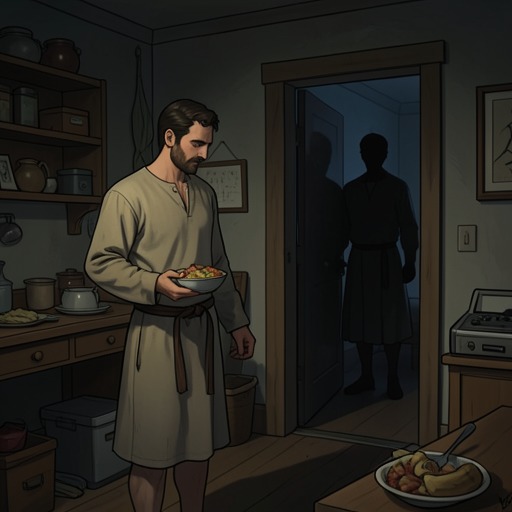
Under the priest, deprivation is organized through rationing. Lázaro is sent to a storeroom where onions hang from a nail, and the priest counts them closely enough that exceeding the assigned portion would bring punishment. The priest’s own meals are more substantial: he spends five blancas a day on meat, shares the broth, but gives Lázaro less than half the bread he requires. On Saturdays, when a sheep’s head is customary, the priest eats the eyes, brain, and meat around the jaws, leaving Lázaro the picked-over bones. These contrasts make hunger the immediate condition from which the maxim’s ingenuity arises.
The chest episode shows that ingenuity depends on attention as well as nerve. After the priest blocks the apparent holes through which mice might have reached the bread, Lázaro finds that even his key is useless. Awake at night while his master sleeps, he uses a knife as a drill against a weaker part of the rotten chest, makes a hole, and quietly takes bread that has already been cut. The small amount he removes brings only brief relief, but the episode turns the old chest from a barrier into an opportunity through close observation and repeated thought.
From Theft to Compassion
The maxim also illuminates a different response to need. While serving the impoverished squire, Lázaro finds himself begging on his master’s behalf and sometimes bringing home food at the cost of leaving himself barely fed. He recognizes the reversal: having left miserly masters in search of better fortune, he now has to support a man who cannot support him. Yet he feels pity rather than resentment because he sees that the squire has nothing. Lázaro distinguishes this helpless poverty from the stinginess of the blind master and priest, whom he considers deserving of hatred because they possess money but still starve him.
That distinction complicates any simple reading of survival as selfish cunning. Hunger has taught Lázaro to judge the circumstances behind another person’s want. The squire’s poverty elicits generosity, even when generosity costs Lázaro food; the earlier masters’ withholding instead provokes concealment and theft. Necessity shapes both his tactics and his allocation of sympathy.
Work, Saving, and Independence
As Lázaro grows older, the same drive to secure his livelihood takes a more stable form. After working for a painter of tambourines, he becomes a water seller for a chaplain at the cathedral. He is given a donkey, four water jars, and a whip, and sells water around the city. Each day he hands his master thirty maravedís and keeps the remainder, along with all his Saturday earnings. His stomach is finally satisfied, and the arrangement lets him convert labor into resources he can retain.
After four years of business and carefully protected savings, Lázaro can buy respectable secondhand clothes: an old fustian doublet, a worn embroidered shirt with slashed sleeves, a cloak once covered in trimmings, and an old sword associated with Cuéllar. Seeing himself dressed as a man of standing, he tells his master to take back the donkey because he no longer wishes to continue the work. The change does not erase the poverty that taught him resourcefulness; it marks a new use for that lesson. What began as stealthy efforts to obtain a meal has become the capacity to save, acquire clothing, and leave a job on his own terms.