Lázaro’s hunger
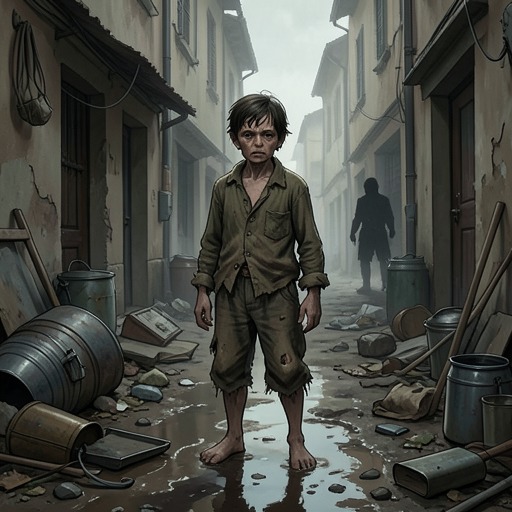
Lazarillo de TormesLázaro’s hunger is the recurring material force that governs his choices, relationships, and precarious progress through life. It turns food into an accounting of power: masters who possess or earn enough withhold it, while Lázaro learns to steal, beg, and work so that he can eat. The narrative’s sharpest reversals arise when a servant must outwit a keeper of provisions, pray for the deaths that bring funeral meals, or feed a master who cannot feed him. His eventual savings mark a real change in circumstance, but they follow years in which survival itself is the central occupation.
A Childhood Measured in Food
Lázaro’s early household survives through precarious labor and informal support. After his father dies, his widowed mother moves to the city, cooks for students, and washes clothes for stable boys. Zaide brings bread, meat, and winter firewood; Lázaro’s initial fear of him gives way as these provisions improve the family’s meals. When Zaide is discovered stealing fodder, bran, wood, horse-grooming tools, aprons, blankets, and saddlecloths to help support the household, the narrative makes the connection between hunger and theft concrete: the stolen goods have been feeding Lázaro’s younger brother as well as his mother and Lázaro. Zaide is punished, and his mother is flogged and forbidden to enter the commander’s house or receive him. She nevertheless serves at an inn and continues raising the children. Lázaro grows into a boy who fetches wine and candles for guests, already doing small tasks within an economy of subsistence.
His first master turns hunger into a contest of ingenuity. The blind man can earn substantial sums through memorized prayers, predictions, and claims of medical knowledge, yet gives Lázaro less than half of what he needs. He keeps bread and other provisions in a cloth bag secured by an iron ring and lock, and handles it so cautiously that even crumbs seem beyond reach. Lázaro unpicks and resews a corner seam to draw out bread, bacon, and sausage. The episode establishes a pattern that returns throughout his life: the person controlling food also controls the terms of dependence, while Lázaro’s wits become a means of contesting that control.
Drink offers another version of the same struggle. The blind man first keeps a small jug of wine beside him; after noticing its level fall, he holds it by the handle. Lázaro then uses a long rye straw to siphon wine through its neck. When his master changes tactics again, holding the jug between his legs and covering its opening, Lázaro makes a tiny hole in its base and seals it with wax. He lies between the man’s legs on the pretext of warming himself by the fire, and the wax melts so that the wine trickles into his mouth. Each countermeasure answers the last, until the master’s vigilance and the servant’s need become a contest conducted through a single vessel.
Hunger as Teacher and Punishment
The priest’s household gives deprivation a more rigid daily schedule. Lázaro receives one onion every four days, kept under lock in an attic closet; the priest counts them closely and warns him not to give in to his appetite. The locked room contains no store of delicacies, only onions hanging from a nail, yet the key and ration make the little food seem guarded as a fortune. The priest spends five blancas a day on meat for himself. Lázaro may share the broth, but not the meat, and is given less than half the bread he needs. On Saturdays, when a sheep’s head is customary, Lázaro buys and cooks it; the priest eats the eyes, brain, and meat around the jaws, leaving him the picked bones and telling him to eat his fill.
Funeral meals make hunger alter Lázaro’s prayers. At wakes, where he is fed well, he begins to hope that someone will die each day; when the priest brings the sacraments to the sick, Lázaro prays not for the usual submission to God’s will but for the patient to be taken. During roughly six months in the priest’s service, twenty people die. Lázaro imagines that his own repeated requests have helped bring about their deaths, because their funerals temporarily keep him alive. The relief is unstable: on days without a burial, he returns to his ordinary hunger, and the abundance he has just tasted makes deprivation harder to bear. He even says that he sometimes invokes death for himself as well, though it never comes.
Hunger also instructs him in practical thought. Reflecting on his efforts to stay alive, Lázaro presents need as the force that sharpens his ingenuity: he spends days and nights thinking through small ways to obtain food, and discovers that famine makes him inventive where satiety would leave him idle. This is not a lesson learned once and left behind. It describes a survival method built from watching, waiting, and exploiting a weak point in whatever system controls provisions. His earlier opening of the blind man’s bag and the later attacks on the priest’s bread chest give that method its physical form.
The Squire: A Reversal of Dependence
After leaving the priest, Lázaro fears he may have exchanged a miserly master for someone worse. When the squire tells him that he has already eaten breakfast and expects no food until supper, Lázaro nearly faints. The news brings his earlier misfortunes back to mind, and he weeps for both the past he has endured and the death he imagines approaching. He nevertheless conceals his distress and claims that, as a young boy, he does not worry much about food. The performance allows him to remain in service, but it cannot fill an empty stomach.
The squire’s poverty soon overturns the usual relation between master and servant. Lázaro goes out to beg for him, and the food he brings is often barely enough to feed the squire; sometimes Lázaro deprives himself to keep the older man alive. He finds the squire’s purse limp and empty, without even the trace of a blanca, and distinguishes his situation from that of the earlier masters who had money but starved him. He feels genuine pity and affection for the penniless man, whom he would rather serve than the blind man or the priest. Hunger thus does not produce a single response in Lázaro: where he resents those who withhold what they possess, he can sympathize with a master who has nothing to give.
That sympathy is tested when a poor harvest leads the municipality to order foreign beggars out of the city, under threat of flogging. Four days after the proclamation, Lázaro sees beggars being whipped through the Cuatro Calles and becomes too afraid to risk asking alms. For two or three days the squire’s household may go without food or even conversation. Neighboring women who spin cotton and make caps give Lázaro small amounts from their meager takings, just enough to help him survive. He worries less for himself than for the squire, who goes eight days without a bite. Even in this extremity the squire preserves the appearance of honor, pretending to pick his teeth with a straw despite having eaten nothing. The scene sets bodily want against the performance of dignity: Lázaro’s hunger is immediate, while the squire’s pride governs how poverty may be shown.
The squire finally disappears to evade creditors. A man and an old woman arrive to collect two months’ rent for the house and bed, demanding more than the squire could have gathered in a year. He says he will go to the market to change a gold coin and asks them to return that evening, but never comes back. Lázaro is left with the house key and the debt collectors’ questions. Hunger here belongs to a larger precarious economy of rent, borrowing, and flight: the master’s inability to meet his obligations ends the household and leaves the dependent boy to face its consequences.
From Subsistence to a Small Reserve
Later, Lázaro finds a more regular form of livelihood selling water around the city. A chaplain gives him a donkey, four water jars, and a whip; each day Lázaro turns over thirty maravedís to his employer and keeps the remainder, along with everything he earns on Saturdays. After four years of saving, he can buy second-hand clothes that let him present himself as a respectable man: an old fustian jacket, a worn embroidered shirt with slashed sleeves, a cloak once covered in trimmings, and an old sword. He then asks the chaplain to take back the donkey because he no longer wants to continue the work. Hunger has not vanished from the story, but its terms have changed: through paid labor and a protected share of earnings, Lázaro can accumulate enough to leave a job rather than seize food in secret or depend entirely on charity.
The contrast between the stolen morsel and the saved coin gives his trajectory its material measure. Under the blind man and the priest, provisions are locked away and the servant’s ration is deliberately inadequate; under the squire, the servant must become the provider; as a water seller, Lázaro earns and retains part of his income. The book does not present this progression as effortless escape from poverty. It shows how bodily need repeatedly narrows his choices, how one precarious arrangement can give way to another, and how practical intelligence and labor eventually create a limited margin of control. Hunger is therefore both an affliction and a tutor: it exposes the cruelties of unequal dependence while shaping the skills with which Lázaro seeks a life less governed by another person’s pantry.