Matrimonio di Lázaro e il «caso» dell'arciprete
Lazarillo de TormesThe marriage of Lázaro de Tormes to the maid of the Archpriest of San Salvador is the apparent culmination of a life spent trying to secure food, shelter, and a future. It gives Lázaro a respectable household and a powerful patron, yet its comfort rests beside a persistent rumor: that his wife’s intimacy with her employer began before the marriage and continues afterward. In the letter that explains his present condition, Lázaro calls himself prosperous and insists that he lives in peace. His own story, however, shows how that peace is maintained: not by disproving the “case,” but by forbidding others to raise it.
Background and Advancement
By the time the marriage is proposed, Lázaro has survived a succession of precarious forms of service. He has also left the dangerous work of assisting a constable after criminals attacked the two men at night with stones and clubs. Seeking a safer occupation and some provision for old age, he receives support from friends and people of high rank and obtains employment in the king’s service. The new post offers more than a title: it gives him a foothold in the city and a reason to imagine that his unstable fortunes may finally hold.
Lázaro works as a town crier, announcing wines for sale, auctions, and lost property, and publicly proclaiming the crimes of those pursued by justice. He says that he performs the work so effectively that matters connected with it pass through his hands; anyone in the city who wants a sale announced, especially a sale of wine, has reason to depend on him. This practical importance brings him into contact with the Archpriest of San Salvador, whose wines he proclaims, and opens the way to the match that will define his final account of his life.
The Marriage and Its Material Security
The Archpriest, who knows Lázaro through his work and is described as both his lord and a devoted friend of the person receiving the letter, proposes that Lázaro marry one of his maids. Lázaro accepts because he expects a person of the Archpriest’s standing to bring him benefit and favor. He says he has not regretted the marriage: his wife is a good woman and a diligent housekeeper, while the Archpriest gives him substantial support.
That support is specific and recurrent. The Archpriest gives the couple nearly two quintals of grain over the course of each year, meat on major religious feast days, and, from time to time, a couple of votive loaves and the breeches he no longer wears. He arranges for them to rent a small house beside his own. On Sundays and other obligatory feast days, they usually eat at his table. The arrangement secures necessities that Lázaro’s earlier life repeatedly denied him, but it also keeps the household materially close to the man at the center of the gossip.
The Rumor and Lázaro’s Answer
The talk concerns Lázaro’s wife going to the Archpriest’s house to make his bed or prepare his food. Lázaro initially dismisses the gossips’ claims as untrue. Yet he also recounts that friends had warned him about the relationship and had told him, at least three times, that his wife had borne three children before marrying him, attributing the children to the Archpriest. The account does not establish the rumor as fact; instead, it places the accusation, Lázaro’s knowledge of it, and his determined refusal to pursue it side by side.
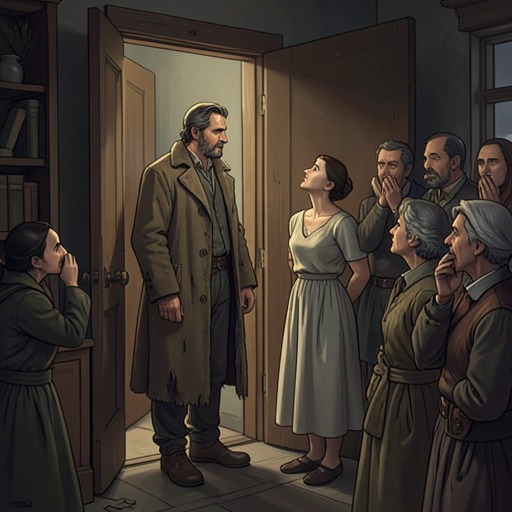
When Lázaro repeats what his friends have said, his wife swears so vehemently to her reputation that he fears the house will collapse around them. She weeps and curses those who arranged her marriage to him. Lázaro regrets having spoken, and he and the Archpriest together comfort her and make promises until she stops crying. Lázaro then swears never again to bring up the story and says that she may come and go from the Archpriest’s house whenever she pleases, by day or night, because he is completely certain of her honesty. The three of them, he reports, reach an understanding.
Afterward, Lázaro polices the subject himself. If someone appears ready to mention it, he warns that a friend should not tell him anything that might distress him. He declares that he loves his wife more than himself and that no woman within the gates of all Toledo is better than she is; anyone who says otherwise, he threatens, will have to face him. His public defense protects the marriage from further challenge, but its force also reveals how thoroughly the rumor has become something he must manage. He calls silence peace, and makes the terms of that silence part of his account.
The “Case” and the Ending
The marriage is not an incidental domestic episode in Lázaro’s letter. The Prologue explains that the addressee had asked him to set out the “case” in detail, and that Lázaro chose to begin at the beginning so the reader could understand his whole person. His childhood already includes the punishment of his mother after she and Zaide were discovered benefiting from Zaide’s thefts. The final controversy likewise concerns household dependence, authority, and the cost of maintaining a place in the world, though Lázaro now stands on the better-protected side of the arrangement.
The story ends by dating Lázaro’s greatest prosperity to the same year that the emperor entered Toledo to hold the Cortes, amid public festivities. That closing claim gives the marriage its double force. Lázaro has an established occupation, a house, regular food, and the Archpriest’s continuing favor; by his own measure, he has arrived safely at the port he sought. Yet the security that marks his success is bound to the very “case” he is supposed to explain. His final posture is neither an open confession nor a convincing rebuttal, but a practiced settlement: he keeps the benefits, protects his household as he defines it, and insists that nobody disturb the peace.