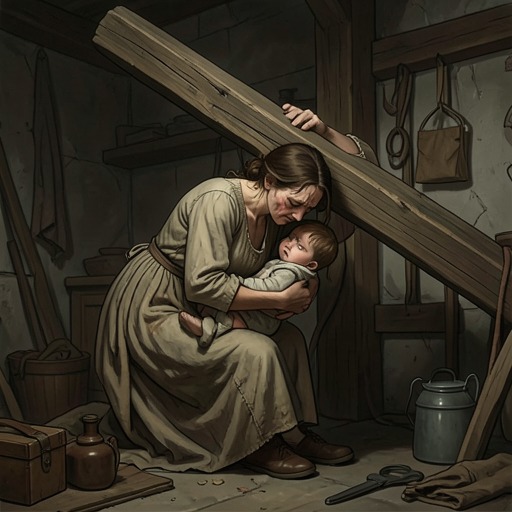
Nascita di Lázaro nel Tormes
Lazarillo de TormesNascita di Lázaro nel Tormes is the opening biographical event in Lázaro de Tormes’s account of his life. Born in a mill on the river where his father works, he receives a name that binds his identity to a place and a lowly livelihood; the story’s first scene makes humble origin the starting point of a life shaped by poverty and service.
Birth and Name
Lázaro tells the addressee, addressed formally as Your Lordship, that he is the son of Tomé González and Antona Pérez, natives of Tejares near Salamanca. His mother is in the mill by the Tormes while pregnant when labor begins, and she gives birth there. Because of this circumstance, he says he took the surname de Tormes: the river is not merely a setting but the explanation for the name under which he will narrate his life.
The account turns an ordinary detail of family circumstance into an origin story. Lázaro’s stated identity begins not with rank or inheritance but with a birth inside a working mill, beside the river that supplies his name. The direct, matter-of-fact explanation also establishes the autobiographical manner of the narrative: he introduces himself by telling the addressee where he came from and how he came to be called what he is.
Family Circumstances and Early Reversal
The birth is followed by a sharp change in the family’s fortunes. When Lázaro is eight, his father is accused of making illicit cuts in the sacks brought to the mill for grinding. Tomé is imprisoned, confesses, and is pursued by the authorities. He then joins an expedition against the Moors as a muleteer serving a knight and dies alongside his master.
After becoming a widow, Antona moves to the city without a husband or protection. She rents a small house, cooks for students, and washes clothes for stable boys, work that brings her into contact with the stables. The account thus places Lázaro’s birth within a family whose means of survival are precarious from the start; his father’s punishment and death soon leave his mother to seek work and support her children alone.
Narrative Significance
The opening links Lázaro’s name and social beginnings to material necessity. His origin is neither elevated nor concealed: it is presented through the mill, his parents’ modest circumstances, and the later loss of his father. This foundation anticipates a life narrated through changing masters and difficult attempts to secure food and livelihood, while the first-person address frames the account as a story told in response to another person’s interest.
The work’s authorship, by contrast, remains unknown. Proposals have included the friar Juan de Ortega, Diego Hurtado de Mendoza, the Valdés brothers, Lope de Rueda, and Sebastián de Horozco, but none is supported by conclusive proof. The introductory discussion associates the book’s likely intellectual milieu with learned Castilian humanism and raises, as a possibility rather than a certainty, a connection with conversos. Those debates concern the work’s origin, not the narrated event: within Lázaro’s account, the birth in the Tormes mill is the concrete beginning of the life he relates.