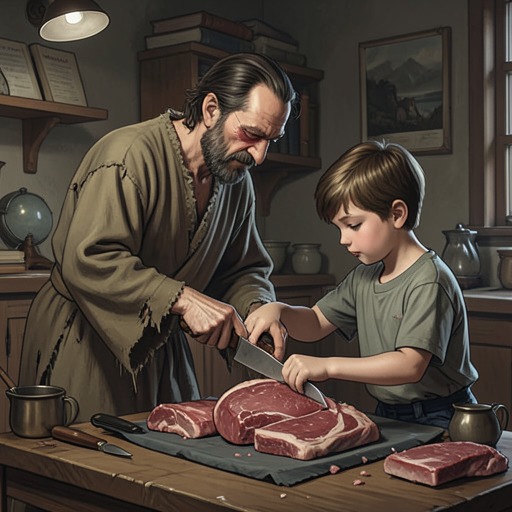
Scambio della salsiccia con la rapa
Lazarillo de TormesThe sausage-for-turnip exchange is a turning point in Lázaro’s apprenticeship to the blind man: an opportunistic theft driven by hunger becomes a humiliating exposure, and the master turns the boy’s punishment into public entertainment. Set in an inn at Escalona, the episode compresses the relationship’s governing pattern into a single meal—scarcity provokes a stratagem, the blind man detects it, and Lázaro pays for the brief satisfaction with his body and his reputation among the onlookers.
Setting and Immediate Circumstances
At the inn in Escalona, the blind man gives Lázaro a piece of sausage to roast. The master eats slices of bread soaked in its dripping fat, then takes a maravedí from his bag and sends the boy to the tavern for wine. Beside the fire lies a small, long, rotten turnip, apparently left there because nobody intended to cook it. The blind man is occupied with the money and fire; Lázaro is alone with the sausage and the turnip, and the smell of the food sharpens his awareness that he is unlikely to get any of it.
The exchange grows directly out of the deprivation that structures Lázaro’s service. The blind man is wealthy enough to possess and manage provisions, yet gives the boy less than he needs; Lázaro says that without his own cunning and dexterity he would have starved. His master’s tightly secured food sack is another expression of the same imbalance: Lázaro has previously opened a seam to steal bread, bacon, and sausage, taking substantial pieces rather than crumbs. At Escalona, the boy sees a faster opportunity and chooses immediate gratification over caution.
The Theft and Its Discovery
While the blind man takes money from his bag, Lázaro swiftly removes the sausage from the spit and puts the rotten turnip in its place. He then goes to fetch the wine and eats the sausage on the way. Returning, he finds the blind man holding the turnip between two slices of bread, still unaware of the substitution because he has not felt it with his hand. When he bites, expecting sausage, he tastes the turnip and demands to know what it is. Lázaro denies responsibility and suggests that someone else must have played a trick while he was away.
The blind man dismisses the denial: he has not left the spit, so no one else could have made the exchange. He rises, takes Lázaro’s head, and smells his breath to test his suspicion. Then, in a furious effort to confirm what he has already inferred, he forces the boy’s mouth open and thrusts in his long, sharp nose. The inspection turns brutally literal: the sausage has not yet settled in Lázaro’s stomach, and the pressure, fear, and haste combine to make him vomit the stolen food onto the master. Sausage and nose emerge together, physically exposing the theft and restoring the stolen meal to its owner.
Punishment and Public Comedy
The blind man’s anger is severe. The people who rush in at the commotion pull Lázaro from his grasp, leaving the master with some of the boy’s remaining hair in his hands. Lázaro’s face is scratched, and his neck and throat are scraped and bleeding. The meal has yielded no lasting advantage: the food is recovered, the attempt is discovered, and the boy suffers a beating that nearly becomes fatal violence in his own account.
Yet the scene does not remain private punishment. The blind man recounts Lázaro’s earlier tricks to the people who arrive, repeating the story of the wine jug and the episode with the grapes before adding this latest theft. His lively narration draws more passersby into the inn to watch. Although beaten and in tears, Lázaro feels that he would wrong the master if he did not laugh too. The crowd’s amusement thus adds a second reversal: the boy is not merely caught but made into the subject of a performance by the very man he tried to deceive.
Meaning in Their Contest of Wits
The episode follows the recurring structure of Lázaro’s service: hunger drives him to devise a stratagem, the blind man’s vigilance uncovers it, and bodily punishment enforces the master’s control. Lázaro’s earlier success in opening the food sack shows that the boy can exploit moments of distraction; this attempt fails because the blind man can use smell and touch to detect what sight cannot. The master’s blindness is not simply an obstacle in the contest but part of its tactics: Lázaro can sometimes take advantage of it, yet the master’s other senses and inexhaustible suspicion make him a formidable opponent.
The episode also reverses the apparent balance of power for an instant. Lázaro gets the sausage, but the stolen food is returned through his own body, and the master converts the boy’s failed concealment into a story he can control. The hunger behind the trick is not erased by the comedy: the theft is described as an attempt to satisfy an intense appetite, while the retaliation leaves Lázaro injured and exposed. In the wider pattern of the boy’s first service, such exchanges teach him both the possibilities and the cost of cunning. They make the blind man an effective, if violent, teacher, and show how survival under scarcity can sharpen ingenuity without freeing the hungry servant from the person who commands the food.