Spanish nobles’ tax exemption and status-maintenance rule
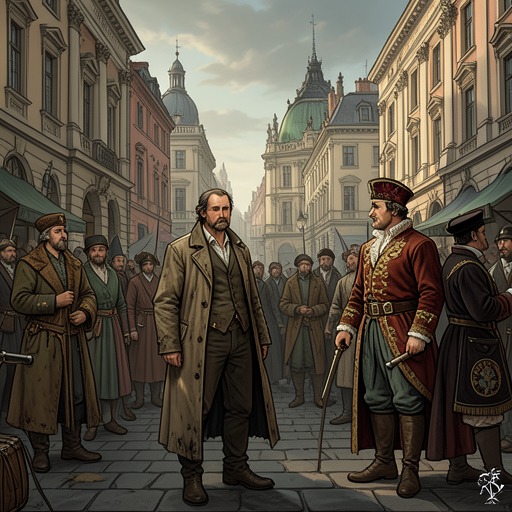
Lazarillo de TormesSpanish nobles’ tax exemption and status-maintenance rule links privilege to a demanding public performance: an hidalgo may escape taxation, but is expected to preserve the appearance and social recognition of rank. The impoverished squire in Toledo makes the contradiction visible. His fine posture, careful dress, and sensitivity to forms of address proclaim distinction, while his dependence on the food Lázaro begs for exposes how little material substance supports that claim.
Privilege and Its Conditions
The novel’s account places the hidalgo within the social order of imperial Spain, where nobles were exempt from taxes but could lose their privileges if their economic condition no longer met the status associated with them. The rule therefore joined advantage to constraint: exemption marked noble standing, while the obligation to sustain an appropriate position could make poverty itself a threat to that standing. The squire’s insistence on his hidalguía is not simply a claim to ancestry; it is a defense of a social position whose visible signs and recognition by others matter.
That dependence on recognition appears in the squire’s manner and appearance. He walks with an erect bearing and takes excessive care over his clothes and person. His concern with how he is greeted likewise turns ordinary encounters into public tests of rank. The novel presents these gestures against the material weakness they conceal: his honor is asserted with great formality, but the means to support the life his status implies are absent.
The Squire’s Code of Deference
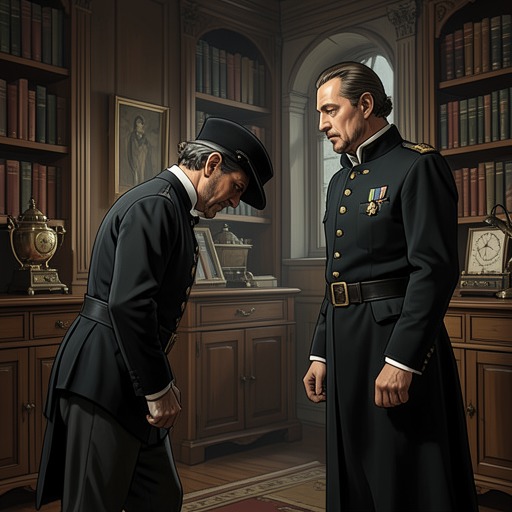
The squire explains that he left his home in Castilla la Vieja rather than continue removing his cap first before a local gentleman. He accepts that the other man was both richer and of higher rank, and that the other also greeted him by uncovering his head; what he resents is having been the first to yield on so many occasions. In his account, a small gesture becomes an accounting of precedence, and leaving home is preferable to accepting what he sees as a repeated loss of honor.
He presents this code as a defining obligation of the hidalgo. A man of quality, he says, owes allegiance only to God and the king and must never neglect the regard due to his own person. His example of correcting a craftsman makes the hierarchy still more explicit: he objected when the man’s blessing addressed him as an ordinary person, demanding instead the deferential form reserved for his status. Lázaro challenges the premise, asking whether wishing someone God’s protection is not already a proper greeting. The exchange shows how the code relies on distinctions in address as well as on material privileges.
Status Against Material Need
The squire’s social performance is sharply at odds with the household’s circumstances. Lázaro obtains food by begging, and the squire readily benefits from what the boy brings home. The man who insists that a hidalgo must maintain his person in the highest consideration is thus sustained by the labor and charity of someone below him in rank. The gap between honor and resources turns the squire into a figure of empty display, but the account also gives him a pathetic dimension: he is courteous to Lázaro when he has money and when the frightened boy takes refuge in the house, even as their poverty remains overwhelming.
The episode makes rank legible through clothing, posture, greetings, and claims about property, then sets those signs beside hunger and dependence. The squire’s behavior is not presented as proof that noble status has no social force; rather, his exemption and insistence on deference coexist with an inability to provide for himself. The satire arises from that mismatch: privilege persists as a code of recognition even when the resources that might seem to justify its display have vanished.
Narrative Significance
The squire is described as an important contribution to the book’s realism: unlike figures drawn from familiar folkloric and literary materials, he is presented as a recognizable product of contemporary Spanish society. His predicament makes the social rule part of Lázaro’s education. The blind man is the boy’s direct teacher, and the miserly priest teaches him indirectly through obstruction; the squire is a failed teacher, offering only the hollow lessons of honra, a culture of reputation and social dignity that Lázaro does not truly adopt.
That contrast reaches beyond the Toledo episode. The squire’s devotion to honor stands against the adult Lázaro’s eventual willingness to defend his household peace in the face of damaging rumors about his wife and the archpriest of San Salvador. The rule’s significance is therefore both social and structural: it exposes the cost of maintaining rank through appearances, while preparing a contrast between the squire’s futile performance of dignity and Lázaro’s later, compromised pursuit of security.