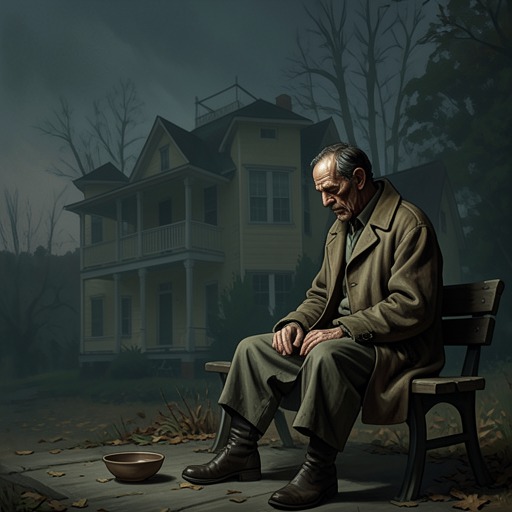
Squid Abandons House to Escape Debt
Lazarillo de TormesThe squire’s flight from his creditors turns a household already marked by hunger and appearances into a scene of attempted seizure, interrogation, and farce. Lázaro is left to answer for unpaid rent and a bed, although his master has vanished and the home contains nothing to recover. The empty rooms make the squire’s cultivated status look less like security than an appearance maintained at other people’s expense; they also reverse the usual master-servant arrangement, as the master abandons the servant who might have expected to be dismissed.
The Flight and the Unpaid Accounts
While Lázaro and the squire are together at home, a man arrives demanding the house rent and an old woman asks for payment for the bed. Their account covers only two months, yet the sum exceeds what Lázaro thinks his master could gather in a year: twelve or thirteen reales. The squire answers that he will go to the market to change a gold coin and tells the creditors to return in the evening. Instead, he leaves and does not come back.
When the creditors return, Lázaro first tells them that his master has not yet come home. Night falls without the squire’s return, and Lázaro is afraid to stay alone in the house. He goes to the neighboring women, explains what has happened, and sleeps with them. His departure is not a plan to aid the escape: he has been left behind, uncertain where his master is and unable to pay what is owed.
The next morning the creditors come back and ask for the tenant. The women point to Lázaro and hand over the house key. He explains that the squire has not returned since going out to change the coin, and suspects that the promised errand was an excuse to get rid of both the creditors and him. His explanation makes the sequence plain: the supposed exchange of money was followed not by payment but by disappearance.
Search of the Empty House
The creditors summon a constable and a notary. With Lázaro and witnesses present, they take the key, open the door, and search the house in order to seize the squire’s goods against the debt. They expect trunks, tapestries, and furniture, but the search reveals a completely empty home. Their questions about where the belongings have gone expose the central discrepancy of the episode: the household they imagined to contain enough property for repayment has no such property to show.
The officials turn their attention to Lázaro. One proposes that the goods must have been removed during the night and urges the constable to arrest him because he must know where they are. The constable grabs him by the collar of his jacket and threatens to detain him unless he reveals the possessions’ whereabouts. Lázaro is terrified: he has often been seized by the collar to guide the blind man, but never before in an arrest. Crying, he promises to answer their questions.
Asked to inventory what the squire owns, Lázaro names what his master had told him: a valuable building plot and a pigeon house in ruins. The officials initially treat these as assets that might cover the debt and ask where they are. Lázaro says they are in his master’s own country, which he understands to be Old Castile. The answer makes the inventory useless rather than helpful. The constable and notary burst out laughing: even if the property were worth twice the debt, this information cannot help them recover it.
Lázaro Released, the Creditors Left to Quarrel
The neighboring women speak up for Lázaro, describing him as an innocent child who has been with the squire only a few days and knows no more about him than the officials do. They add that they had given the boy what food they could, for God’s sake, and that he went to sleep at the squire’s house only at night. Their testimony confirms both his dependence and his limited knowledge: the boy left to face the inquiry has not been a partner in the escape and has not shared in the master’s alleged wealth.
Once his innocence is established, the officials let Lázaro go. The constable and notary then demand their fee from the man and woman who called them. The creditors resist paying because there has been no seizure and, as they point out, nothing from which a fee could be recovered. The officials argue that they have neglected a more promising case to attend to this one. The dispute shifts the scene’s comic focus: after failing to find the squire or his property, the parties argue over who should pay for an enforcement effort that has produced no recovery.
The quarrel ends with an improvised seizure of the old woman’s red blanket, though it is hardly a valuable prize. The five people shout at one another, and Lázaro says he does not know how the matter concluded; he supposes the poor blanket paid for everyone. The imagined trunks and tapestries have vanished, the alleged land lies in the absent debtor’s distant country, and the only property actually taken is a worn household covering.
Reversal and Significance
Lázaro closes the episode by calling the squire his poor third master and describing the reversal that defines the ending: masters ordinarily abandon their servants, but here the master leaves first and runs away from Lázaro. The boy is not simply dismissed; he is stranded in the vacant house and exposed to creditors and officials, then cleared only when the neighbors establish how little he could know. The departure leaves him without a master and makes his precarious dependence visible in practical terms.
The episode also sharpens the contrast between outward dignity and material want. Earlier, the squire’s pride had persisted despite his poverty; here the creditors’ expectation of trunks, tapestries, and furnishings meets an empty interior, while his only reported assets are a building plot and a ruined pigeon house back in Old Castile. The scene makes social standing look like a claim that cannot settle a bill. Its humor is built from the consequences of that mismatch: the creditors cannot locate the debtor, cannot find goods to seize, cannot extract useful information from the frightened boy, and finally fall into a dispute over a blanket.
For Lázaro, the episode continues a life in which a master’s position offers no reliable protection from hunger or abandonment. The neighboring women’s small acts of feeding and sheltering him stand against the squire’s disappearance and the formal officials’ effort to find someone responsible for an uncollectible debt. The flight ends not in repayment or punishment of the master, whose whereabouts remain unknown, but in Lázaro’s release and the creditors’ quarrel. The empty house is therefore more than the setting for a debtor’s escape: it is the material proof that the squire’s appearance of status cannot provide either security for himself or care for the boy he leaves behind.