
The Crown and the Question of Justice
Le Morte d'ArthurThis flow traces Arthur’s efforts to establish rule through public judgment and the pressure exerted by private violence and political betrayal.
increasing Bearing strength in each event
 decreasing
Bearing strength in each eventdecreasingJustice After the Sword
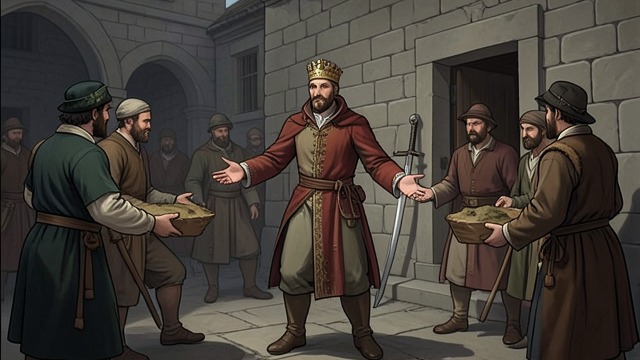
A New King Restores Lands
Complaints reach the throne
After the barons accept Arthur, lords and commoners report lands taken during the unsettled succession. Arthur orders property restored to its rightful owners.
Authority through redress
His early rule gains legitimacy by repairing harms as well as winning wars. The principle offers a contrast to later decisions made in anger and fear.
A Rule for Knights
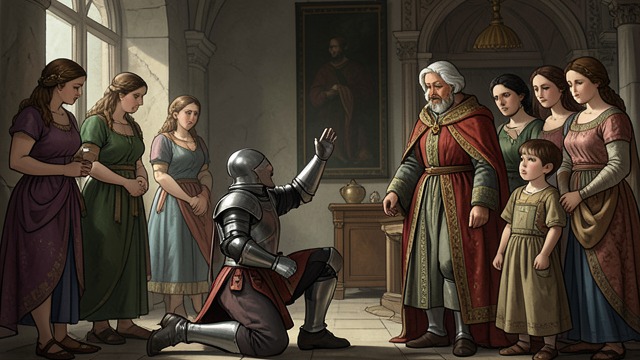
Oaths Define the Order
Duties declared
Arthur charges the Round Table knights not to commit outrage or murder, to avoid treason, and to give mercy to those who ask.
Women and the vulnerable
The oath requires knights to aid ladies and gentlewomen. Its ideals are tested repeatedly by knights who fail to protect others or to restrain their own pride.
A Court Custom of Trial
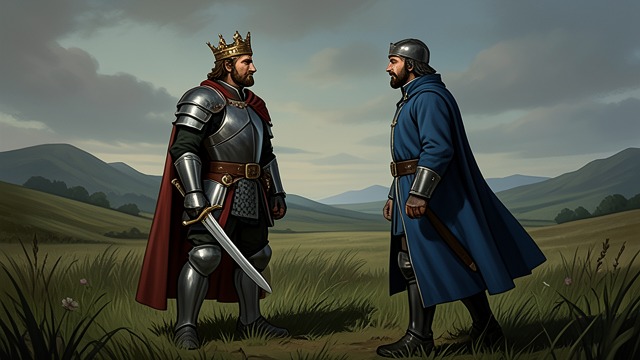
Allegation Requires Combat
A king is accused
Sir Blamor accuses the King of Ireland of murder. The law requires the accused to fight or find a champion, even though the king arrived without knowing the charge.
Tristram takes the risk
Sir Tristram volunteers to defend the king, relying on the truth of his cause. His victory protects the king’s honor but also binds the two families through gratitude.
Judgment in the Queen’s Case
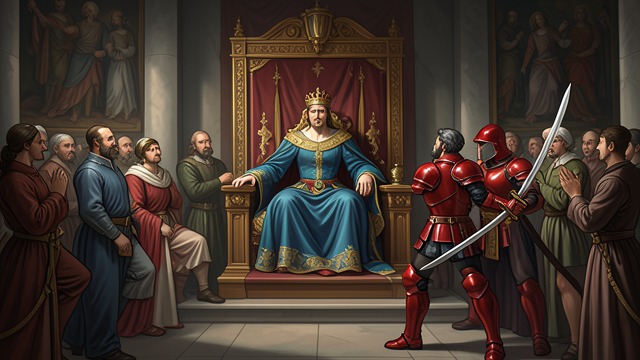
A Queen Put on Trial
Poison raises suspicion
Sir Mador accuses Guenever of treason after Patrice is poisoned. The court’s laws make the queen’s life depend on whether a champion will answer the charge.
Launcelot wins the combat
Bors prepares to defend her, but Launcelot takes the field and defeats Mador. The queen is cleared, though the episode exposes how fragile justice becomes when it depends on personal allegiance.
Justice Fails in Civil War
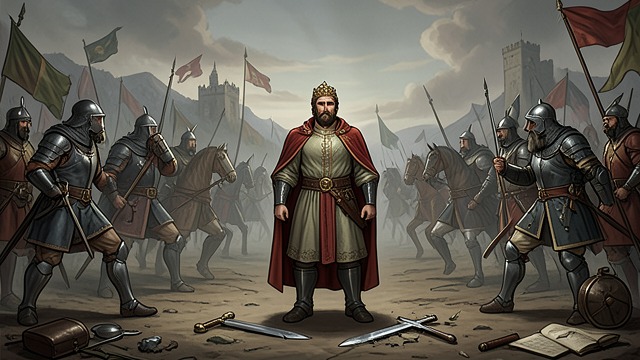
Royal Authority Collapses
False claims divide the realm
Mordred’s seizure of power and Guenever’s refusal of marriage split the kingdom. Arthur can no longer command common allegiance through his title alone.
The last battle
A fragile truce breaks, and armies slaughter one another. Arthur’s death leaves no court capable of reconciling justice, loyalty, and power.
Immediately after Arthur is recognized as king
At the Pentecost feast after the early adventures
During the Irish king’s trial at Arthur’s court
After Patrice dies at Guenever’s feast
After Mordred’s usurpation, during Arthur’s return
