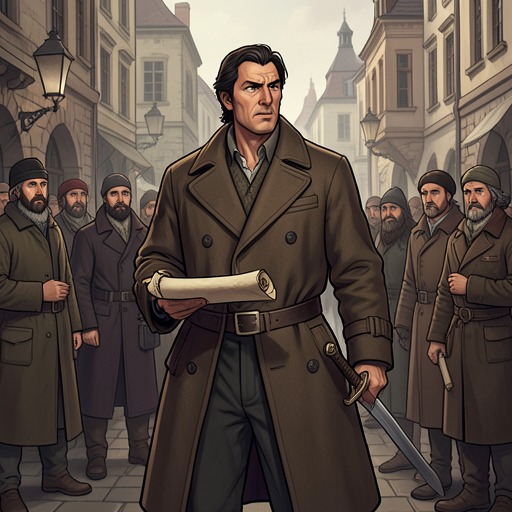
Arthur's royal court
Le Morte d'ArthurArthur’s royal court is the setting in which Arthur’s kingship becomes a working political order. There he receives counsel and foreign demands, restores lands, makes appointments, hears disputes, and binds knights to a shared code. Its public ceremonies and fellowship promise unity, but the court’s authority must continually confront rebellion, treachery, and the ambitions of rulers beyond Britain.
Establishing the King’s Authority
Arthur’s court emerges against a succession crisis. Before Uther Pendragon dies, he publicly blesses Arthur as his heir and commands him to claim the crown justly and honorably. After Uther’s death, powerful lords strengthen themselves and the realm remains in jeopardy. Arthur’s later recognition through the sword in the stone turns the question of succession into a public affirmation: at Pentecost, he alone draws the sword before lords and commons, who acclaim him as king. Arthur forgives those who had delayed him, offers the sword at the altar, is knighted, and is crowned; he then swears to rule with true justice.
The court’s authority takes practical form in the restoration of lands taken during the disorder after Uther’s death. Arthur also appoints officers: Kay becomes seneschal of England, Sir Bawdwin of Britain constable, Sir Ulfius chamberlain, and Sir Brastias warden of the north. These acts connect legitimacy to governance: recognition of the king is followed by restitution, service, and the organization of the realm. Arthur’s campaigns extend that authority beyond the lands around London, bringing the north, Scotland, and parts of Wales under his rule.
Counsel, Ceremony, and Fellowship
The court is not only a household around a throne but an assembly of rulers, princes, and knights. After a long war, Arthur holds a royal feast with the Round Table and allied kings, princes, and noble knights. In that ceremonial setting, twelve elderly Roman ambassadors enter bearing olive branches and demand Britain’s tribute for Emperor Lucius. Their formal status matters: although their message angers the young knights, Arthur forbids anyone to insult or harm them, orders that they be lodged and generously provided for, and convenes his lords and Round Table knights to hear their advice.
Counsel at court leads directly to policy. Arthur rejects the tribute, arguing that he owes no earthly prince allegiance and that his predecessors give him a claim to imperial sovereignty. His allies pledge military support, and he sends the ambassadors back with his answer, gifts, and expenses paid. The scene sets measured diplomatic conduct beside an uncompromising political claim: Arthur protects the messengers’ dignity while preparing to answer Rome by force.
The court’s fellowship is also renewed through selection and obligation. After a battle leaves eight Round Table knights dead, Arthur asks King Pellinore to advise him on choosing replacements. Pellinore recommends balancing older and younger knights, naming King Uriens among the elders and Gawaine, Griflet, and Kay among the younger candidates. The exchange presents membership as a matter of judgment and service, not merely rank: the court must replenish its fellowship after loss and assess the worth of those who may join it.
Justice and the Duties of Knighthood
Arthur’s court gives political force to a code of conduct. After the quests associated with the white hart, the brachet, and a captured lady have been pursued, Arthur establishes rules for the Round Table knights. They must avoid outrage and murder, flee treason, show mercy to those who ask for it, and assist ladies and gentlewomen on pain of losing their worship and lordship. They must not fight in a wrongful cause for law or worldly gain. The knights swear to these terms, old and young alike, and renew their oaths every year at the high feast of Pentecost.
The code is tested by the gap between a public ideal and a particular choice. When King Pellinore reports his quest, Queen Guenever reproaches him for failing to save a lady. Pellinore admits that he pressed on in his pursuit rather than stopping to help, and says that he will regret it for the rest of his life. Merlin reveals that the dead lady was Pellinore’s daughter Elaine and that the dead knight, Sir Miles, was her beloved. He foretells that Pellinore will later be abandoned by the man he trusts most in his greatest distress. The episode makes the court a place where conduct is not judged only by success in arms: the pursuit of an adventure can itself become a moral failure, with consequences extending beyond the immediate scene.
Arthur’s judgments also combine punishment with restoration. After defeating Sir Damas in combat, Arthur grants mercy to the people who have knelt before him and settles the dispute between Damas and his brother Sir Ontzlake. He orders Damas to yield the manor to Ontzlake, who is to provide him an annual palfrey, forbids Damas from distressing knights who ride on adventure, and requires him to free twenty prisoners with their equipment. Ontzlake, whom Arthur recognizes as a true and capable knight, is invited to join his court. The ruling corrects an abuse of power, releases the captives, and turns a local dispute into a new bond of service to the king.
The Court Under Pressure
The court’s cohesion is repeatedly strained by rival claims and internal betrayal. In one crisis, Sir Mador accuses the queen of treason after a knight is poisoned at her dinner. At first no knight will fight on her behalf, and she asks Sir Bors to do so. The accusation makes the court’s ideals of loyalty and justice precarious: the queen’s standing is challenged in public, and her defense depends on a champion willing to answer the charge.
The final challenge comes from within Arthur’s family. Mordred assumes kingship in England and intends to marry the queen, his uncle’s wife. Arthur’s return leads to a confrontation at Dover, where Mordred tries to prevent him from landing, and Gawaine dies. The court that once gave order to succession, counsel, and sworn fellowship is now caught in a struggle over the crown itself. Its history therefore traces both the making of Arthurian authority and the vulnerability of that authority when loyalty gives way to treason.
Narrative Significance
Arthur’s royal court functions as the arena where private conduct acquires public consequences. A knight’s failure to aid a lady becomes a matter of judgment and future punishment; an accusation against the queen tests the fellowship’s willingness to defend her; a dispute over land becomes an occasion for royal justice and the release of prisoners. Feasts, councils, oaths, appointments, and verdicts repeatedly show the court converting the ideals of kingship into action.
That political center is never secure simply because Arthur has been acclaimed. It depends on the continued cooperation of lords and knights, on the king’s ability to balance mercy with discipline, and on a shared understanding of legitimate service. The repeated contrast between that ordered fellowship and rebellion—from the unsettled succession after Uther’s death to Mordred’s usurpation—makes the court both the instrument of Arthur’s rule and the measure of its eventual fracture.