Chivalry
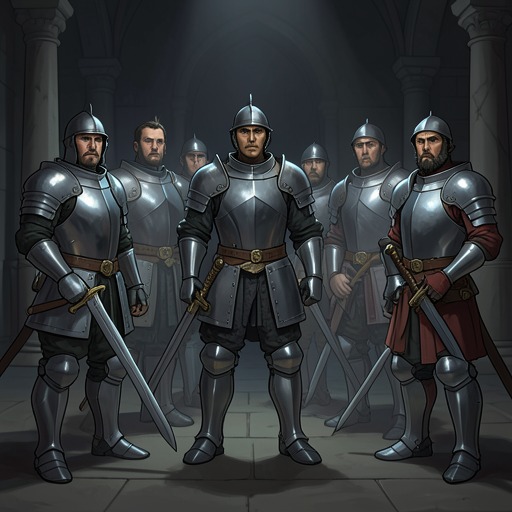
Le Morte d'ArthurChivalry is the governing ideal of knighthood in Malory’s book, at once a martial vocation and a discipline of service. Its knights are charged to use power for others, especially the poor and weak, and to restrain cruelty, treason, and injustice. Yet the narrative never treats the ideal as automatically fulfilled: Arthur’s order and the Round Table’s reputation rise to extraordinary heights, while the conduct of individual knights shows how readily honor can be tested, compromised, or recovered through mercy.
Meaning and Origins
Chivalry is difficult to reduce to a single definition. The book’s framing discussion compares it to ideas such as love, duty, patriotism, and loyalty: their meaning is recognizable, but their breadth resists confinement in a simple formula. It therefore joins chivalry to knighthood rather than treating the two as entirely separate ideas. The chevalier is a mounted soldier whose birth and wealth allow him to lead vassals and retainers, embodying lordship and outward power; yet the knight is also a servant, expected to obey as well as command and to use strength not for selfish ends but in the service of others.
The ideal is situated within a broader effort to restrain the violence of the age. The account associates chivalry with the Peace of the King, the Truce of God, and the decrees of the Council of Clermont. Its outward form is military, but its intended ends are also religious and social. Legal and ecclesiastical authority, in this account, sanctioned its humane principles in hopes of spreading them through Christendom and checking barbarism. Chivalry thus becomes more than a rank or battlefield skill: it is represented as a solemn order, with an ethical purpose that gives force its obligations.
The Code in Arthur’s Realm
Arthur’s fellowship turns this ideal into a program of government. The framing account presents the king and the Round Table as bringing widespread disorder into order: Arthur establishes power across England, Wales, and Scotland, and his march to Rome makes him emperor. His achievement gives the knights’ reputation an apparently ever-brighter reach, as though their honor has risen beyond the reach of adverse fortune. This public triumph makes the later tests of chivalry more consequential: the book first displays a realm in which the code seems to have mastered disorder, then shows that status and victory cannot guarantee moral constancy.
After the quests surrounding the white hart, the brachet, and a captured lady, Arthur formally charges his knights to observe a practical code. He provides lands to knights who lack sufficient means and forbids outrage, murder, and treason. They must not be cruel; they must grant mercy to those who ask it, or forfeit Arthur’s favor, honor, and lordship forever. They must also give aid to ladies and gentlewomen, with failure carrying the severest penalty. The code therefore joins material provision to behavioral duties: Arthur supports less wealthy knights, then makes their use of power answerable to explicit rules.
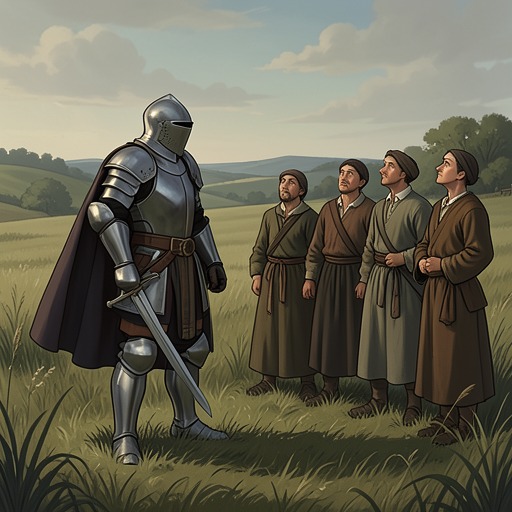
The narrative tests those rules through particular judgments rather than leaving them as ceremony. When Arthur has fought as Sir Damas’s champion and defeated Sir Ontzlake, he does not simply reward the man whose cause he served. He judges Damas, described as proud and unworthy in conduct, and assigns his manor to Ontzlake on terms that provide Damas a palfrey. The king’s decision shows that service to a patron does not exempt a knight or lord from judgment. In another episode, Arthur permits a young petitioner’s seemingly modest request for food and drink for a year, despite advising him to ask for something better; the request is accepted as the first of three gifts. Such episodes place the practice of rule alongside the code’s larger claims about honor, generosity, and obligation.
Tests of Service, Courage, and Mercy
The adventures of individual knights make the code legible through choices under pressure. Beaumains, seeking battle and asking to be knighted by Sir Launcelot, encounters the consequences of a siege in which defeated knights have been left hanging from trees. He rejects the shameful fate awaiting him if captured and declares a preference for dying in open battle rather than suffering a dishonorable death. When he confronts the Red Knight, he condemns the knight’s treatment of his opponents as a disgrace to knighthood and insists that the spectacle of the dead has strengthened, not frightened, his resolve. Courage here is not merely willingness to fight: it is a refusal to accept cruelty as a legitimate expression of prowess.
After defeating the Red Knight, Beaumains faces a second test. Earls, barons, and knights kneel and ask him to spare the defeated man, offering homage and fealty and proposing that he make amends for his wrongs. Beaumains says he is reluctant to kill him, and allows that the knight acted at a lady’s request; he agrees to spare his life on a condition. The episode makes mercy an active exercise of authority, not an abandonment of judgment: the offender’s conduct remains shameful, but the victor can choose a remedy other than death.
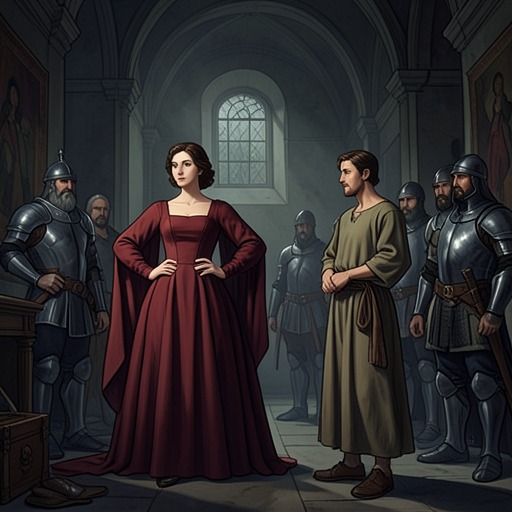
Launcelot’s conduct in two encounters gives the duty to protect a more personal and precarious form. When a knight’s wife is pursued with a drawn sword, she appeals to Launcelot for protection and asks him, in the name of true knighthood, to save her. Launcelot places himself between them. The husband says she betrayed him; she denies wrongdoing and describes his jealousy concerning her affection for a cousin. Launcelot takes up her appeal before the accusation can settle the matter, treating protection as an immediate obligation while the dispute remains contested. The scene shows the tension between a knight’s duty to aid a woman in danger and the uncertainty of the claims made in a private conflict.
In a separate ambush, a lady helps her armed husband trap Launcelot while he is unarmed and retrieving a hawk. Launcelot protests that an armed knight’s attempt to kill an unarmed man by treachery is shameful. These paired episodes complicate a simple picture of the protector: Launcelot’s service to women can be invoked amid disputed loyalties, and a lady may also participate in deception against him. The code’s language of honor is therefore tested by circumstance, not secured by titles or by the gender of the person involved.
Tristram’s challenge to Sir Marhaus likewise makes obligation the ground of combat. Marhaus urges the young knight to return to his vessel, noting that he has faced the best knights of the land and matched the best in the world. Tristram refuses: he cannot forsake Marhaus in the quarrel because he was knighted for his sake. He also identifies himself as a queen’s son and recalls the promise, made at his uncle’s request and by his own choice, to fight Marhaus to the utmost and deliver Cornwall from its old tribute. His decision binds personal loyalty, a pledge of service, and a political objective together. The passage presents prowess as accountable to promises and allegiance rather than as an end in itself.
The Limits of Worldly Honor
The book’s account of chivalry sets the Round Table’s worldly achievements against the coming of the Holy Grail. Arthur’s fame and the honor of his knights appear to unfold into forms ever brighter and less vulnerable to adverse fate. That confidence is unsettled when the Grail arrives and all the knights enter its quest with the self-reliance that had served them in worldly chivalry. The framing account insists that such confidence will not suffice: the knights must face tests different from those by which they were proved in the field. Chivalry remains necessary, but prowess and public reputation cannot on their own meet the spiritual demands of the quest.
The golden age of chivalry is located, in the book’s historical reflection, between about the middle of the eleventh century and the end of the fourteenth. The Crusades are described as both cause and effect of chivalry: the spirit of knighthood animated people of many ranks and nations, while the struggle in the Holy Land reinforced the chivalric spirit at home. The account compares the knight errant’s defense of widows, orphans, and travelers against local oppressors with the perceived religious conflict of the Crusades. The comparison connects the public, collective ideal of knighthood with its more local work of rescue and protection.
Historical Inheritance and Narrative Judgment
The framing account treats chivalry’s legacy as ethical as well as literary. It credits the knights and ladies of the Middle Ages with transferring Christian ethics into ordinary worldly life in a rough and partly barbarous age. That transfer was gradual and mixed with evil, the account cautions, and is not complete. Its importance lies not in a claim that medieval chivalry achieved moral perfection, but in the lasting attempt to make daily conduct answer to Christian principles.
That inheritance is extended into the book’s account of manners. In the Middle Ages, the Virgin Mary represented ideals of womanhood and ladyhood for people from prince to peasant; in more modern terms, Saint Paul is offered as a model of the gentleman, with principles and conduct described as chivalrous. The discussion links the knightly code to the social ideal of the lady and gentleman, while also acknowledging the long historical process through which those ideals were carried into common life.
Finally, the book refuses to confine chivalry to the past. It contrasts old knights who risked their lives to defend the weak and attack oppressors with people of its own nineteenth-century world who, in ordinary life, continue to struggle against powers that oppress the vulnerable. Their chivalry consists in joining adventurous enthusiasm to patient endurance and gentle service. The code’s lasting measure is therefore not armor, rank, or victory, but the responsible use of strength in the defense of others—and the continuing effort to make that service part of everyday conduct.