Confession and penance
Le Morte d'ArthurConfession and penance are practices of spiritual preparation and moral reckoning in the Holy Grail narrative. The text makes confession a condition for approaching the Grail, then gives Launcelot’s visionary experience a precise penitential measure: twenty-four days of stillness answer, in his own interpretation, twenty-four years of sin.
Confession as preparation for the Quest
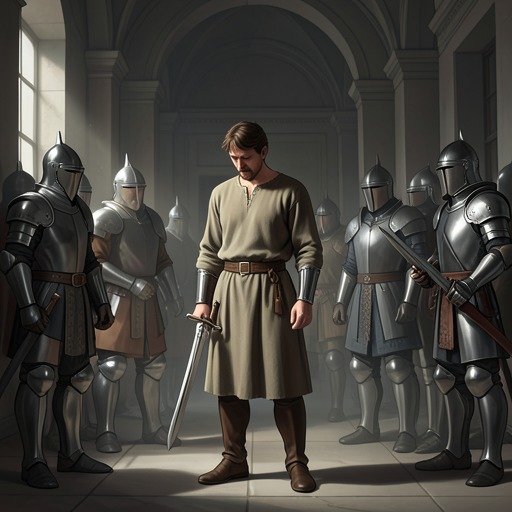
Bors seeks counsel from a religious man because he wants guidance in the Quest of the Holy Grail and hopes to attain its spiritual and worldly distinction. The man tells him that no one can achieve the Grail except through cleanness, which he identifies as pure confession. At a hermitage, Bors removes his armour, confesses in the chapel, and shares bread and water with the hermit. The ritual is followed by a continuing discipline: he agrees to eat nothing else until he sits at the Grail’s table, and he puts on a scarlet garment in place of his shirt as a sign of chastisement, to be worn until the Quest is fulfilled.
The hermit’s account distinguishes Bors’s general spiritual stability from a specific exception: he says Bors has not been corrupted by fleshly lusts save once, when he fathered Elian le Blank. Confession therefore belongs not simply to the outward observance of a Questing knight, but to an acknowledgment of personal moral history. The bird Bors sees afterward, which gives its own blood so that its young may live, is presented to him as a token; the episode places the visible image of sacrifice alongside the confession and discipline that mark his departure.
Penance measured against a life of sin
Launcelot’s experience at Carbonek gives penance a different form. After he has lain motionless for twenty-four days and nights, he opens his eyes and asks why he has been awakened, saying that he had been more at ease before. When those around him tell him how long he has lain there, he understands the duration as punishment for the twenty-four years he had been a sinner. The matching numbers turn an extraordinary bodily state into an explicit spiritual reckoning, as Launcelot himself interprets it.
On recovering, Launcelot remembers the hair he has worn for nearly a year and regrets that he broke his promise to the hermit. Though told he is whole, he takes up the hair again and puts it on beneath a linen shirt, then wears a new scarlet robe over it. His renewed clothing makes visible his continued commitment to penance even after the ordeal has ended. Those present recognize him as Launcelot, and King Pelles welcomes him; Launcelot, in turn, laments the death of Pelles’s daughter and praises the son she bore, Galahad.
Spiritual access and its limits
The Grail material frames these episodes within Christian explanations of the sacred vessel. Its legends connect the vessel with the Last Supper and with Joseph of Arimathea’s keeping of the blood of Jesus Christ; the narrative also associates that sacred history with the wound of King Pellam and the later healing of him by Galahad. Against this background, confession and penance are not merely knightly disciplines: they concern the moral fitness with which a person approaches a sacred mystery.
That fitness is not identical for every knight. At Carbonek, Launcelot has seen marvels but is told that he will see no more of the Grail. Later, when Joseph of Arimathea appears to Galahad and his companions, the vision leads to their reception of the sacred vessel’s spiritual food. Set beside Bors’s preparation and Launcelot’s partial vision, the contrast makes spiritual achievement dependent on more than worldly prowess: confession, chastisement, and the limits of what a knight is permitted to behold all shape the Quest’s meaning.