England
Le Morte d'ArthurEngland is the principal realm of King Arthur’s story: first contested among powerful lords, then brought under the authority of a king whose rule extends across Britain and beyond, and finally left to a successor after the fellowship that sustained it has broken apart. Its political fortunes are inseparable from the Round Table. The company helps turn disorder into order, but the long prosperity of Arthur’s dominion conceals the tragic consequences of Queen Guenever’s love for Sir Launcelot.
Realm and Scope
In Caxton’s account of the book, Arthur is presented as the great conqueror and excellent king of a realm then called Britain. The narrative’s England is not merely a bounded setting: it is the political center from which Arthur’s authority expands across Wales and Scotland and eventually reaches toward Rome. Caxton describes the work as a history of chivalrous deeds and adventures, divided into twenty-one books, placing the rule of the realm within a broader story of arms, loyalty, courtesy, and love.
A later account of Arthur’s rise emphasizes how difficult it is to fit these events within the limits of history. After Uther’s death at St. Albans, the Lords and Commons assemble at London’s greatest church, where Merlin and the Christian bishop of Canterbury guide the election of Arthur. In the ensuing wars against Cornwall, Wales, and the North, Arthur’s power is established through conflict and alliance; the king of France assists him. The narrative thereby gives England a double character: it is a kingdom whose authority must be won, and the center of a dominion that grows to include territories beyond it.
Arthur’s Establishment of Rule
The succession crisis after Uther’s death leaves England exposed to ambitious lords. Each powerful claimant gathers men, and the realm remains in jeopardy while the barons contend over who should rule. Merlin counsels the archbishop of Canterbury to summon the lords and men of arms to London at Christmas, where the test of the sword will reveal the king. At the feast of Pentecost, many try and fail to draw it; Arthur alone succeeds before the assembled lords and commons. The people acclaim him, and he forgives those who had delayed him rather than punishing them.
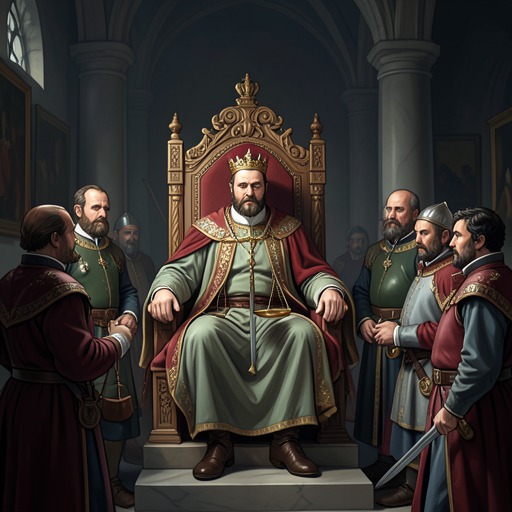
Arthur’s accession is made visible in both ceremony and administration. He offers the sword on the altar, is knighted by the best man present, receives the crown, and swears to rule justly. He then requires the crown’s lords to render their service. Complaints about wrongs committed since Uther’s death lead him to restore lands to those who had been dispossessed. He appoints Sir Kay seneschal of England, Sir Bawdwin of Britain constable, Sir Ulfius chamberlain, and Sir Brastias warden of the northern approaches. The restoration of property and the assignment of offices present kingship as a work of ordering, not simply a claim to power.
That order expands through further victories. The account says that within a few years Arthur wins the North, Scotland, and territories owing obedience there; he also overcomes resistance in Wales. In the broader description of his reign, the Round Table fellowship helps reduce widespread anarchy, and Arthur brings all England, Wales, and Scotland under his authority. His campaign against Rome raises the scale of his ambition still further: he claims the empire as a right belonging to his predecessors and becomes, in the account’s sweeping summary, emperor and head of the kingdoms and chivalry of Christendom.
England as a Political Stage
England’s authority is repeatedly tested by rival claims, obligations, and rebellion. When the Roman emperor Lucius demands tribute, Arthur rejects the demand and asserts his own right to the empire. He explains that he owes no tribute to an earthly prince, Christian or heathen, and declares his intention to lead an army to Rome. Parliament arranges for the fleet to be ready at Sandwich within fifteen days. Before departing, Arthur appoints Sir Bawdwin and Sir Constantine, son of Sir Cador of Cornwall, as governors, and entrusts them with the realm and Queen Guenever. The episode shows how a claim made in England’s name can carry the king away from England, requiring delegated rule at home while the campaign is fought abroad.
The realm is also the setting for domestic conflict within the royal family. When the queen of Orkney comes to Arthur’s court, her sons greet her after fifteen years apart. She demands to know what has become of her youngest son, Sir Gareth, who had spent a year at court serving as a kitchen knave. Arthur and Sir Gawaine admit that they had not recognized him and regret their treatment; Arthur acknowledges that Gareth has proved himself a worthy knight. England’s court thus appears not only as the seat of authority but as a place where status can be concealed, misjudged, and eventually recognized.
The most direct threat to the kingdom’s political order comes when Sir Mordred presumes to make himself king of England and seeks to marry Queen Guenever, his uncle’s wife. The episode’s chapter heading places usurpation and the attempted marriage together: the challenge is at once to the crown and to the existing royal bond. The book’s larger account describes the fellowship’s flourishing as eventually shadowed by the consequences of Guenever’s love for Sir Launcelot. What had seemed a stable realm is therefore exposed as vulnerable not only to external enemies but to divisions within the relationships that sustain its political order.
Search, Exile, and Return
England becomes a landscape of pursuit when Sir Launcelot is lost to the court. At King Arthur’s request, and especially at the queen’s desire, Sir Gawaine, Sir Uwaine, Sir Sagramor le Desirous, Sir Aglovale, and Sir Percivale de Galis set out to search England, Wales, and Scotland, accompanied by eighteen more knights. They travel as a company of twenty-three, adequately supplied for the search. The scale of the party turns Launcelot’s absence into a concern for the whole court, while the search across the realms makes personal separation a matter of public fellowship.
Launcelot’s own movements give England a contrasting geography of exclusion and refuge. Banished from Logris, that is, England, for ever, he remains unable to move for more than a fortnight after his ordeal. He asks Dame Elaine to seek a place for him from her father, since he can never return to Arthur’s court. His departure is not merely a journey away from the royal center; it is the consequence of a sentence that bars him from the country and the community whose honor he once embodied.
Yet England also receives the returning knight. After Launcelot’s madness and absence, he comes with his companions to Camelot, identified in the account with Winchester, where Arthur and the knights welcome him joyfully. Sir Percivale de Galis and Sir Ector de Maris recount his adventures: during his absence Launcelot had called himself Le Chevaler Mal Fet, the knight who had trespassed, and had unhorsed five hundred knights in three days. Queen Guenever weeps as the tale is told, then welcomes him. His return restores him to the court’s sight, but the queen’s grief and the king’s question about the cause of his madness show that restoration does not erase the history of separation or suspicion.
The Realm after Arthur
In the final movements of the book, England becomes the terrain over which Launcelot’s companions search and the place where the old fellowship gives way to a new reign. Sir Bors de Ganis warns Launcelot that he will find few friends if he rides through the realm. Launcelot nevertheless insists on departing alone, traveling westward for seven or eight days until he reaches a nunnery. Later, after Sir Lionel and many lords are killed while seeking him, Sir Bors leads the host home and joins Sir Ector de Maris, Sir Blamor, Sir Bleoberis, and other kin in searching all England. Bors eventually finds Launcelot at a chapel; after hearing the bell for Mass, he attends the service and asks the bishop to receive him into the same religious habit as Launcelot. The search ends not in a restored courtly life but in shared prayer.
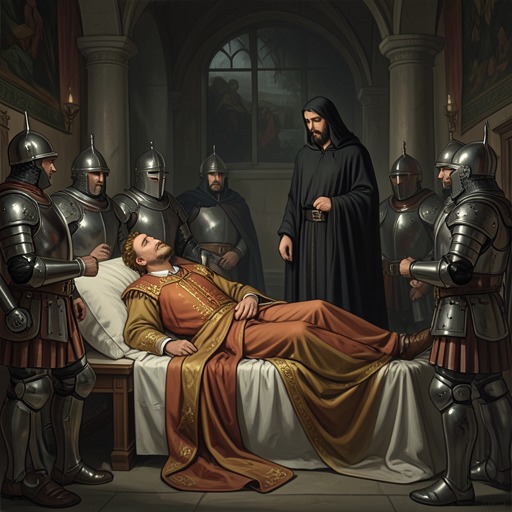
Launcelot’s body is eventually brought to Joyous Gard. His companions lay him in the choir, pray and sing psalms over him, and leave his face uncovered according to the custom described for men of worship before burial. Sir Ector arrives while the service is underway, having spent seven years searching England, Scotland, and Wales for his brother. England’s geography of quests and departures thus closes around a long search and a funeral, while the rites preserve the bonds of kinship and fellowship after political unity has failed.
Sir Constantine, son of Sir Cador, is then chosen king of England. The account calls him a noble knight and says that he rules the realm honorably. The bishop of Canterbury returns to his bishopric, Sir Bedivere remains a hermit for the rest of his life, and the surviving knights disperse to their own countries rather than staying with Constantine. The closing description remembers the Round Table as having numbered one hundred and forty when its members were whole together. England endures under a successor, but the fellowship that had helped make Arthur’s order possible is no longer whole; the realm’s continuity and the company’s dissolution are presented as different outcomes.