Faith and belief
Le Morte d'ArthurFaith and belief are active tests in Malory’s Grail narrative: they govern who may approach sacred mysteries and whether a knight trusts God when worldly protection fails. From the warning that faith is required to enter a sacred ship to Launcelot’s rebuke for relying on armour, belief becomes both a condition of spiritual passage and a measure of the distance between knightly prowess and Christian service.
Faith as a Condition of the Grail Quest
When Percivale and his companions encounter a ship bearing a warning, its message identifies the speaker as Faith and cautions that the ship offers no help to anyone who fails in belief. Percivale’s sister, whom he recognizes there as the daughter of King Pellinore, makes the condition personal: she tells him not to enter unless he believes fully in Jesus Christ, because the ship is so perfect that it will tolerate no sin. Percivale accepts the risk, saying that if he is an untrue knight, he will perish there. Belief is thus presented not as an abstract assent but as a qualification for entering a sacred space, where the trial exposes the condition of the entrant.
That threshold is part of a larger Christian framework around the Sangreal. The book’s introductory account relates the Grail to the dish of the Last Supper and to the vessel in which Joseph of Arimathea received Christ’s blood; in the Grail story, the vessel’s history and its appearances place the knights’ adventures within a narrative of Christian sacred history. The marvels do not stand apart from doctrine: they direct the quest toward the Passion, the Eucharist, and the spiritual demands placed on those who seek the vessel.
Trust Tested Against Worldly Protection
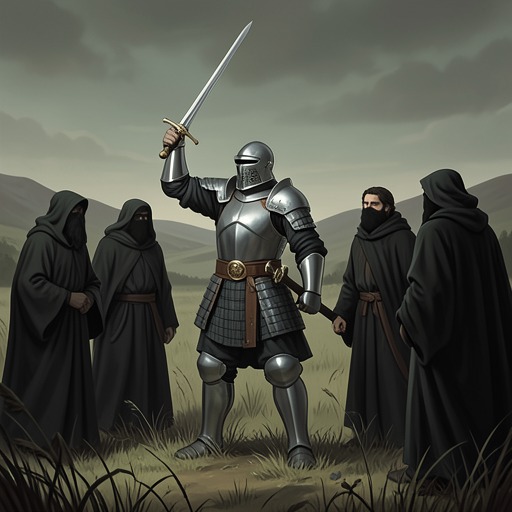
Launcelot’s encounter at a castle makes the conflict between faith and reliance on arms explicit. A voice directs him to leave his ship and enter, where he will see part of what he desires. At the entrance, two lions guard the way. Launcelot reaches for his sword, but a dwarf strikes his arm and the weapon falls. A voice reproves him for trusting his armour more than his Maker, whose aid should be greater than that of arms. Launcelot recognizes the rebuke as a correction of his own failing, thanks Christ for the mercy, puts his sword away, and crosses himself. He then passes the lions unharmed.
The episode turns a familiar measure of knightly competence on its head. Launcelot is armed and prepared for danger, yet those defences are shown to be spiritually misplaced at the threshold of a sacred adventure. Once he sets aside the sword and acknowledges the correction, he can proceed. The scene makes trust consequential: faith changes his response to danger, while the narrative distinguishes divine protection from the strength he usually brings to combat.
Revelation, Sacrament, and the Limits of Sight
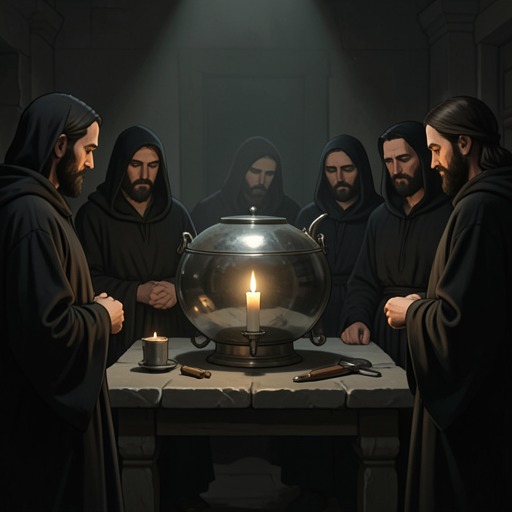
At the Grail feast, the knights’ experience moves from signs toward a more direct revelation. Joseph, identified as the first bishop of Christendom and long dead, appears with four angels before the silver table. The ceremony includes candles, a towel, and a spear from which blood falls into a vessel. During the mass, a figure in the likeness of a child enters the bread; Christ then appears bearing the signs of the Passion and tells the knights that he will no longer hide himself from them. Galahad receives the vessel first, followed by his companions, and Christ identifies it as the dish in which he ate the lamb on Holy Thursday.
Yet the revelation is explicitly incomplete. Galahad has seen what he most desired, but Christ says he has not yet seen it as openly as he will in Sarras. The Grail’s appearance therefore offers both fulfilment and deferral: the knights are fed and shown a part of the sacred mystery, but their journey must continue. The vessel is also to leave Logris permanently, because its people have turned to evil living and do not serve or worship it rightly. The withdrawal makes the relation between faith and conduct plain: access to holy things cannot be separated from the moral life of those who claim their honour.
Belief, Obedience, and the Shape of the Narrative
The Grail episodes connect belief to humility, obedience, and dependence on God rather than to martial achievement alone. Launcelot’s weapons cannot secure his entrance; Percivale’s willingness to risk the ship is framed by a warning about belief; and the knights’ participation in the sacred feast culminates in a command to continue toward Sarras. The quest repeatedly puts spiritual qualification beside the language of knightly prowess, making success depend on a different kind of readiness.
This structure also gives faith a narrative function. A warning establishes a test, a failure or correction changes how a character proceeds, and a revelation opens the next stage while withholding the final vision. The sacred objects and ceremonies carry the plot forward, but they also judge the world around them: the Grail departs from Logris because the people’s conduct has made them unworthy of its honour. Faith and belief consequently link individual choices to the fate of a kingdom and turn the quest into an examination of whether its knights can live according to the spiritual order they seek.