Feudal system
Le Morte d'ArthurThe Feudal system is described as a half-patriarchal, half-military order devised to control the widespread anarchy of the Middle Ages. It bound people from king to vassal through reciprocal service and protection, but the same local power that offered security could become a source of renewed violence. The book’s episodes of contested succession, rebellion, royal justice, and political reward give that tension practical form: order depends not only on who rules, but on how power and obligation are exercised.
Origin and Structure
The book sets the Feudal system against a background of recurring war and weak public authority. When the personal influence of a strong ruler faded, society repeatedly fell back into disorder; people had to defend themselves and their households without reliable aid from law or government. The Church is identified as a major force of civilization, while the State is also credited with developing its own means of imposing order. The first great political response was the establishment of a system that joined military hierarchy to bonds of family, neighborhood, and kinship.
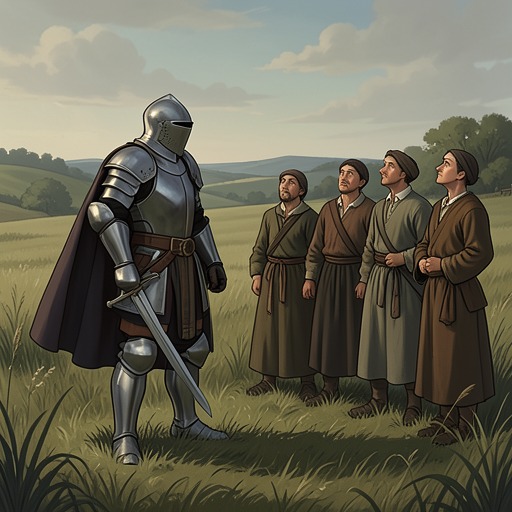
Those without enough wealth or power to become lords became vassals, willingly or otherwise. In principle, every rank, from king downward, owed reciprocal service and protection. These obligations were not merely transactions between strangers: they were sustained by relationships and shared interests formed through family, neighborhood, and clan. The system thus offered a social bond as well as a military one, with authority matched by duties toward those dependent on it.
Protection and the Return of Disorder
The system’s central weakness was that protection could turn into predation. A lord responsible for defending his own vassals might invade a neighboring lord’s rights and ravage the possessions of that lord’s dependents. The remedy for anarchy therefore carried within it a means of reproducing anarchy: power organized for defense could be redirected toward private aggression. The book describes the resulting political landscape as one in which monarchies weakened and lesser tyrants crushed social order, with insecurity also obstructing learning, artistic life, and material well-being.
The text presents this violence as part of a broader cycle rather than as a problem solved by hierarchy alone. When government could not reliably restrain force, one person’s defense became another’s threat, and war served both as a consequence and a cause of disorder. The Feudal system’s significance lies in this double character: its ties could establish obligations across ranks, yet those ties could not by themselves prevent powerful lords from abusing their authority.
Limits on Private Violence
The book describes measures intended to reduce the harm caused by private warfare. Under the Peace of the King, private war was to be delayed for forty days after the alleged offense that prompted retaliation. The Truce of God suspended private hostilities from Thursday through Monday each week. These restrictions did not abolish armed conflict; they placed limits on when vengeance could be pursued, making time itself a protection against immediate retaliation.
At the Council of Clermont in November 1095, private war was censured and the Truce of God confirmed. Women and priests were placed under the Church’s protection, while husbandmen and merchants—identified as defenseless victims of military plunder—received a three-year safeguard. The text compares these protections with the Cities of Refuge in the law of Moses: in both cases, special safeguards temporarily restrained the vengeance of people otherwise driven by anger. Its emphasis is on a gradual contest between force and religious or civil authority, in which violence yields ground before a more complete order can be established.
Royal Authority and Feudal Obligation
The narrative episodes show royal authority being asserted not simply through command, but through the settlement of obligations. After Uther Pendragon’s death, he publicly names Arthur as his successor and grants him his blessing, charging him to claim the crown righteously and honorably. Arthur’s claim then becomes a matter of political crisis: powerful lords strengthen themselves, and many aspire to rule. When Arthur draws the sword before the assembled lords and commons, they acknowledge him as king; he forgives those who had delayed him, swears to uphold justice, and restores lands taken from their rightful owners during the unsettled succession.
Arthur also makes service to the crown explicit. He summons those who hold land from him to perform their obligations and appoints officers to govern and defend the realm. His authority is thus represented as a combination of acknowledged kingship, justice, the restoration of property, and the service owed by those who hold from the crown. The account does not treat this as a simple escape from disorder: Arthur’s need to secure recognition and overcome resistance shows how much political order depends on the conduct of rulers and lords.
The conflict with the eleven kings makes that dependence especially clear. Their coalition is bound by an oath not to abandon one another until they have destroyed Arthur, and their forces are described as fifty thousand mounted men and ten thousand on foot. After the fighting, Merlin advises Arthur to distribute the goods taken in battle to King Ban and King Bors, so they can reward their own knights; the two kings pass the wealth on to their men. The episode presents rewards as a mechanism that sustains service and encourages future allegiance, linking material resources to the political bonds on which a military coalition relies.
Claims, Judgment, and the Costs of Rule
The dispute over Roman tribute extends the question of obligation beyond the immediate lord-vassal relationship. Twelve elderly ambassadors arrive bearing olive branches and demand Britain’s tribute for the Roman emperor, appealing to the supposed precedent of earlier payments. Arthur forbids his knights to harm the envoys and provides for their lodging before answering their demand. He rejects Roman sovereignty, denies that he owes tribute to any earthly prince, and claims the right to the empire through his predecessors. He then offers the ambassadors gifts, pays their expenses, and assigns an escort for their departure. The scene places a forceful claim of sovereignty beside restraint and formal treatment of messengers, showing that political authority is exercised through both refusal and prescribed conduct.
Elsewhere, Arthur uses judgment to correct the misuse of power within his own realm. After defeating Sir Damas’s champion, he orders Damas to yield the manor to his brother Sir Ontzlake under specified terms, release twenty imprisoned knights with their equipment, and cease distressing knights who travel on their adventures. Arthur makes continued abuse punishable by death and offers Ontzlake a place at court, with the prospect of advancement if his service merits it. His decision combines redress for those held captive, restraint on a predatory lord, and a new bond between the king and a worthy knight.
Across these episodes, the Feudal system appears neither as a stable cure for violence nor as a merely decorative hierarchy. It is a structure of reciprocal dependence whose promises of protection can be undermined by private force, and whose obligations must be enforced or renewed through royal justice, public recognition, service, and reward. The book’s ideal of political order rests on power being answerable to duties; when protection becomes domination or allegiance turns into rebellion, the structure intended to govern conflict becomes one of its principal arenas.