Igraine
Le Morte d'ArthurIgraine, a noblewoman praised for her wisdom and goodness, is the wife of the Duke of Tintagil and the mother of Arthur. Her encounter with Uther Pendragon establishes the concealed parentage on which Arthur’s childhood and succession depend, and the book’s editorial frame makes that concealment the first link in a longer chain of guilt and tragic consequence. In the story itself, Igraine is neither a conspirator nor a knowing participant in Uther’s plan: she understands the encounter as one with her husband, and learns the truth only later.
Identity and Introduction
The opening account presents Igraine as the Duke of Tintagil’s wife, a notably fair and wise lady. Uther sends for the duke and requires him to bring Igraine to court. The king takes a strong interest in her and seeks her love, but Igraine refuses to assent. Concluding that they have been summoned so she will be dishonoured, she advises her husband that they should leave at once and ride through the night toward their own castle. They depart without the king or his council knowing.
That refusal sets the immediate conflict in motion. When Uther discovers their departure, he becomes furious; after the duke refuses a further summons, Uther threatens to fetch him from his strongest castle within forty days. The duke prepares Tintagil and Terrabil for defence, placing Igraine in Tintagil while he holds Terrabil. The narrative thus establishes both Igraine’s initial agency—she identifies the danger and chooses flight—and the military pressure that follows when Uther’s desire is resisted.
Uther’s Deception and the Duke’s Death
During the siege, Merlin offers Uther a way to reach Igraine by magical disguise. Uther swears to grant Merlin’s request: the child born of Igraine is to be delivered to him for upbringing. Merlin then arranges for Uther to appear as the duke, while Uther’s companions take the likenesses of the duke’s knights. Igraine receives the apparent husband at Tintagil, believing the person before her to be the man she is bound to welcome as her lord. The account does not present her as knowing that Uther has assumed another’s appearance.
Meanwhile, the real duke, seeing Uther leave the siege, rides out from Terrabil to attack the king’s force and is killed before Uther reaches Tintagil. Uther arrives at the castle more than three hours after the duke’s death. Merlin returns before daybreak, and Uther departs after kissing Igraine. When Igraine hears that her husband had already died, she wonders privately who had come to her in his likeness; she mourns, but keeps her question to herself. The contrast between what she experienced and what has happened outside the castle is central to the episode: the truth is present in the chronology, but not yet available to her.
Marriage and Arthur’s Secret Upbringing
After the duke’s death, the barons seek an agreement between Uther and Igraine. Uther entrusts the negotiations to Ulfius, and the parties eventually meet. Ulfius presents the king as a vigorous, unmarried knight and Igraine as a fair lady, and proposes that she become queen. The proposal is accepted, and Uther and Igraine marry in the morning with public celebration. The account describes the marriage as a settlement arranged after the deception, not as a disclosure that Igraine has already been told the full circumstances.
When Igraine is expecting a child, Uther asks whose child it is. Igraine is disconcerted but answers truthfully as she understands it: on the night her husband died, a man who resembled him in speech and appearance came to Tintagil with two knights who likewise seemed to be the duke’s companions. She had welcomed the visitor as her husband. Uther tells her that he himself came in that likeness, that he is the child’s father, and that Merlin counselled the deception. Igraine then rejoices on learning the father’s identity. Her account makes clear that she had not known the visitor was Uther; the revelation changes her understanding of the child’s conception and of the night of her husband’s death.
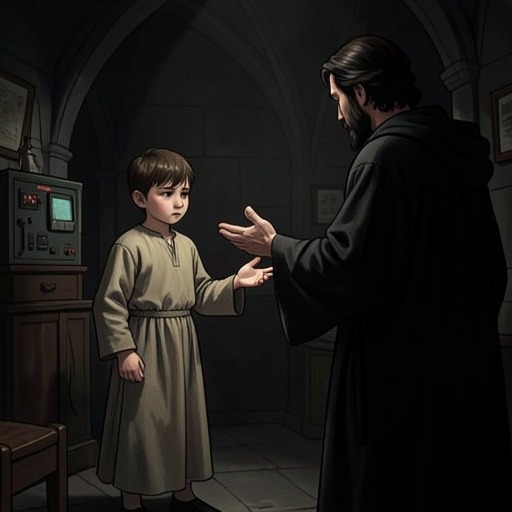
Merlin’s prior arrangement governs what happens next. He identifies Sir Ector as a trustworthy lord to bring up the child and directs that the baby be delivered to him secretly, before baptism. Uther agrees. After the birth, the child is handed to Merlin, who takes him to Sir Ector; a holy man baptizes him as Arthur, and Sir Ector’s wife nurses him. Igraine is identified as Arthur’s mother, but the narrative gives the practical custody and nursing of the infant to Merlin and the Ector household. Her place in the story is therefore bound to a separation: Arthur’s identity is known to his parents, while his upbringing is deliberately arranged elsewhere.
Family and the Tragic Design
The editorial account treats Uther’s crime as the opening cause of a broader tragedy. It links the concealment of Arthur’s parentage to Arthur’s later unwitting love for a woman he does not know to be his sister, and then to the birth of Mordred. It also recounts the prophecy that the sister’s child would destroy Arthur and the knights of his realm. In this interpretation, Igraine’s episode is not an isolated romance or succession prelude: the hidden identity created around Arthur’s birth becomes part of the structure that carries the story toward its ending.
The family connections are further complicated by the account of the arrival of Lot’s wife, Igraine’s daughter by her mother, at Arthur’s court. She comes with her sons, including Gawaine, Gaheris, Agravaine, and Gareth. Arthur does not know that she is his sister; the editorial frame identifies her as the mother of Mordred, while the narrative episode at court says that Mordred is born of Arthur’s union with her. Igraine’s earlier marriage and Arthur’s concealed parentage thus stand behind a later relationship whose true kinship is unknown to Arthur at the time.
Igraine’s characterization remains spare but distinct. The editor contrasts her wifely simplicity with the more forceful or complicated qualities assigned to other women in the story. Her first decision—to leave court rather than consent to Uther—shows prudence and a refusal of his advances; her later silence about the mysterious visitor follows the duke’s death, and her account to Uther is candid when he asks about the child. The narrative’s larger irony is that a woman who initially recognizes the danger at court cannot recognize the disguised king who reaches her, while the concealed truth of that encounter outlives the immediate crisis and shapes the destiny of her descendants.