Jesus Christ
Le Morte d'ArthurJesus Christ is the sacred presence at the heart of the Holy Grail narrative: his life and Passion give the Grail its Christian meaning, his blood is carried into Britain as a relic, and his power is shown through healing and revelation. In the Grail episodes, miracles do more than display divine power; they distinguish spiritual purity from worldly prowess and turn the knights’ adventures into tests of faith and repentance.
The Grail’s Christian History
The Grail’s origins are presented in more than one way. Earlier traditions describe a vessel that miraculously supplies food, but the Christian romances make it the dish that held the paschal lamb at the Last Supper, the vessel in which Joseph of Arimathea received blood from Jesus Christ’s wounds, or the sacramental cup itself. In the account most directly connected with Malory’s story, Joseph takes the dish from the place where the Supper was held, receives Jesus Christ’s blood in it, and brings it to Britain, where it becomes an instrument of conversion and is kept at Corbenic. The commentary also notes another account in which the vessel comes to Joseph while he is imprisoned, sent by Jesus Christ to comfort him.
This history makes the Grail a link between the Passion and the later adventures of the knights. Its significance rests not only in its status as a relic, but in its continuing association with Christ’s blood and presence. The narrative’s closing declaration of the Grail story calls it the holy vessel and the signification of the blessed blood of Jesus Christ, brought to Britain by Joseph of Arimathea; the framing prayer asks mercy for sinful souls. The quest is therefore placed within a story of sin, grace, and possible redemption.
Signs of Divine Power
At the Pentecost feast at Camelot, the Grail enters the hall covered in white samite, though no one can see the vessel’s bearer or behold the Grail itself. The hall is filled with fragrance, and every knight receives the food and drink he most desires; then the vessel disappears. The abundance is miraculous, but the knights’ inability to see the Grail establishes an important limit: divine favor may be experienced without being fully possessed or comprehended. The appearance prompts Gawaine and many of the other knights to vow that they will seek the vessel, turning a shared wonder into a demanding spiritual undertaking.
The Grail’s power is also manifested through healing. When Sir Percivale and Sir Ector de Maris are near death, Percivale prays to Jesus Christ. The holy vessel passes by, and both knights are restored to health. Percivale glimpses the vessel and its bearer, while Ector explains that it contains part of Jesus Christ’s holy blood and cannot be seen except by a perfect man. The episode makes the miracle both a gift and a sign of spiritual qualification: the knights are healed, but the ability to perceive the sacred remains unequal.
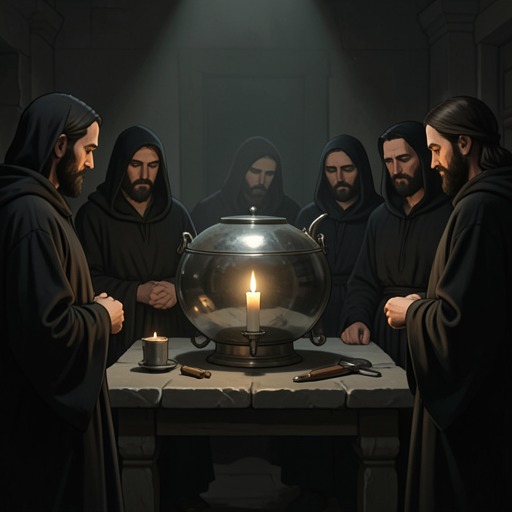
A later vision makes the sacramental meaning still more explicit. At a silver table, Joseph appears with angels, candles, a towel, and a spear that sheds three drops into a box. During the mass, the bread is shown in the likeness of a child and then returned to the vessel. Jesus Christ appears bearing the signs of the Passion and gives the knights the sacred food. The scene connects the Grail’s relic tradition to the mass and presents the knights’ reception of it as passage from a deadly life into a spiritual one.
The Measure of the Knights
The Grail’s presence exposes the difference between physical achievement and spiritual fitness. When it passes a sick knight, he is healed after approaching and kissing it. Sir Launcelot, however, is present but cannot rise to meet the vessel. The healed knight and his squire interpret his failure as evidence of unconfessed sin. Launcelot later accepts the judgment that his conduct has left him without the goodness or will required to receive the Grail’s grace, and he undertakes repentance and penance. The contrast is sharp: Launcelot’s celebrated prowess does not ensure spiritual access.
The hermit’s explanation to Launcelot extends this contrast through biblical imagery. Jesus Christ cursed a leafy fig tree that bore no fruit; the hermit applies the image to Launcelot, who had been given fairness, understanding, and prowess but showed no spiritual fruit when the Grail appeared before him. The rebuke does not erase Launcelot’s gifts; it recasts them as insufficient without goodness and a changed life. He resolves to abandon his former wickedness, undertake penance, and pursue knighthood under a renewed discipline.
Narrative Significance
Jesus Christ is not simply a figure from the Grail’s distant past. His blood gives the vessel its sacred history, his presence is revealed through its miracles, and his example supplies the moral measure by which the questing knights are assessed. The Grail’s appearances move between mystery and disclosure: at Camelot it provides a feast while remaining unseen, while in later visions the sacred story of the Passion and the sacrament is made visible to chosen witnesses.
This pattern also limits the authority of worldly honor. A knight may be famous, strong, and successful in arms yet fail before the Grail; conversely, healing and spiritual insight are granted in circumstances that make purity and faith more decisive than reputation. Through Jesus Christ’s connection to the vessel, the quest becomes more than a search for a sacred object. It tests whether the knights can turn from sin toward the spiritual life that the Grail signifies.