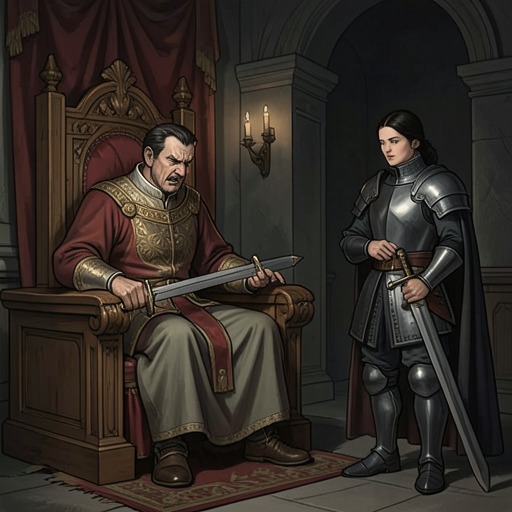
King Anguish of Ireland
Le Morte d'ArthurKing Anguish of Ireland is a monarch whose story joins the obligations of tribute and justice to the dynastic marriage of his daughter, La Beale Isoud. He sends Sir Marhaus to enforce Ireland’s claim against Cornwall, later faces a murder accusation at King Arthur’s court, and is defended by Sir Tristram, whose service earns him a promised reward. Tristram spends that favor not on himself but on Isoud’s marriage to King Mark, turning Anguish’s gratitude into an alliance with consequences beyond the court.
King and Kin
King Anguish rules Ireland and is the brother of Sir Marhaus, a renowned knight of the Round Table. When Cornwall refuses to pay the tribute it owes Ireland, Anguish calls upon Marhaus to fight for the claim. The king’s appeal makes the dispute a family matter as well as a political one: he entrusts his brother with Ireland’s cause, while promising to provide what Marhaus needs for the undertaking.
The text presents Anguish’s claim as a demand for arrears, not a newly imposed payment. Cornwall, under King Mark, has withheld tribute for seven years. When Anguish’s messengers report that Cornwall will pay nothing unless Ireland sends a champion, the king is greatly angered and appoints Marhaus to uphold his right. Marhaus agrees readily, invoking both the justice of the claim and the chance to advance his reputation as a knight.
The Tribute Dispute and Tristram’s Wound
Marhaus crosses from Ireland and arrives in Cornwall near Tintagil Castle. He remains offshore, sending King Mark the same choice each day: pay the seven years of outstanding tribute or provide a knight to fight him. Cornwall’s barons fear that no one can defeat so famous a combatant. Their suggestion that they seek Sir Launcelot is set aside, in part because Marhaus is himself a Round Table knight and members of that fellowship would be reluctant to fight one another.
Sir Tristram, then young, is angered and ashamed that no Cornish knight will take up the challenge. He fights Marhaus, wins, and receives a wound from a poisoned spearhead. The injury cannot be cured by the healers King Mark summons. A wise lady tells the king that Tristram must go to the country from which the poison came if he is to recover. Mark therefore provides a well-provisioned vessel for Tristram and his companion Gouvernail to sail to Ireland.
On reaching Ireland, Tristram conceals his identity, calling himself Tramtrist and saying that he is from Liones. King Anguish receives him and offers him all the help available in the land. In the course of speaking to his guest, Anguish describes the loss of Marhaus, the best knight he had, and explains that the knight died in Cornwall. Tristram knows more about that death than he lets the king see: he was Marhaus’s opponent, but remains silent about his identity.
Anguish entrusts the wounded stranger to La Beale Isoud, his daughter, because she is a skilled healer. She discovers the poison in Tristram’s wound and cures him. Tristram teaches her to play the harp, and affection grows between them. Anguish’s hospitality thus brings together the man who killed his brother and the daughter who will become central to Tristram’s life, even though the king initially does not know the visitor’s true name or role in Marhaus’s death.
Trial at Arthur’s Court
Later, Sir Bleoberis and Sir Blamor de Ganis summon Anguish to King Arthur’s court under threat that he will lose his lands if he fails to appear. At Camelot, Blamor accuses him of treason, alleging that the king killed one of his kinsmen in Ireland. Anguish arrives without knowing why he has been summoned and is taken aback by the charge. Under the custom described in the narrative, a person accused of treason or murder must answer by fighting the accuser or finding a champion to fight in his place.
While Anguish considers how to answer, Tristram learns from Gouvernail that the king is under accusation. Tristram resolves to defend him, recalling the hospitality he received in Ireland and naming Isoud as another reason for his loyalty. Anguish welcomes Tristram and explains that Blamor has challenged him over the death of a knight related to Launcelot. He knows that Blamor and his kin are formidable fighters, and accepts Tristram’s offer to stand for him.
Tristram makes his service conditional on Anguish swearing that he had no part in the knight’s death. He also requires the king to promise a reasonable reward if Tristram succeeds. Anguish agrees. The terms matter: Tristram does not defend him without first securing an assurance of innocence and a pledge that his service will be repaid. The episode presents the king’s peril through the period’s trial by combat, in which a champion can answer a grave accusation on another person’s behalf.
Tristram defeats Blamor but asks that the outcome not be made a cause of further injury or dishonor. He appeals to the judges and to the opposing side to spare the defeated knight, and Anguish agrees to be guided by his champion. The judges accept this appeal. Blamor’s brother, Bleoberis, also acknowledges that although his brother has lost the fight, he has not been dishonored, and the parties make peace. Anguish and the two brothers are reconciled; Tristram and Blamor exchange oaths not to fight one another. The narrative says that the blood of King Ban thereafter loved Tristram for this generous conduct.
The Reward and Isoud’s Marriage
Anguish and Tristram return to Ireland, where the king makes Tristram’s service widely known. The queen and the court show him honor, while Isoud’s joy at his return is described as especially strong. When Anguish asks why Tristram has not yet claimed the promised reward, Tristram names La Beale Isoud—but not as a bride for himself. He asks Anguish to give her to King Mark, his uncle, because he has promised to arrange that marriage.
Anguish would have preferred Tristram to marry Isoud himself, and says so plainly. Tristram refuses on the ground that breaking his promise would bring him shame. Anguish nevertheless leaves the choice to him and grants Isoud’s departure to Cornwall, whether Tristram intends to marry her or give her to Mark. The decision shows the limits as well as the force of Anguish’s favor: he expresses a personal preference, yet honors the reward he pledged and permits Tristram to determine the arrangement.
Isoud is prepared for the journey with Dame Bragwaine as her principal attendant, accompanied by others. Before they leave, Isoud’s mother gives a drink to Bragwaine and Gouvernail, instructing them to serve it to Mark and Isoud on their wedding day. She intends it to make the couple love one another for life. During the voyage, however, Tristram and Isoud mistakenly drink from a golden flask they take to contain wine. Anguish’s agreement to the marriage therefore leads into a story in which the planned match and the lovers’ attachment diverge: he sends his daughter to become Mark’s wife, while Tristram’s earlier loyalty and intimacy with Isoud now complicate that purpose.
Political and Narrative Role
Anguish’s episodes repeatedly place royal authority beside a claim that must be enforced or judged. In the dispute with Cornwall, he acts through a champion rather than simply collecting the withheld tribute by force. In the later accusation, the court’s custom requires a combatant’s answer, and Anguish’s position depends on Tristram’s willingness to represent him. The king is thus shown both exercising authority and relying on the networks of kinship, reputation, and service that make that authority effective.
His relationship with Tristram develops through reversal. Anguish first sends Marhaus against the Cornish who refuse payment; Tristram, serving Cornwall, defeats Marhaus and then enters Ireland under an assumed name as a wounded guest. Anguish welcomes and helps the man responsible for his brother’s death without knowing who he is. Later, once Tristram has become his acknowledged champion, the king entrusts his own safety and honor to him. Their bond is grounded in hospitality, gratitude, and a sworn promise, but it also carries the unresolved history of Marhaus’s death.
Anguish’s final importance in these episodes lies in the consequence of keeping his word. His promised reward enables Tristram to arrange Isoud’s marriage to Mark, despite Anguish’s wish that Tristram marry her himself. The king’s generosity sustains the bond between them, while the marriage plan exposes the tension between political obligation and personal affection that shapes the wider story.