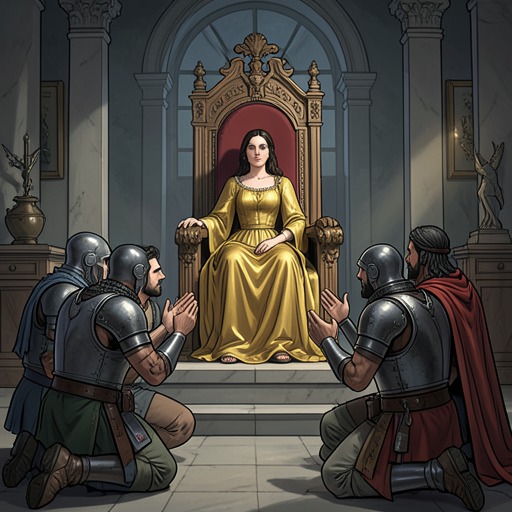
King Howel of Brittany
Le Morte d'ArthurKing Howel of Brittany is a ruler whose court gives Sir Tristram refuge, healing, and a new marriage, and whose kingdom Tristram defends in return. Howel’s relationship with the knight is bound together by hospitality and service: he welcomes Tristram when an envenomed wound drives him from Cornwall, then receives him as a champion when war threatens Brittany. After Tristram saves his kingdom, Howel offers him the crown, but Tristram declines, citing his obligation to Howel for the healing he received through the king’s daughter.
Identity and Introduction
The narrative presents Howel as King of Brittany, father of Sir Kehydius and Isoud la Blanche Mains. His first significant appearance in this episode comes after Tristram has been wounded by an envenomed arrow and learns, through a message conveyed from La Beale Isoud, that he cannot recover without traveling to Brittany. The message directs him to Howel’s daughter, who can heal him.
Howel welcomes Tristram when he learns who has arrived. Tristram states that he has come seeking his daughter’s help, having been told that she alone can heal him; Isoud la Blanche Mains does so. The account makes the king’s household, rather than Howel alone, the immediate source of the knight’s recovery, but places the welcome and treatment within Howel’s court.
Brittany’s War and Tristram’s Service
Howel’s kingdom is threatened by Earl Grip, who wages war against him, gains the advantage, and besieges him. Howel’s son Sir Kehydius is badly wounded when he rides out, leaving the king without his help in the field. Gouvernail then advises Howel to ask Tristram, his lord, for aid. Howel follows that counsel and appeals to Tristram in the kingdom’s need.
Tristram agrees to fight for Howel and goes into the field with whatever company he can assemble. He kills Earl Grip with his own hand and slays more than a hundred knights that day. The account says his deeds become the talk of all Brittany; his victory ends the immediate danger posed by Grip’s campaign and establishes his standing as Howel’s defender, not merely a guest receiving care.
Obligation, Offer, and Marriage
After the victory, Tristram is received with honor. Howel embraces him and offers to resign his entire kingdom to him. Tristram refuses the offer, saying that he is already bound to Howel to act for him because of the king’s daughter. His response frames the service not as a bid for political reward but as repayment for the healing and hospitality extended to him.
Howel and Sir Kehydius subsequently make great efforts and generous offers in support of a match between Tristram and Isoud la Blanche Mains. The narrative says that their efforts foster love between the two. Tristram, surrounded by welcome, riches, and other pleasures, nearly forsakes La Beale Isoud; he agrees to marry Howel’s daughter, and the marriage is solemnly celebrated.
Significance and Later Connection
Howel’s episode links rescue, reciprocal service, and marriage. Tristram enters Brittany in need of healing, becomes its protector when the king is threatened, and is offered sovereignty as the measure of his success. By declining the crown and naming his obligation to Howel’s daughter, he turns the offer into a statement of personal indebtedness; the marriage that follows also changes his relationship with La Beale Isoud and has consequences beyond Howel’s court.
Howel’s household remains connected to Tristram’s later movements. After learning of Tristram’s marriage, La Beale Isoud sends him a letter asking him to return to her court with Isoud la Blanche Mains, where both women would be cared for. Tristram secretly sets out with Sir Kehydius, Dame Bragwaine, and Gouvernail. A contrary wind carries their vessel to the coast of North Wales, near Castle Perilous, interrupting the journey before the party reaches Cornwall. In this later episode, Sir Kehydius accompanies Tristram from the household through which Howel first offered healing and then aid in war.