Knighthood
Le Morte d'ArthurKnighthood in the book means more than the status of a mounted warrior. It joins birth and wealth, command and service, martial training and religious obligation: a knight may lead, but is sworn to use power for others, especially the poor, weak, and oppressed. The ideal is made public through the rites of admission and the oath of office, then tested in Arthur’s story by competing claims to kingship, the duty of allegiance, and the conduct of war.
Definition and Social Meaning
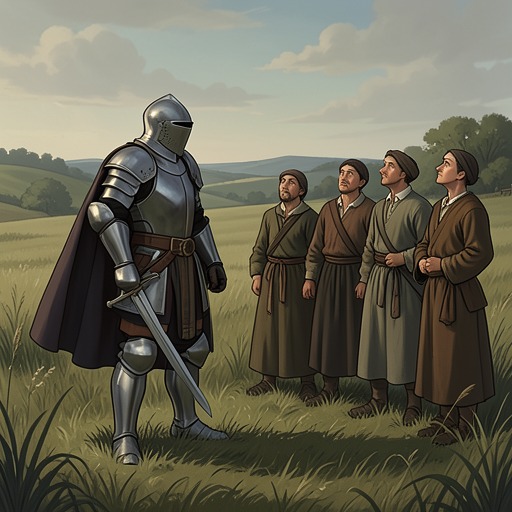
The account links Knighthood to the efforts to restrain the private violence of the age. The Peace of the King delayed private vengeance for forty days after an alleged crime, while the Truce of God suspended hostilities from Thursday to Monday each week. In that context, Knighthood is described as the offspring of the same impulse toward restraint: a way to direct the force of arms toward protection rather than private advantage. The knight embodies an apparent double meaning. He is a chevalier, a rider of the war-horse, whose birth and wealth enable him to lead vassals and retainers; yet he is also to be a servant. The power to command therefore carries a contrary obligation: to obey where duty requires it and to employ strength for those unable to defend themselves. The book treats this principle not as a new discovery, but as an enduring moral claim whose distinctively medieval European form gave it a particular institutional force.
Religious Rites and the Knight’s Oath
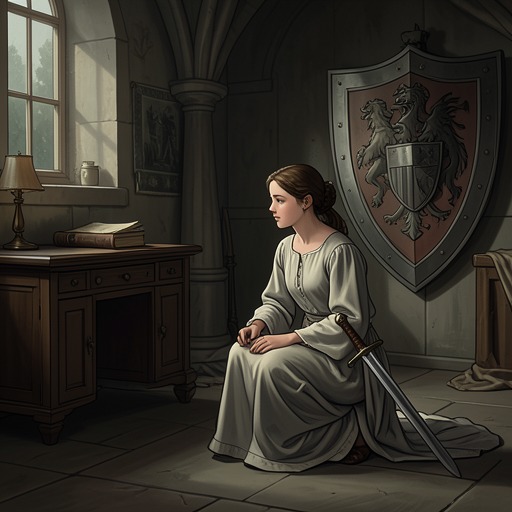
Knighthood existed before the Church consecrated its admission. Charlemagne permitted a governor to make knights by girding them with a sword and striking them, and Charlemagne himself invested his son Louis without religious ceremony. Edward the Elder likewise gave Athelstan a soldier’s clothing, a jeweled belt, and a sword with a gold sheath without church rites. By the reign of Edward the Confessor, however, the account describes Hereward being knighted by the Abbot of Peterborough with confession, absolution, and prayer. The rite subsequently spread across Europe, with the Normans adopting it later than others. The candidate’s admission became a sustained religious observance. On the eve, he confessed and spent the night in prayer and fasting in a church. A bath, white garment, godfathers, and sometimes a tonsure marked the new state of life; next morning he heard mass and offered his sword on the altar for a priest’s blessing. A high-ranking priest or an already qualified knight could then confer the office in the name of God, Saint George, and Saint Michael the Archangel. The new knight swore to fulfil the duties of his profession, and received communion in confirmation of that oath. The oath gave the rank its stated ethical content. It required the knight to speak truth, maintain right, protect women, the poor, and the distressed, practise courtesy, pursue infidels, resist the attractions of ease and safety, and maintain his honor in perilous adventures. The Council of Cleremont extended the protective ideal beyond the ceremony: it directed every person of noble birth, upon reaching twelve, to swear before his bishop to defend the oppressed, widows, and orphans. Noblewomen, married and unmarried, were to receive special care, and the knight was to help make travel safe and destroy tyranny. In this account, church and legal authority formally sanctioned the humane purposes of a martial institution.
Education, Service, and the Winning of Honor
Education for Knighthood generally began before the age specified by the Council. Castles served as schools for noble youths, and a feudal lord’s household could also receive the children of poorer gentry. A father might entrust a child to a fellow knight whom he considered better suited to teach the duties and accomplishments of their station. The ideal was an education in conduct as well as combat: a well-regarded knight’s household was imagined as a place where goodness gave rise to greatness, and greatness to honor. A boy of gentle birth commonly entered such a household at seven or eight, under names including Childe, Damoiseau, Valet, or Page. He learned modesty, obedience, horsemanship, and the use of arms, beginning with weapons suited to his strength. Lance practice used a wooden figure designed to turn and strike an inept rider with its wooden sword. He also learned the chase and attended his lord in duties that might later seem menial, but which the book presents as training in humility and obedience. The Black Prince’s service to the French king, his prisoner, illustrates the ideal: he personally served at table and declined to sit beside a prince he considered his superior in rank. Admission alone did not complete a knight’s public standing. He still had to win his spurs through deeds. The account illustrates this with Edward III’s decision during the battle of Crécy: when told that the Black Prince’s division was hard pressed, the king asked whether his son had been killed, wounded, or knocked down. Hearing that he remained alive but was closely engaged, Edward refused further requests for aid and told the messenger to let the prince win his spurs. The episode makes honor something earned through the test of action, rather than granted automatically by birth or ceremony.
Knighthood and the Making of Kingship
Arthur’s early story places recognition, fosterage, and political legitimacy alongside the ideals of the knightly order. Uther Pendragon acknowledged Arthur as his son before his death and entrusted the child’s upbringing to Sir Ector, whose wife nursed him. When Arthur later drew the sword from the stone, Sir Ector knelt and disclosed that he was Arthur’s foster father, not his father by blood. Arthur grieved at the revelation, but affirmed his debt to Ector and promised to honor him; at Ector’s request, he made his foster-brother Sir Kay seneschal for life. Their exchange presents loyalty and obligation as bonds that can arise through upbringing as well as descent. The public ordeal of the sword turned a disputed succession into a visible claim. After Uther’s death, powerful lords sought the crown, and the archbishop called them to London for a Christmas assembly. A sword fixed in a stone and anvil bore an inscription identifying whoever could draw it as England’s rightful king. Many tried and failed. Arthur drew it easily; when the lords resisted accepting a young ruler, the test was repeated at Christmas, Candlemas, and Easter. At Pentecost, Arthur alone again drew the sword before lords and commons, and the commons declared him king, interpreting the repeated outcome as God’s will. Arthur’s coronation joined that recognition to a promise of just rule. He offered the sword at the altar, was made a knight, and swore to his lords and commons that he would rule truly and uphold justice. He restored lands taken from their owners after Uther’s death and appointed officers, including Sir Kay as seneschal of England. The sequence makes the king’s own investiture part of the narrative’s account of legitimate authority: the ruler receives public recognition, accepts obligations, and is expected to repair wrongs.
Allegiance, Conflict, and the Limits of the Ideal
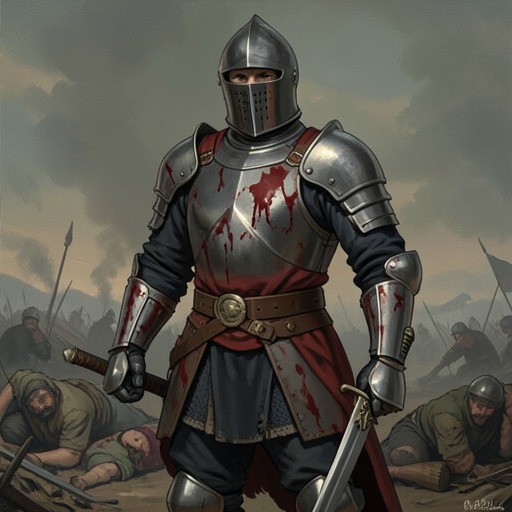
The demands of Knighthood do not remove political conflict; they establish standards by which it can be judged. When eleven kings gathered against Arthur, their alliance was sealed by an oath not to abandon one another until they had destroyed him. Their stated commitment and the force assembled—fifty thousand mounted men and ten thousand on foot—show how oaths and military followings could support resistance as readily as rightful rule. The book’s ideal of service therefore exists amid rival bonds of loyalty and organized violence. The same tension appears when Rome demands tribute. Twelve ambassadors bearing olive branches brought Emperor Lucius’s demand that Britain recognize Roman lordship and pay what the Romans claimed was customary tribute. Young knights were ready to attack the envoys, but Arthur ordered that they be protected, lodged, and treated well while he considered his answer. After his allies promised military support, he rejected the demand, denied owing tribute to any earthly prince, and claimed the right to the empire through his predecessors. He also sent the ambassadors away with gifts and an escort. The episode contrasts the knights’ impulse to answer an affront with force against Arthur’s control of violence and courteous treatment of messengers, while his rejection of Rome turns the dispute into a contest over the source of sovereignty. Before departing on the Roman campaign, Arthur arranged the government of the realm at a parliament in York. He appointed Sir Bawdwin and Sir Constantine as governors, entrusted them with the kingdom and Queen Guenever, and declared Constantine his heir should he die. His decision shows that military leadership entails responsibility for succession and administration, not simply command in battle. Yet the story also records the fracture between formal duty and personal attachment: Sir Launcelot was angry that Arthur left Sir Tristram with King Mark because of La Beale Isoud, while Guenever grieved at the departure. Knighthood’s political order is thus carried by people whose loyalties are also shaped by friendship and love. The book’s account of Knighthood finally depends on the gap between its promised service and the violence it seeks to govern. Its rituals make a warrior answerable to religious authority; its oath turns strength into a duty of protection; and its training teaches obedience before command. But rival kings, tribute demands, and the mobilization of armies show that those principles operate within a world of contested sovereignty. In Arthur’s rise, the ideal appears as both a personal vow and a public framework for just rule, one that must be continually tested against the claims of blood, allegiance, and war.