Launcelot’s faction
Le Morte d'ArthurLauncelot’s faction is the company of knights who chose Sir Launcelot amid the crisis at King Arthur’s court and followed him into exile. It began as an armed circle of supporters, expanded through additional allies, and crossed the sea as a hundred-strong following. In France, Launcelot rewarded its members with lordships and offices; at the same time, their departure made the Round Table’s division visible and left Britain exposed to further strife.
Formation in the Court Crisis
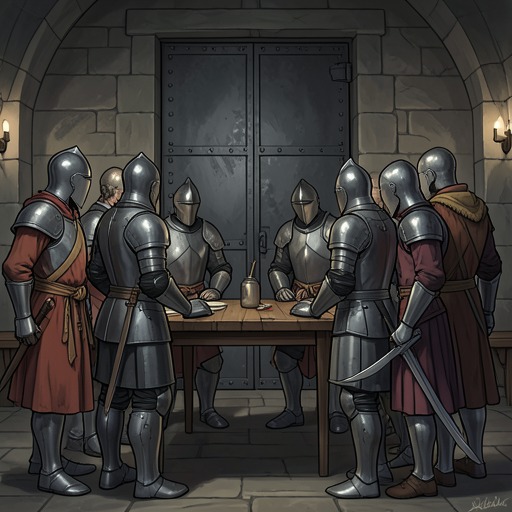
The faction took shape when Sir Launcelot summoned knights to learn which of those lodged near King Arthur would stand with him and which would become his foes. He explained that he had served King Arthur and Queen Guenever loyally, but that an attack in the queen’s chamber had convinced him that his position was no longer safe. He reported that Sir Agravaine and other knights had been sent to betray him, and feared that the king, in anger over the deaths, would condemn the queen to the fire. Launcelot therefore declared his readiness to fight for Guenever, whom he maintained was a true lady to her lord.
Sir Bors helped gather the first supporters. Twenty-two knights assembled under his call, among them Sir Lionel, Sir Ector de Maris, Sir Blamor de Ganis, Sir Bleoberis de Ganis, Sir Palamides, and Sir Safere. The group’s ties were not all of one kind: Launcelot had made two of the knights, while Sir Bellangere le Beuse was drawn to him through his mother’s kinship with Launcelot. These personal bonds helped turn a court emergency into a company prepared to act together.
The initial twenty-two were soon joined by about eighty more knights from Northgalis and Cornwall, whose allegiance was associated with Sir Lamorak and Sir Tristram. The rapid expansion changed the company from a small circle of immediate allies into a substantial armed force. Its membership reflected not simply one chain of kinship or service, but several overlapping loyalties converging around Launcelot.
Allegiance, Exile, and Collective Commitment
When Launcelot left the court, he told Queen Guenever that he must depart from the fellowship and asked her to pray for him. He also promised to return if she were in danger and a knight’s aid could deliver her. After bringing her to King Arthur, he rode away; the court mourned his departure, while Sir Gawaine stood apart from the general grief. The company’s alignment with Launcelot thus placed its members outside the court’s fellowship as well as beside him.
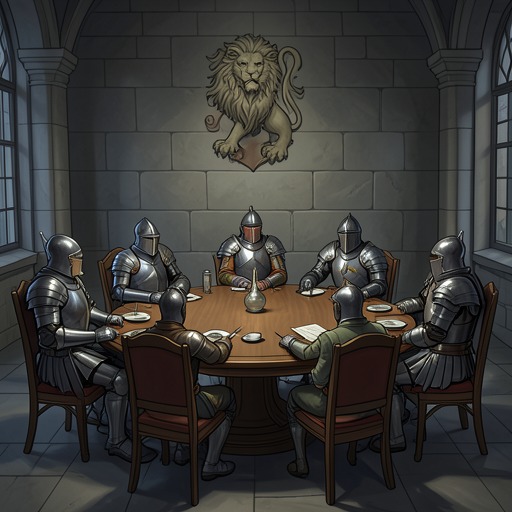
At Joyous Gard, Launcelot asked his knights what course they would take. They answered together that they would do as he did, and prominent supporters—including Sir Palamides, Sir Safere, Sir Bellangere le Beuse, Sir Urre, and Sir Lavaine—said they would not fail him, whether he stayed in Britain or went abroad. They argued that knights who had shared his distress in the realm would share his fortunes elsewhere, and that those outside his blood would no longer be welcome at court. The faction’s loyalty became an explicit collective choice to follow its leader rather than seek a separate accommodation with Arthur’s court.
Launcelot offered to divide his livelihood and lands freely among the company, keeping for himself no more than what his own person required. The knights answered that they would be ashamed to leave him. They also judged that there would be no peace in the realm: the fellowship of the Round Table was broken, and the kingdom had depended on that fellowship for quiet and rest. Their response links the faction’s solidarity to a political diagnosis: the split was not merely a private quarrel but a breach in the institution that had supported the king and the realm.
Departure and Political Settlement in France
Launcelot acknowledged that the realm’s stability had not rested on him alone, but recalled that he had helped quiet rebellions and feared that more trouble would follow. He specifically worried that Sir Mordred, whom he regarded as envious and disposed to create discord, would disturb the peace. The company then prepared to leave. A hundred knights crossed the sea with Launcelot, having vowed not to abandon him in either prosperity or hardship; they sailed from Cardiff to Benwick, a place also identified by other names in the account.
In France, Launcelot and his kin held extensive lands. He strengthened and supplied the towns and castles under his control, and the people of those territories came to him. He then called a parliament and made a series of appointments that gave his following a political structure as well as a military one. Sir Lionel was crowned king of France; Sir Bors, king of the lands formerly held by King Claudas; and Sir Ector de Maris, Launcelot’s youngest brother, king of Benwick and Guienne. Launcelot made Sir Ector prince over them, while his own land of Guienne was included in the settlement.
Launcelot also distributed duchies and earldoms among his knights. Sir Blamor received Limosin, Sir Bleoberis Poictiers, Sir Gahalantin Querne, and Sir Galihodin Sentonge; other companions were made earls of territories including Perigot, Roerge, Bearn, Comange, Arminak, and Foise. Sir Palamides was made duke of Provence, Sir Safere duke of Langedok, Sir Dinas duke of Anjou, and Sir Clarrus duke of Normandy. The account says Launcelot advanced many more knights than it names. These grants converted the company’s loyalty into rank and territorial responsibility, with Launcelot rewarding both kin and other supporters through an ordered distribution of power.
Significance in the Breakdown of the Round Table
Launcelot’s faction begins in a crisis over the queen’s safety and his own standing at court, but its consequences extend to the government of territories beyond Britain. Its members defend their allegiance as a response to exclusion and threatened conflict, then preserve that allegiance through a mass departure and a settlement under Launcelot’s authority. The transfer of a hundred knights and the creation of new rulers and lords show how a personal following can become a rival political order.
The departure also sharpens the contrast between the Round Table as a fellowship associated with peace and the factional division that follows its fracture. The knights themselves describe the fellowship as broken and the realm as unlikely to remain quiet. Launcelot’s concern about Sir Mordred gives that fear a concrete focus, while the narrative’s later account of Mordred’s assumption of kingship confirms that the danger of renewed disorder was not merely abstract. The faction’s establishment in France therefore stands both as a reward for its members and as a lasting sign of the political division that had begun at Arthur’s court.