Merlin
Le Morte d'ArthurMerlin is the magician, counsellor, and prophet whose knowledge shapes the rise of Arthur and repeatedly illuminates the fate awaiting his court. Loyal to the house of Uther Pendragon, he helps secure Arthur’s birth and kingship, warns him of dangers that lie ahead, and counsels him in affairs of war. Yet his own story turns on the limit of foresight: he predicts that Nimue will imprison him, recognizes that he cannot escape that outcome, and is left beneath a stone despite the effort of a passing knight to help him. His career joins political service, supernatural knowledge, and personal vulnerability in a figure who can interpret destiny but cannot master it.
Identity and Service
The book’s introductory account describes Merlin as distinctly drawn, “half Christian, half magician,” and marked by “dog-like loyalty” to Uther Pendragon’s house. The combination is important to his role: he is not simply an adviser who offers practical counsel, but a supernatural agent whose predictions and enchantments repeatedly influence the course of the royal story. At the same time, loyalty is his defining allegiance. His gifts serve the dynasty and its future, even when the designs he advances involve secrecy and deception.
His importance is visible in the structure of the narrative as well as in individual scenes. The book’s contents place Merlin’s counsel to Arthur before the king’s preparations for war, and later give prominent attention to Merlin’s infatuation with a Lady of the Lake and his confinement under a stone. The same character thus belongs to both the public history of Arthur’s rule and a private story of desire, captivity, and death.
Arthur’s Birth and Claim to the Crown
Merlin’s intervention in Arthur’s birth begins with Uther’s siege of the Duke of Tintagil. As the king’s desire for Igraine overwhelms him, Merlin is sought for a remedy. He agrees to help after Uther promises to grant his request, and his plan enables Uther to assume the duke’s likeness and approach Igraine while the duke is away. The episode establishes Merlin’s power as a maker of political circumstances: his craft helps bring about the union from which Arthur is born, but it also contributes to the concealment of Arthur’s parentage that the book’s opening later identifies as part of a tragic chain of consequences.
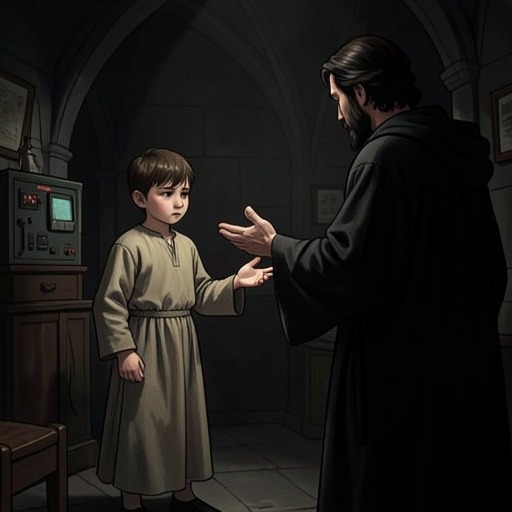
Once Igraine is to give birth, Uther confirms that he is the child’s father and explains that the encounter occurred through Merlin’s counsel. Merlin then arranges the child’s fostering. He selects Sir Ector as a trustworthy guardian, directs that the baby be delivered to him at a private postern, and specifies that the child be entrusted to Merlin before baptism. The plan is carried out: Merlin brings Arthur to Sir Ector, and Sir Ector’s wife nurses him. Merlin’s role is therefore not limited to causing the circumstances of Arthur’s conception; he also directs the secrecy and care through which the infant enters another household.
Years later, Merlin makes Arthur’s hidden parentage public at Carlion when assembled kings challenge the boy’s right to rule. He tells them that Arthur is Uther Pendragon’s son, born in wedlock to Igraine, whom Uther married after the duke’s death. He also foretells Arthur’s future dominion over England, Wales, Ireland, Scotland, and further realms. Some of the kings take the prophecy seriously; others mock Merlin or call him a witch. In either case, his declaration changes the dispute from a contest over a supposedly low-born boy into a claim grounded in royal descent and a promised future.
Merlin continues to advise Arthur as the kingdom faces threats. The chapter sequence records him counselling Arthur to send for King Ban and King Bors in preparation for war, while the introductory account describes the Round Table fellowship as helping Arthur bring order to widespread anarchy and extend his rule. Merlin is one of the narrative’s chief agents of counsel in this movement from contested kingship toward political authority, though the book’s larger account also makes clear that prosperity cannot erase the consequences set in motion at Arthur’s beginnings.
Prophecy and the Limits of Counsel
Merlin’s knowledge includes warnings about what his own service cannot avert. The introductory account presents him as having foretold that Arthur’s incestuous union with an unknown sister would produce Mordred, who would destroy the king and the knights of his realm. Arthur tries to prevent the prophecy’s fulfilment through a cruel act, but the attempt fails. Merlin’s prophetic authority thus gives the story a sense of destiny without making him an all-powerful controller of events: he can disclose a danger, but disclosure does not guarantee that it can be escaped.
His warning about the future also extends to Arthur’s marriage and to dangers within the royal household. The contents identify Merlin as warning Arthur of Guenever, while his later counsel urges the king to guard both his sword and its scabbard because a woman he trusts will steal them. The warning gives Arthur advance knowledge of a coming loss, but not a means to prevent it. As with Merlin’s prediction of his own confinement, foreknowledge marks the approach of an event rather than cancelling it.
The Grail tradition offers another measure of Merlin’s place in the book’s spiritual world. The introductory discussion explains that the Grail story came to be interpreted in Christian terms: as the dish of the Last Supper, the vessel in which Joseph of Arimathea received Christ’s blood, or the sacramental cup. It also notes that Merlin’s romance recounts the vessel coming to Joseph while he was imprisoned, as a comfort. In the plot, Merlin connects Arthurian history to this sacred history through his account of the Grail and the spear that wounded Christ. He tells Balin that King Pellam’s long-lasting wound can only be healed by Galahad during the Grail quest, and that the Dolorous Stroke has brought destruction upon three countries. His explanation joins a knight’s immediate misfortune to a much larger religious and political consequence.
Nimue and Merlin’s Confinement
After the quests of Gawaine, Tor, and King Pellinore, Merlin becomes infatuated with Nimue, one of the damsels of the lake whom Pellinore has brought to court. He persistently seeks her company; she treats him well while learning the knowledge she wants from him. Even as he tells Arthur that he will not endure much longer, Merlin recognizes that his own end is approaching. He predicts that he will be buried alive beneath the earth and again warns Arthur about the theft of the sword and scabbard. When Arthur asks him to use his craft to prevent the misfortune, Merlin says it cannot be done.
Merlin accompanies Nimue on her travels, including a visit to Benwick, where he speaks with Elaine, the wife of King Ban, and sees the young Launcelot. He comforts Elaine over the war against King Claudas by prophesying that her son will one day avenge her and become the most renowned knight in the world. He identifies Galahad as the child’s first name and explains that Launcelot is the name given after confirmation. The episode shows Merlin’s prophetic attention passing beyond Arthur’s immediate court: he reads the future of another royal household and gives Elaine hope through the promised career of her son.
His attachment to Nimue, however, becomes an increasingly private and damaging bond. The narrative says that she grows weary of his persistent attention and fears him because of his demonic parentage; she wants to be free of him. When Merlin tries to use his subtle arts to take her away, Nimue makes him swear that he will not enchant her if he wants her favour. He swears, and the pair continue together. His affection and his knowledge do not protect him: instead, his teaching gives Nimue the means to act against him.
Merlin shows Nimue a marvel in a rock beneath a great stone. She induces him to go under the stone to explain its wonders, then uses her craft to keep him there. He cannot escape by his own power, and Nimue leaves him. The episode completes a reversal built into his earlier prophecy: the man who had arranged Arthur’s hidden upbringing and interpreted the fates of kings is himself overcome by knowledge imparted to someone else.
A later adventure confirms that Merlin remains trapped. Sir Bagdemagus, riding in search of honour after leaving Arthur’s court, encounters the rock and hears Merlin lamenting beneath the stone. Bagdemagus tries to help, but the stone is so heavy that a hundred men could not lift it. Merlin tells him not to labour in vain: only the woman who put him there can release him. Bagdemagus departs, and Merlin’s confinement continues. The scene gives his prediction a concrete, public consequence while emphasizing the helplessness that has replaced his former command of events.
Narrative Role and Significance
Merlin’s story is shaped by a contrast between the breadth of his knowledge and the narrowness of his control. He can foresee the ruin tied to Arthur’s birth, identify the lineage on which Arthur’s claim depends, and interpret the spiritual stakes of the Grail and the Dolorous Stroke. Yet the same narrative shows him unable to undo the destiny he predicts, prevent the loss of Arthur’s scabbard, or escape the trap laid by Nimue. Prophecy makes the future legible, not obedient.
His career also binds together two kinds of plot. In the royal narrative, Merlin’s counsel makes a concealed heir possible, gives Arthur’s rule a public foundation, and supports the king’s response to military danger. In the personal narrative, the adviser who has served the royal house becomes captive to his own attachment and to the arts he has taught. That reversal does not erase his earlier loyalty or usefulness; it makes them part of a wider tragic design in which service and foresight cannot secure mastery over every consequence. Merlin’s disappearance therefore marks both the loss of Arthur’s counsellor and a warning that even extraordinary knowledge has limits.