Round Table
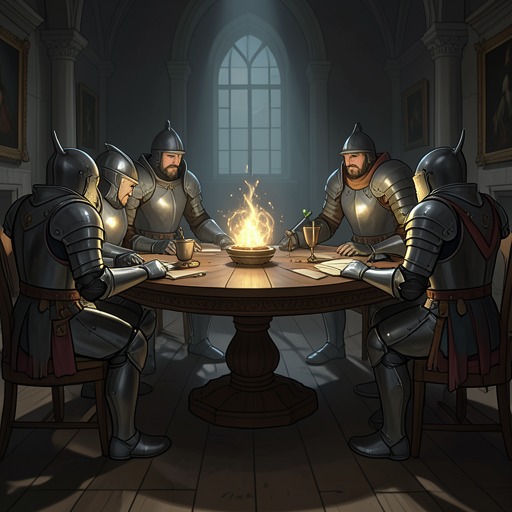
Le Morte d'ArthurThe Round Table is both the fellowship of knights gathered around Arthur and a public expression of the order he seeks to establish. Founded at his marriage to Guenever, formally blessed, and renewed through an annual oath, it binds knightly prowess to obligations of justice, restraint, and aid. Its authority is tested by the realm’s rebellions and by challenges to Arthur’s sovereignty, while its fellowship gives the king a means to assemble allies and knights in support of his rule.
Institution and Foundation
At his wedding to Guenever, daughter of Leodegrance, king of Cameliard, Arthur received the Round Table. The account presents the marriage and the table together: a dynastic alliance and a fellowship that gives the court a collective structure. The next chapter records the knights’ appointment and the blessing of their seats by the bishop of Canterbury, placing the fellowship under ecclesiastical sanction as well as royal authority.
The book’s prefatory discussion also treats the table as a material relic associated with Arthur. It notes Caxton’s reference to a Round Table at Winchester, described as an oak board bearing the knights’ names. The surviving object and the literary institution are not identical kinds of evidence, but their association shows how the Round Table could function both as a remembered artifact and as the emblem of Arthur’s court.
Oath and Code
The fellowship’s moral obligations are set out after the quests associated with the white hart, the brachet, and the abducted lady. Arthur establishes his knights and provides lands to those who lack them, then charges them not to commit outrage or murder, to flee treason, and not to be cruel. They must grant mercy to anyone who asks it, aid ladies and gentlewomen on pain of death, and refuse to fight in a wrongful quarrel for either legal pretext or worldly gain. The knights of the Round Table, old and young alike, swear to these terms.
The oath is not a one-time founding ceremony: the knights renew it each year at the high feast of Pentecost. That recurrence makes the fellowship a continuing discipline, not merely a rank or a title. Arthur’s grant of lands and his demands for service also place generosity and obligation side by side: material support helps sustain the knights, while the oath sets limits on how they may use their power.
Fellowship in Practice
The Round Table serves as a body of allies in moments when Arthur’s authority is challenged. When eleven kings gather against him, the account introduces the three kings who arrive at Bedegraine and find a well-provided fellowship there. The episode sets their coalition, pledged to destroy Arthur, against the hospitality and unity of his company. The table’s political significance lies not only in the knights’ individual prowess, but in their capacity to form a fellowship around the king.
That collective role is also visible when Rome demands tribute. At a royal feast attended by allied kings, princes, and knights of the Round Table, twelve aged ambassadors deliver the emperor’s demand that Arthur recognize Roman overlordship and pay the tribute claimed for Britain. Arthur protects the messengers from the young knights who would attack them, then consults his lords. His allies pledge military support; he rejects the claim and asserts his right to sovereignty. The Round Table thus appears in a setting of counsel and alliance as well as combat: the fellowship helps make the king’s decision a shared political undertaking.
Strain and Significance
The ideal embodied by the Round Table is measured against the conduct of its members and the pressures on Arthur’s kingship. Its annual oath names the wrongs the knights must avoid—murder, treason, cruelty, and unjust conflict—while the narrative repeatedly places the fellowship amid armed opposition and disputes over lawful authority. The table’s code therefore does not describe a world in which violence has disappeared; it defines standards meant to govern a world where knights wield force and kings must secure allegiance.
The contrast becomes especially sharp when Mordred presumes to take the throne of England and seeks to marry the queen, his uncle’s wife. The chapter heading presents this act as a challenge to both the king and the bonds of kinship on which the court depends. Against that act of usurpation, the Round Table’s founding promise—service under Arthur and a shared code of conduct—stands as an ideal of ordered fellowship, even as the political world around it is threatened by divided loyalties.