Salisbury
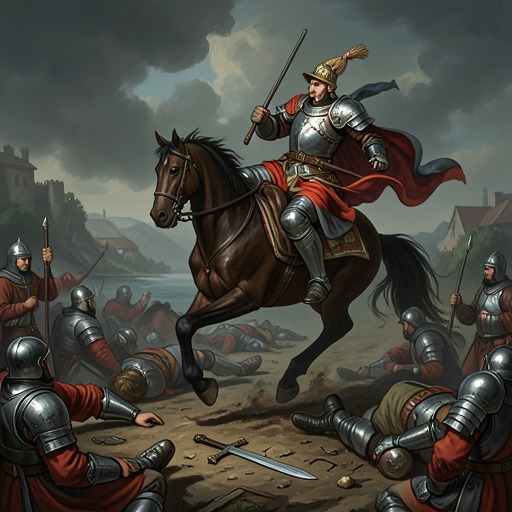
Le Morte d'ArthurSalisbury is associated above all with a prophecy of civil war: Merlin tells King Arthur that a great battle will take place beside the city, with Mordred fighting against him. Its importance lies less in a detailed description of the place than in its role as a fixed point in the story’s foreknowledge of the kingdom’s destruction.
Prophecy and the Coming Conflict
Merlin’s warning comes amid revelations about threats to Arthur’s rule. He has already explained Morgan le Fay’s treachery involving Excalibur’s protective scabbard and Accolon, and he then predicts the battle near Salisbury, naming Mordred as Arthur’s opponent. Salisbury thus enters the narrative as the setting attached to a future crisis: the prophecy identifies both the coming conflict and the family relationship at its center, before that conflict occurs.
A Place Within the Arthurian Political World
The text gives no account here of Salisbury’s geography, inhabitants, or political administration. Instead, the city functions as a marker in Merlin’s forecast, linking the fate of Arthur’s kingship to a particular place. The prediction gains force from its contrast with the order Arthur attempts to establish elsewhere: after his recognition as king, he restores lands taken during the disorder following Uther’s death and imposes obligations of justice and mercy on the Round Table knights. The prophecy points toward a later conflict that will test that restored political order.
Connection to the Final War
The later narrative describes Mordred presuming to take the kingship of England and seeking to marry Guinevere, his uncle’s wife. Arthur receives news of Mordred’s actions and returns, meeting him at Dover, where Mordred tries to prevent his landing; Gawaine dies in the encounter. The account then recalls Merlin’s warning that Arthur should not fight on that day. These events develop the larger conflict anticipated by the Salisbury prophecy, although the cited passages do not themselves narrate a battle at Salisbury. The city’s narrative significance is therefore prophetic and anticipatory: it names the place where the struggle between Arthur and Mordred is foretold, while the account of their eventual confrontation is situated elsewhere.