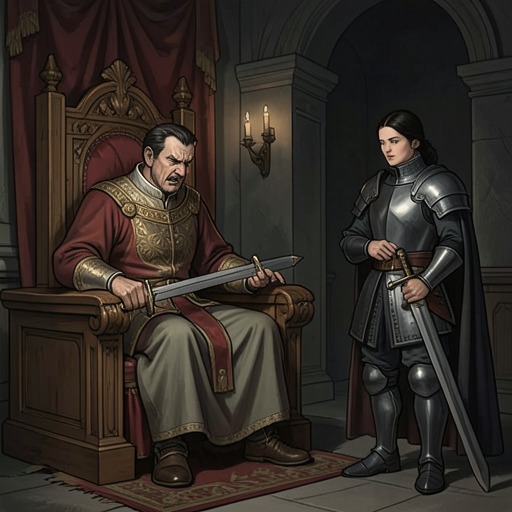
Sir Bleoberis de Ganis
Le Morte d'ArthurSir Bleoberis de Ganis is a celebrated knight of the Round Table, brother of Sir Blamor de Ganis and cousin to Sir Launcelot. His encounters with Sir Tristram bring together courtly claims, personal reputation, and family loyalties: Bleoberis fights to keep a lady he has taken from King Mark’s court, later makes her choice the condition of peace, and eventually joins Tristram in sparing his brother from death or public disgrace. His record also places him in the great tournaments and wandering encounters of the romance, where prowess, courtesy, and allegiance repeatedly prove difficult to separate.
Identity and Kinship
Bleoberis enters the narrative as a knight of considerable renown, identified as the brother of Sir Blamor and a near kinsman of Sir Launcelot. When he names his family to Tristram, he says that he and Blamor are Launcelot’s sister’s children. That relationship gives a personal dimension to encounters that might otherwise be only contests between famous knights: Tristram respects Launcelot so deeply that he is reluctant to continue fighting Bleoberis once their connection is known.
His reputation is not confined to his kinship. At King Mark’s court, the king grants Bleoberis a boon because he is a Round Table knight of great renown. Later, Tristram recognizes him as a noble knight, while the court’s tournament reports distinguish his accomplishments from those of Tristram and Launcelot. Bleoberis therefore occupies a position of acknowledged standing, though the narrative also subjects that standing to tests of judgment and conduct.
The Lady Taken from King Mark’s Court
Bleoberis uses the boon granted by King Mark to claim the fairest lady in the court. He chooses the wife of Sir Segwarides, takes her away, and has her ride behind his squire. The choice provokes anger in the court. When Segwarides hears what has happened, he arms and rides after them to recover his wife; Bleoberis defeats and wounds him, leaving him in grave danger.
Tristram initially refuses to intervene while Segwarides himself is present, reasoning that the husband should act for his own wife. But when news reaches the court that Segwarides has been badly overcome, a lady rebukes Tristram for allowing a woman to be taken away. Tristram then rides after Bleoberis. The sequence makes the dispute more than an exchange of blows: it concerns whether Tristram should act as champion when the lady’s husband has already undertaken her rescue, and whether Bleoberis’s granted boon can justify taking a married woman from the court.
Tristram overtakes Bleoberis and demands that he return the lady or deliver her to him. Bleoberis refuses and says he fears no Cornish knight. Tristram answers by reporting that he has already defeated Sir Sagramore and Sir Dodinas, two knights of Arthur’s court. Bleoberis acknowledges their quality but still insists that Tristram must defeat him before taking the lady. The two fight first on horseback, each bringing the other down, and then continue on foot with swords for more than two hours.
During a pause, Bleoberis asks Tristram’s name and lineage. Tristram identifies himself as the son of King Meliodas, the son of King Mark’s sister, and King Mark’s nephew. Bleoberis then discloses that he is Sir Bleoberis de Ganis, brother of Sir Blamor and a kinsman of Launcelot. Tristram says that, for Launcelot’s sake, he does not wish to fight Bleoberis further; Bleoberis likewise says he is reluctant to continue. Instead of letting either man decide the lady’s fate by force, Bleoberis proposes that she stand between them and go in peace with whichever knight she chooses. Tristram accepts, expecting that she will choose him. The next chapter’s title establishes the reversal: she rejects Tristram and remains with Bleoberis, but then expresses a wish to return to her husband. The resolution thus separates her decision about the knights from the question of her marriage.
Conflict, Reputation, and Courtesy
Bleoberis’s reputation follows him into tournament and quest episodes, where his skill remains conspicuous even when his motives or conduct are disputed. At a tournament where Tristram rides with a plain black shield, Bleoberis fights on the side opposing him. He and Sir Gaheris are among those whose deeds impress Tristram; after Tristram sees Sir Persides knocked down and nearly killed amid the fighting, he unhorses Gaheris and then Bleoberis. The judges award Tristram the prize without identifying him, naming him instead as the knight with the black shield. Bleoberis is therefore both a formidable presence in the field and one of the opponents whose defeat makes Tristram’s anonymous success possible.
A later encounter complicates the pattern of rivalry. Sir Palamides has been unhorsed by Bleoberis and demands a foot fight with the knight who struck him down. Bleoberis identifies himself and stands ready to answer. Before the challenge develops further, Palamides speaks of Sir Lamorak, praising him as the best knight of his age and recalling that Lamorak once defeated him and thirty other knights at a tournament. Palamides also relates Lamorak’s subsequent death at the hands of Sir Gawaine and his brothers. The episode places Bleoberis among a wider network of contests and kinship disputes: a challenge to him opens onto the death of Lamorak and the grief of Lamorak’s brother, Sir Percivale.
Bleoberis also pursues Breuse Saunce Pité, whom he accuses of betraying ladies and destroying good knights, especially knights of Arthur’s company. After Palamides falls to Bleoberis, Bleoberis turns on Breuse and calls him to account. Breuse flees, then seeks protection from Sir Ector de Maris, Sir Percivale, and Sir Harry le Fise Lake by presenting Bleoberis as the villain. Bleoberis continues after him, but the other knights intervene. Ector, Percivale, and Harry all fall in their separate encounters with Bleoberis; Harry then prevents Breuse from striking Bleoberis while Bleoberis is down, insisting that a knight must not attack a fallen opponent. Breuse escapes during the confusion. When the knights learn one another’s identities, Ector recognizes Bleoberis as his cousin, and the group regrets that Breuse has got away. The episode sets Bleoberis’s pursuit of a man he considers treacherous beside the danger of mistaken judgment: the pursuit itself turns him into the apparent threat to those who have heard only Breuse’s account.
Mercy and the Settlement with Sir Blamor
In another contest, Bleoberis’s brother Sir Blamor is defeated by Tristram and refuses to utter the humiliating word that would concede the field. Blamor asks Tristram to kill him rather than let him live in shame. Tristram is caught between the rules of the contest and his reluctance to kill a worthy knight who is related to Bleoberis and connected to Launcelot.
Tristram appeals to the kings judging the matter, asking them, for their own honor and for that of King Arthur and Launcelot, to take the decision into their hands. He argues that it would be a shame and a pity for Blamor to die, and asks King Anguish, for whom Tristram is fighting, to show mercy. Anguish agrees to be guided by him. The judges consult Bleoberis, who acknowledges that his brother has lost through force of arms but has not lost heart or been shamed. He is willing, rather than see Blamor shamed, to let Tristram kill him; the judges refuse to make that the outcome, recognizing the pity shown by both the king and champion.
The kings instead arrange a settlement. Blamor and Tristram are raised up; the brothers are reconciled with King Anguish, and Bleoberis and Tristram make peace. The two brothers swear that neither will fight Tristram, and Tristram makes the same oath. The narrative says that, because of this courteous battle, all of Launcelot’s kin love Tristram thereafter. Bleoberis’s significance here lies not simply in his family connection but in his part in converting a contest that might have ended in death or disgrace into a durable agreement between the opposing sides.
Later Encounters and Narrative Role
Bleoberis appears again in the account of the great tournament, where he and Sir Ector report to Queen Guenever on the beauty and qualities of La Beale Isoud. After seven nights, Bleoberis and Ector leave Tristram and the queen; they have received gifts, while Sir Gareth and Sir Dinadan remain with Tristram. When Bleoberis and Ector reach Guenever, she asks where they have been and how Tristram and Isoud fare. They praise Isoud’s beauty, bounty, cheerfulness, and goodness, and Guenever answers that others who have seen her say the same. They also report the tournament’s results: Palamides wins the degree on the first day, Tristram on the second, and Launcelot on the third. Asked who did best overall, they say that Launcelot and Tristram suffered the least dishonor; Palamides’s change of side cost him much of his worship. Through this report, Bleoberis serves as a witness and evaluator of the competition, carrying its judgments from the tournament to the queen’s court.
Across these episodes, Bleoberis is neither reduced to a single rivalry nor insulated by his prestige. His closeness to Launcelot shapes Tristram’s restraint; his seizure of Segwarides’s wife sets in motion a contest that ends by restoring her choice to her; his defense of Blamor helps turn an ordeal of honor into reconciliation; and his tournament and quest encounters keep his prowess visible within the wider company of Round Table knights. The recurring tension is between the public language of chivalric reputation and the decisions that give it substance: a knight may be renowned, yet still be judged by how he treats a lady, a fallen opponent, or a defeated kinsman.