Sir Bors
Le Morte d'ArthurSir Bors is one of the principal knights of the Round Table and a figure through whom the Arthurian narrative joins martial fellowship to spiritual trial. He appears as a warrior, envoy, rescuer, and companion, but his decisive significance comes in the Holy Grail story: unlike the knights who cannot withstand its tests, he completes the quest with imperfection acknowledged and forgiveness granted, then returns to help restore the court’s feasts and tournaments.
Identity and Place in the Fellowship
William Caxton’s account places Sir Bors among the knights whose deeds and adventures form the broad history of Arthur’s reign. In the book’s contents, he appears in accounts of Sir Launcelot and Sir Lionel, in the Grail material, and in a later book specifically devoted to Sir Bors and Sir Lionel. This distribution makes him more than a participant in a single episode: his story crosses the courtly, military, and spiritual parts of the larger narrative.
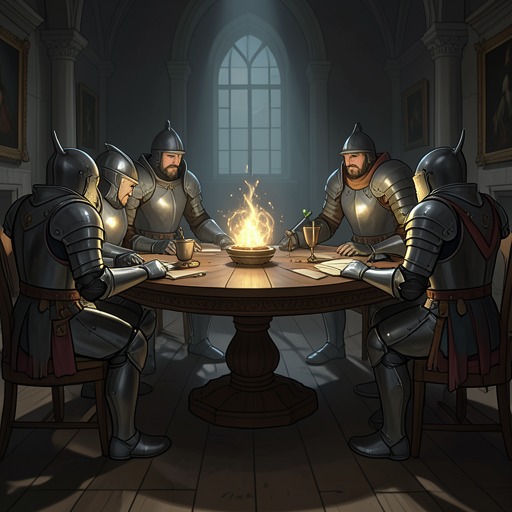
The literary account of the whole story identifies Sir Bors as one of the leading members of the Round Table fellowship, alongside Sir Launcelot, Ector de Maris, and Sir Gawaine. Their reputation and confidence have been earned in the field of worldly chivalry, yet the Grail brings tests of a different kind. The contrast marks the limit of the fellowship’s ordinary measures of prowess: even its chief knights cannot assume that success in arms will prepare them for spiritual judgment.
Service to Arthur and the Round Table
Sir Bors is among the knights who stand with King Arthur during the campaigns that establish and defend the realm. In the account of the gathering against Arthur, the assembled kings and their forces threaten the order his fellowship is building. The broader narrative describes Arthur and the Round Table as transforming widespread disorder into a kingdom extending across England, Wales, and Scotland; Bors belongs to the fellowship through which that political and chivalric order is maintained.
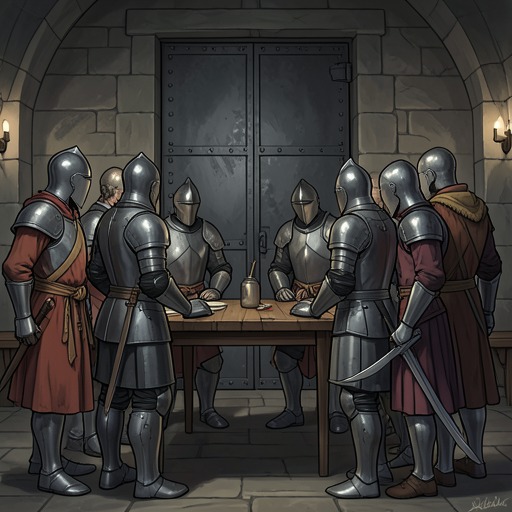
When Arthur resolves to answer the Roman demand for tribute with war, he sends Sir Bors with Sir Gawaine, Sir Lionel, and Sir Bedivere to deliver a warning to the Roman emperor, Lucius. The four reach Lucius’s camp and present Arthur’s demand that the Romans leave his lands or prepare for battle. The audience becomes a clash: Sir Gawaine kills a Roman knight after an insult, and the messengers withdraw toward their hidden companions as the Roman forces pursue them.
The encounter turns into a fighting retreat. When Bors sees a Roman knight advancing, he strikes him with a spear; he then kills Caliburn, a strong fighter from Pavia, after Caliburn has brought down many of Arthur’s men. As the Romans gather reinforcements and the fighting renews, Bors and Sir Berel are captured. Sir Gawaine pursues their captors and recovers Bors, while Sir Idrus rescues Berel. The British knights eventually drive the Romans back, and Arthur’s army suffers no loss of a knight of standing, although Gawaine is badly wounded. Bors’s mission thus becomes both diplomatic and martial: the warning is delivered, but the party’s survival depends on fighting together and recovering its captured companions.
Kinship, Court, and Companionship
Bors’s appearances repeatedly place him within relationships that organize the Round Table’s obligations. He is sent on the Roman embassy with Sir Lionel, identified in the narrative as his brother, and later appears with Lionel in the book’s account of their dealings with King Brandegoris. Caxton’s contents also associate Bors with the later story of the brothers, giving their kinship a distinct place in the narrative rather than treating them simply as two knights among many.
His connection to King Arthur’s household is apparent in the court’s larger family history. Merlin arranges for Arthur, still an infant, to be delivered to Sir Ector for fostering, and the grown Arthur later discovers that Ector is not his father but the man whose household raised him. Sir Bors’s own story does not depend on that concealed parentage, but the episode establishes the kind of bonds that shape the court: sworn service, fosterage, and kinship all create claims of loyalty. Bors’s actions in Arthur’s service belong to this fellowship of obligation.
At the feast of Pentecost, the Queen of Orkney arrives after fifteen years away. Sir Gawaine, Sir Agravaine, and Gaheris kneel to ask her blessing; Bors is not named among them. The scene nevertheless places his courtly world within the Round Table’s familial tensions, where royal kin return to the feast and questions of recognition, honor, and belonging are spoken openly. His own more direct service to the court is shown in the Roman embassy, where the king trusts him to carry a consequential message alongside Gawaine, Lionel, and Bedivere.
The Grail Quest and Spiritual Change
The Grail quest changes the standards by which the knights’ worth is measured. The book’s contents place Bors at the threshold of Galahad’s story: he comes to Dame Elaine, sees Galahad, and learns that the child is fed with the Holy Grail. This encounter connects Bors to the sacred history that will test the Round Table, rather than leaving him solely within the cycle of courtly adventures and battles.
In the account of the quest’s outcome, the contrast between earthly knighthood and spiritual readiness becomes decisive. The knights enter the quest with the self-reliance that had served them well in worldly chivalry, but it cannot carry them through the new trials. Sir Launcelot, Ector de Maris, Gawaine, and other leading members of the fellowship fail to stand those tests. The quest is achieved by the holy knights alone; two leave this life for a higher one, while Bors returns. His place among the quest’s survivors makes his story a passage between two forms of the Arthurian world, not a simple continuation of tournament and battle.
Bors is not described as entirely without fault. The account instead stresses that he is forgiven and sanctified. That qualification matters: his spiritual success does not erase the difference between him and the wholly holy knights, but neither does imperfection exclude him from grace. He becomes the link between the earthly and spiritual worlds precisely because he returns bearing both the memory of the courtly fellowship and the consequences of its religious trial.
Return and Narrative Significance
After the quest, Bors returns to help restore the glory of feasts and tournaments at Camelot and Westminster. The return offers a renewal of the Round Table’s public life, but not a full restoration of its earlier confidence. The Grail has exposed a division between good and evil that cannot be closed again, and the larger story continues toward tragedy despite the efforts of Arthur and Sir Launcelot to avert it.
The final image of the account moves from that courtly world toward departure and penitence: Arthur travels in a barge toward the Holy Isle, Guenever lives at Almesbury in fasting, prayers, and charitable works, and Launcelot and his fellowship, once knights, become hermit-priests performing humble service. Bors’s return stands in contrast to these departures. He is the surviving mediator who can re-enter the court’s public fellowship after encountering its spiritual limits. His role gives the Grail episode a consequence beyond the quest itself: the sacred ordeal does not merely sort the knights into victors and failures; it alters the meaning of the fellowship to which Bors returns.