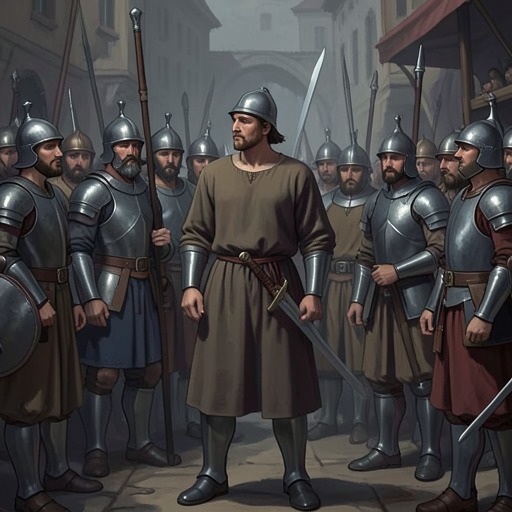
Sir Dagonet
Le Morte d'ArthurSir Dagonet is King Arthur’s fool and also a knight whom Arthur made with his own hands, a comic court figure whose appearances bring the rituals of chivalry into contact with ridicule, mistaken expectations, and genuine peril. Malory’s humour repeatedly draws on the pranks played on Dagonet, but the episodes do not reduce him to a harmless joke: he rides into confrontations armed, can be defeated or endangered, and sometimes becomes the instrument through which other knights’ pretensions are exposed.
Identity and Place at Court
Dagonet belongs to the king’s household as its fool, yet his knighthood gives him a place within the same martial world as the Round Table knights. Arthur is said to love him greatly and to have knighted him personally. At tournaments, Dagonet could make Arthur laugh, a courtly function that sits beside, rather than cancels, his status as an armed participant in knightly affairs. His role therefore moves between service as comic entertainment and involvement in the public tests of courage and reputation.
Malory’s account of humour in the romance specifically points to the pranks played on Dagonet, along with those played on Dinadan, as examples of the narrative’s comic vein. Dagonet’s episodes show how that humour works: other knights arrange an encounter for him, onlookers laugh at the result, and a supposed joke may quickly turn into danger. The comedy arises from the gap between the role others assign him and the seriousness of the encounters into which they send him.
The La Cote Male Taile Episode
When La Cote Male Taile first rides out on a quest, Sir Kay arranges for Dagonet to follow him, mounted and armed, and tell him to prepare for a joust. Dagonet is acting on Kay’s instructions; he is not simply an accidental passer-by. La Cote Male Taile knocks him over his horse’s croup, and the watching damsel uses the encounter to shame the young knight, saying that Arthur’s court has sent a fool to meet him at his first joust. The episode makes Dagonet the means by which another knight’s standing is publicly tested, even as the joke falls most directly upon him.
Dagonet’s defeat is part of a broader sequence in which La Cote Male Taile is repeatedly unhorsed by more accomplished knights. Sir Bleoberis and Sir Palamides each throw him down; when he explains himself to the damsel, he argues that falling to such knights does not make him a worse knight, especially since neither fought him on foot. Dagonet’s initial defeat thus helps establish the contrast between a courtly prank and the increasingly serious tests of prowess that follow. The encounter is not evidence that Dagonet is himself a formidable jouster; it shows instead how readily the court can turn him into a prop in another knight’s trial of honour.
King Mark and the Forest Well
During another episode, Dagonet rides through a forest in Cornwall with two squires and stops at a well to drink. While the riders are occupied, their horses break loose. The naked Sir Tristram, then living apart in the forest, comes upon them and plunges Dagonet into the well, followed by the squires. He retrieves the horses one at a time and sends the men on their way while they are still wet. The incident is comic in its abrupt reversal: Dagonet arrives as a king’s fool among companions, but Tristram briefly controls the encounter and makes him the object of a practical joke.
Dagonet’s report later turns the joke into a warning. After he and his squires have returned to their horses, he mistakes the shepherds’ laughter for evidence that they arranged the humiliation, and beats them. Tristram sees the men who had regularly given him food and drink being struck; he seizes Dagonet, throws him to the ground, takes his sword, and kills one of the squires. The remaining squire flees. The escalation is consequential: Dagonet’s retaliation against the shepherds draws Tristram back into the open, and the fool leaves the forest after an encounter that has become deadly rather than merely comic.
Dagonet subsequently tells King Mark what happened and warns him against approaching the well, describing the naked man there as a fool. Mark misidentifies the figure as Sir Matto le Breune, a knight who had lost his wits after Sir Gaheris defeated him and won his lady. The error connects Dagonet’s account to a larger pattern of mistaken identities and damaged reputations: Mark interprets Tristram’s forest life through a different knight’s story, while Dagonet’s own status as a fool shapes how his report is received.
The Disguise and Its Reversal
In a later comic pursuit, Dinadan tells King Mark that Sir Launcelot is among the knights in a fellowship, although Launcelot is not there. Dinadan identifies a shield for Mark to fear, and then gives a different account of the supposed knight’s shield to the others. Sir Mordred, who is hurt and cannot properly bear his own armour, proposes that Dagonet wear his harness and shield and charge Mark. Dagonet accepts the part, is armed in Mordred’s equipment, mounted on a large horse, and given a spear.
When Dagonet rides at him crying that he will kill him, Mark sees Mordred’s shield and takes the approaching rider for Launcelot. He flees through the forest, while Dagonet follows, shouting after him. Sir Uwaine and Sir Brandiles laugh at the spectacle and ride after them to see how it ends, careful that Dagonet should not be hurt. The scene’s comedy depends on several layers of mistaken recognition: Dagonet plays a role chosen for him, Mark interprets the shield as proof of a feared opponent, and the watching knights know that the apparent threat is their fool in borrowed armour.
The laughter does not make Dagonet disposable. The knights explicitly do not want him harmed, and the narrator recalls both Arthur’s affection for him and the king’s personal act of knighting him. His courtly place is thus marked by a double regard: he is an object of amusement, but also someone valued and protected by the fellowship. The contrast gives the prank its limit as well as its comic force.
Narrative Role
Dagonet’s episodes repeatedly unsettle the easy division between fool and knight. Others exploit the mismatch for amusement: Kay sends him to challenge La Cote Male Taile, and Mordred’s armour turns him into a false likeness of Launcelot. But the consequences are not uniformly light. In Cornwall, the encounter at the well is followed by violence against the shepherds and the death of a squire; in the pursuit of Mark, the other knights laugh while also taking care that Dagonet remains safe.
The character’s narrative function is therefore more than comic interruption. By placing the fool inside jousts, armed disguises, and the rougher business of knightly travel, the romance makes reputation visibly unstable: a shield can make Mark flee from a man who is not Launcelot, and a court’s joke can send Dagonet into an encounter with real consequences. Dagonet remains a recurring measure of the court’s humour, but his knighthood and Arthur’s affection keep that humour attached to the obligations and risks of the world he inhabits.