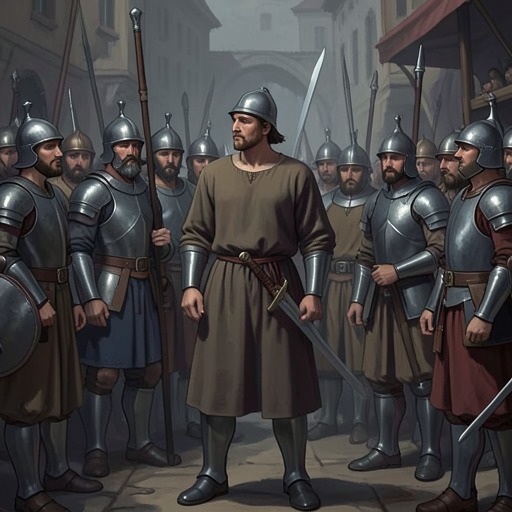
Sir Dinadan
Le Morte d'ArthurSir Dinadan is a Round Table knight distinguished by wit, limited bodily strength, and a loyalty that repeatedly draws him into perilous company. He mocks the ideals and bravado of chivalry even as he takes hard knocks in its service. Across the episodes preserved in Malory’s narrative, his humor is not an escape from fellowship but one of its most recognizable forms: Dinadan teases good knights, assists them, and is valued by them in return.
Identity and Character
A literary account of the knights describes Dinadan as able to give and receive hard blows despite having no great bodily strength. His characteristic response to the martial and romantic codes surrounding him is banter: he makes humorous protests against love and arms, and good knights who know him esteem him. This makes him distinct from the fiercer Sir Gawaine and from the courageous Saracen Sir Palamides, whose skill lacks, in a different way, the gentleness and delicate sense of honor associated with the Christian knight.
The episodes give that description a practical shape. Dinadan may argue against a dangerous undertaking, complain of the cost of fighting, or tease a companion into action; yet he is not simply a cowardly jester. He rides into conflict, overthrows opponents, and risks himself for fellow knights. His comedy keeps the language of chivalry from becoming solemn or self-congratulatory, while his deeds show that skepticism about the code does not necessarily mean disloyalty to the people bound by it.
Fellowship with Sir Tristram
Dinadan’s association with Sir Tristram repeatedly puts this contrast under pressure. When Tristram is preparing to leave by ship, Dinadan seeks him out and challenges him to joust. Tristram unhorses him, but Dinadan then asks to join his company. Tristram welcomes him, and the two ride together to their ships. Dinadan’s challenge is thus followed not by resentment but by fellowship: defeat becomes the prelude to shared travel.
That companionship becomes more dangerous when a damsel brings news of a plot against Sir Launcelot involving thirty knights. Tristram immediately offers to go to the place, while Dinadan protests that the odds are unreasonable. He says he will not take on fifteen knights, and asks to borrow Tristram’s Cornish shield, reasoning that its reputation may cause opponents to spare him. The exchange makes Dinadan’s self-preserving humor explicit, but it does not end his participation. He goes with Tristram, and the two take part in the confrontation; Dinadan is wounded in the encounter.
Afterward, when Tristram is badly bruised and Sir Palamides approaches, Dinadan warns him that he is in no condition to fight. He offers to ride against Palamides himself, giving Tristram time to withdraw. The scene reverses the apparent meaning of his earlier reluctance: Dinadan’s caution has not made him indifferent to danger, and he is prepared to face it when doing so may protect his companion. Elsewhere, after Tristram has left him too weary and bruised to ride, Dinadan remains behind at a priory while Tristram continues on. His usefulness and his limits are both plainly shown.
Dinadan also acts as a social bridge among knights who are rivals. He encounters Palamides, who explains that although he and Tristram had not been inwardly friendly, Tristram once rescued him from death; the two had also agreed to meet in battle at Merlin’s stone near Camelot, but Palamides could not keep the appointment because he was imprisoned. Dinadan hears the explanation and helps keep the history of the missed meeting in circulation. In another episode, he recognizes Palamides from the signs described to him, approaches him, and the two greet one another with joy. Their cordial reunion shows Dinadan moving easily through a fellowship marked by shifting rivalries, rescues, and obligations.
A Knight Among Knights
Dinadan’s humor is also a measure of his attachment to the company he mocks. In one tournament episode, he overthrows four knights and performs well in arms. Sir Launcelot nevertheless knocks him down when ordered to bring him before the queen and the high prince. The narrative calls Dinadan a scoffer and jester, but also the merriest knight in the fellowship, and stresses that he loves every good knight and is loved by them in return. His popularity is not a reward for unbroken martial superiority; it rests on affection, humor, and a recognizable willingness to join the shared business of knighthood.
The same combination appears in his dealings with Sir Launcelot. When Launcelot is angered by a letter from King Mark, Dinadan takes it from his hand while he sleeps and reads it. He then asks Launcelot to disclose the reason for his anger, presenting himself as a poor knight who nevertheless bears goodwill toward Launcelot and all worthy knights. Launcelot accepts him as trustworthy and explains his counsel. Dinadan advises him not to take Mark’s threats seriously and proposes answering them with a lay about the king. Here his weapon is not the lance but comic composition: he responds to political hostility by turning it into material for ridicule.
The lay about King Mark recurs in Dinadan’s reputation. Tristram identifies him to La Beale Isoud as the maker of the song and praises him as both the best joker and jester and a noble knight of his hands, adding that good knights value his fellowship. The episode joins the literary and social dimensions of his character: Dinadan can make a song out of a king’s conduct, but his place among the knights is secured by more than mockery.
Courage, Counsel, and Narrative Function
Dinadan’s exchanges with Tristram show how his teasing can operate as counsel. When Tristram has performed poorly over the course of a day, Dinadan calls him a coward. Tristram protests that no earthly knight has called him that before and insists that Launcelot remains peerless in courtesy, generosity, and prowess. The account clarifies that Dinadan’s accusation is meant to anger Tristram and rouse his spirits, not to settle a sincere judgment of his character. His provocation is therefore tactical: he uses the language of shame to make a companion fight more fiercely in a contest with Palamides.
This tactic gives Dinadan an unusual role in a world where reputation and martial display can dictate action. He does not simply celebrate the ideal of the fearless knight. He exposes its absurdities, notices when odds are poor, and speaks openly about the cost of combat. Yet he also knows how to use the same ideals to encourage a friend, and he repeatedly remains in situations from which his jokes might seem designed to excuse him. The tension between resistance to heroic posturing and participation in heroic action is the source of his comic force.
The book’s contents place Dinadan within the larger Tristram narrative, including episodes in which Tristram meets him and the two devise plans, and a chapter concerning Dinadan’s lay about King Mark. These references frame him not as the center of a single continuous quest but as a recurring companion whose presence alters the tone of scenes: conflict gains a skeptical voice, while fellowship gains a witness willing to speak frankly. His courage is real but not grandly solemn, and his humor is most revealing when it accompanies practical loyalty.