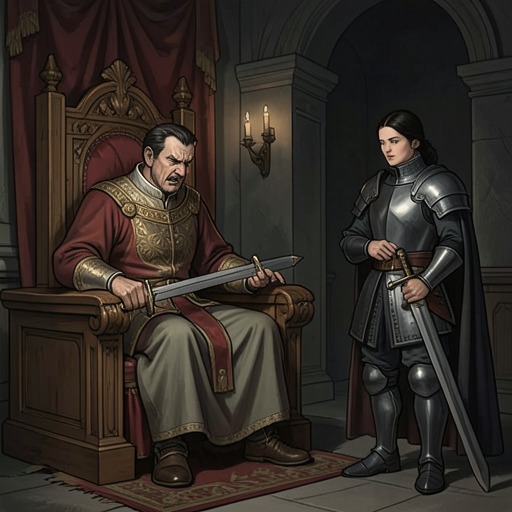
Sir Dinas the seneschal
Le Morte d'ArthurSir Dinas the seneschal is a knight in King Mark’s service, identified by his office as seneschal and repeatedly placed at the point where royal command meets practical duty. He leads part of Mark’s army against an invading force, yet later rejects the king’s authority when Mark’s treachery becomes intolerable. His story turns on that change: service to a ruler does not bind Dinas to support every act the ruler commits.
Identity and Service
Sir Dinas appears as an established knight in Cornwall and as a trusted military leader under King Mark. When Sir Tristram is wounded at a tournament, he goes to rest at Dinas’s castle. The choice of refuge locates Dinas within the network of knights available to Tristram, even though Dinas serves the uncle with whom Tristram’s relationship is fraught.
That position becomes consequential when the Sessoines invade near Tintagil. Mark’s council insists that Tristram must be summoned because the enemy cannot otherwise be overcome, but Mark’s hatred makes him reluctant to ask for help. Dinas is not merely part of the courtly background: he is one of the commanders entrusted with defending the country while the king confronts the invasion.
Command in the War Against the Sessoines
Mark divides his army into three forces, led respectively by Sir Dinas, Sir Andred, and Sir Arguis. Dinas commands the first division, and when the defenders emerge from Tintagil Castle, he rides ahead and kills two knights himself. The fighting continues for a long time, with heavy losses; Dinas is described as the best fighter on Mark’s side.
Despite that leadership, the defenders cannot hold their position. Mark and Dinas withdraw to Tintagil, pursued by the Sessoines, who press so close that ten enter the gates and four are killed by the portcullis. The battle therefore reveals both Dinas’s distinction in arms and its limits: his prowess helps lead the defense, but it cannot by itself prevent the retreat or end the siege.
Mark sends for Tristram twice as the danger mounts. Tristram first answers that his wounds will prevent him from bearing arms for eight days; when he is healed, he returns with ten knights of Arthur’s and fights his way into Tintagil. Dinas’s command belongs to the same defensive crisis, in which the king’s need for Tristram overrides his hostility, while Dinas and the other defenders endure the immediate pressure of the invasion.
From Royal Service to Resistance
Dinas’s decisive break with Mark follows a separate betrayal. After Mark has secretly imprisoned Tristram, Sir Sadok discovers what has happened and takes the news to Dinas at the town of Arbray. Once Sadok explains the king’s treachery and felony, Dinas declares that he will defy such a king and give up the lands he holds from him. The declaration makes his change of allegiance concrete: he is willing to surrender the material basis of his service rather than remain bound to a ruler who has acted dishonorably.
The response is collective. The knights present support Dinas’s position, and, on his advice and Sadok’s, they provision the towns and castles throughout the country of Liones and gather the people they can muster. What begins as Dinas’s refusal thus becomes organized resistance, prepared through the practical work of securing strongholds and assembling a force.
Promises, Deception, and Tristram’s Release
The resistance is complicated by Mark’s ability to manipulate his subjects. Sir Percivale tells Mark that imprisoning Tristram was shameful and warns that the world’s great knights love Tristram. Mark admits that he resents Tristram because he loves Mark’s queen, La Beale Isoud. Percivale rejects this accusation as an unworthy way for an uncle to regard his nephew, and Mark promises not to harm Tristram. The promise does not hold.
Mark sends Dinas a sworn assurance that he will go to the Pope of Rome to wage war against the miscreants. Believing that undertaking, Dinas orders the people he has raised to disperse and return home. Mark uses their dispersal to seize Tristram again, in direct violation of his promise to Percivale. The episode shows how Dinas’s willingness to act on an apparently honorable royal commitment can be exploited: his attempt to stand down the gathering force gives Mark an opening to renew the imprisonment.
Tristram writes to La Beale Isoud, asking her to prepare a vessel so they can leave for Logris. Isoud instead asks Dinas and Sadok to imprison Mark until she and Tristram have departed. Dinas agrees, and the plan is carried out. Tristram is released, and he and Isoud make preparations to leave. Dinas’s final action in these scenes is therefore not simply opposition to Mark: it is a direct intervention that turns resistance into the practical means of escape for Tristram and Isoud.
Narrative Significance
Dinas’s actions distinguish loyalty to a king from loyalty to the conduct expected of a ruler. He serves Mark in battle, leads men during the defense of Tintagil, and initially takes Mark’s sworn message as a reason to disband his supporters. Yet once the king’s betrayal is made clear, Dinas accepts the cost of repudiating his lord and joins in protecting the person Mark has wronged.
His arc is also one of collective action rather than solitary heroism. Dinas and Sadok communicate the truth of Mark’s conduct; Dinas’s defiance wins the agreement of the knights; and their preparations help make Tristram and Isoud’s departure possible. The repeated contrast between Mark’s assurances and his subsequent actions gives Dinas’s resistance its moral and political force: the king’s authority loses its claim on service when his own sworn word proves unreliable.