Sir Ector
Le Morte d'ArthurSir Ector is the faithful lord entrusted with Arthur’s upbringing and the foster father who helps shape the future king’s earliest family ties. When Arthur proves his right to rule by drawing the sword from the stone, Ector tells him that he is not Arthur’s birth father; Arthur responds with grief, gratitude, and a promise to honor Ector’s son, Sir Kay.
Identity and Fosterage
Merlin recommends Sir Ector to Uther Pendragon as a man of exceptional truthfulness and faithfulness, and as a lord with substantial lands in England and Wales. The plan is for Ector’s wife to nurse the royal child while Ector’s own child is placed with another woman. After Arthur is born, he is secretly delivered to Merlin, baptized, and named; Merlin then brings him to Ector’s household, where Ector’s wife nurses and raises him.
Ector’s role thus begins as a carefully arranged act of guardianship. Arthur grows up in Ector’s family without knowing his birth, and the household’s care gives him a father and mother in practice before his royal identity is disclosed. Ector’s son Kay grows up as Arthur’s foster-brother, a relationship that later becomes a matter of public office as well as family affection.
The Sword and the Revelation
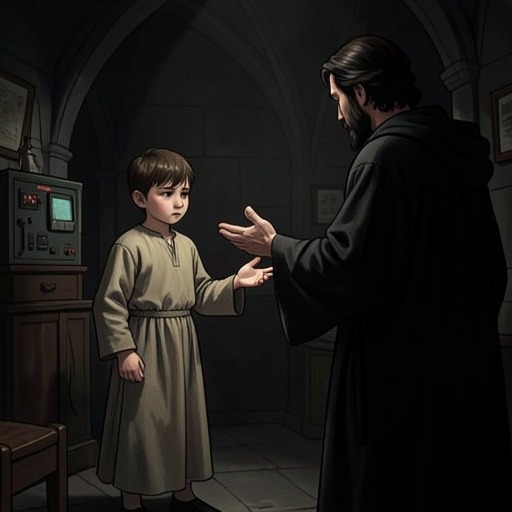
When Ector accompanies Kay and Arthur to the stone bearing the sword, he first asks Kay to try it. Kay cannot move the sword, but Arthur draws it easily. Ector and Kay then kneel, prompting Arthur to ask why his own dear father and brother are kneeling to him. Ector explains that he is not Arthur’s father by blood and recounts how Arthur was entrusted to him for fostering, by the king’s command and through Merlin’s arrangement.
The revelation unsettles Arthur: he grieves when he learns that Ector is not his birth father. Yet the disclosure does not undo their bond. Arthur calls Ector the person to whom he is most indebted in the world and remembers that Ector’s wife cared for him as she did her own child. The scene distinguishes bloodline from lived kinship without diminishing the latter: Ector cannot claim to have fathered Arthur, but the years of care establish a lasting obligation between them.
Arthur’s Promise and Ector’s Family
Ector asks Arthur to remember him kindly if he becomes king. Arthur pledges that he will not fail the man who raised him, and Ector names the service he wants in return: that Kay be made seneschal over Arthur’s lands. Arthur agrees, promising that no one else will hold the office while he and Kay are alive.
After Arthur’s authority is publicly confirmed, he makes Kay seneschal of England. The appointment fulfills the specific promise Ector requested and carries their foster-family relationship into the organization of the new reign. Arthur also restores lands to those who had been dispossessed after Uther’s death and assigns other offices to trusted supporters; in this settlement, Kay’s position is a concrete reward grounded in Ector’s care and Arthur’s pledged gratitude.
Kinship and Narrative Significance
Sir Ector’s importance lies not in a long sequence of independent adventures, but in the part he plays in the story’s account of identity, succession, and loyalty. Arthur’s royal descent is concealed during his childhood, while his upbringing depends on Ector and Ector’s wife. When the concealment ends, Arthur’s response confirms that his foster ties retain moral force alongside his newly revealed bloodline.
Ector also links private obligation to public rule. His request for Kay’s appointment turns Arthur’s gratitude into a continuing office at court, while the revelation scene establishes that the future king owes loyalty to those who cared for him before his inheritance was known. The narrative therefore presents Ector as both guardian and witness: he safeguards Arthur’s childhood and, when the sword establishes Arthur’s claim, makes the hidden history of that childhood known.