Sir Kay
Le Morte d'ArthurSir Kay is Arthur’s foster-brother, an early companion in arms, and a royal officer whose sharp tongue often makes him a comic target but whose courage and service remain essential to the court. He is present at decisive moments of Arthur’s rise, becomes seneschal of England, and repeatedly tests the obligations that bind the Round Table: he mocks an unknown youth who is in fact Gareth, yet later stands with Gaheris against King Mark’s treachery and protects the fellowship’s oath even at personal risk.
Identity and Place at Court
Sir Kay is the son of Sir Ector and Arthur’s foster-brother. Ector raised Arthur as his own, and, when the sword in the stone established Arthur’s claim, Kay’s place in the household became part of the new king’s settlement. Arthur promised Ector that Kay would be seneschal for as long as they both lived; after his coronation he formally made Kay seneschal of England. Kay thus joins intimate kinship to public office: he is not Arthur’s blood brother, but has a secure place in the family created by fosterage and in the governing structure of the realm.
The narrative gives Kay a recognizable comic edge. Malory’s account of the adventures of La Cote Male Taile and Beaumains, and of the braver knights’ pranks involving Dinadan and Dagonet, belongs to a broader vein of humor in which Kay’s mockery helps generate the comedy. That humor does not remove him from serious action. He appears beside Arthur in battle, serves as an officer, and repeatedly enters danger alongside fellow knights.
Arthur’s Rise and the Seneschal’s Office
At the New Year tournament, Kay rides with Sir Ector and the young Arthur. When Kay discovers that he has left his sword behind, he sends Arthur back to fetch it. Arthur cannot find the sword at home and, wanting his foster-brother not to be without a weapon, pulls the sword from the stone. Kay recognizes it and initially claims that its appearance proves he should be king. Ector insists that Kay swear how he obtained it; Kay tells the truth, identifying Arthur as the one who brought it to him. That small act of disclosure redirects the claim toward Arthur rather than allowing Kay to exploit the discovery.
After Arthur draws the sword repeatedly before the assembled lords, he is crowned and promises to govern with justice. He restores lands taken from their rightful owners after Uther’s death and appoints Kay seneschal of England, alongside other officers entrusted with the constableship, chamberlainship, and northern wardenship. Kay’s advancement is therefore tied not to a claim of his own but to Arthur’s gratitude toward Ector and the foster-family that raised him. His office places him among the people who help turn Arthur’s personal accession into the administration of a kingdom.
Kay also serves as a practical presence in the early military narrative. During the five kings’ surprise attack, Arthur and the queen are caught unarmed in their pavilion. Kay, Gawaine, and Griflet react to the alarm; when the king’s party reaches the Humber and sees the five kings approaching, Kay argues that they should meet them despite being outnumbered. His initiative frames him as bold rather than cautious, though the evidence here records the decision and the opening of the encounter rather than its full outcome.
The Beaumains Affair
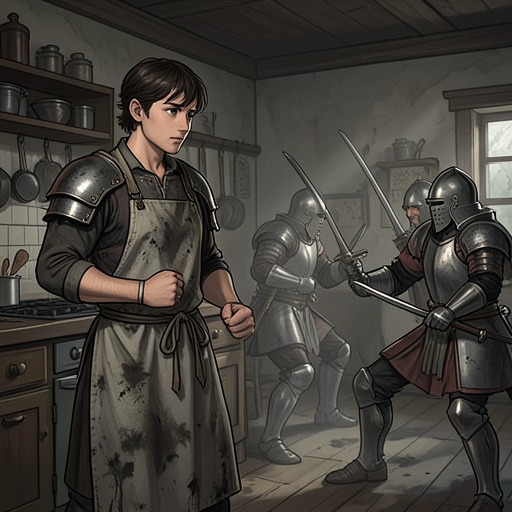
Kay’s most consequential episode of ridicule begins when a young man arrives at Arthur’s court and asks for three gifts. He first requests only enough food and drink for a year, reserving his other petitions until the next annual feast. Arthur orders Kay, as steward, to provide for him as for a lord’s son. Kay instead judges the stranger by his modest request and unnamed identity, calls him Beaumains, meaning Fair-hands, and sends him to the kitchen to eat with the boys and lads. The youth accepts the treatment without complaint, remaining meek and mild through the year while watching knightly contests and displaying unusual strength at feats of skill.
Launcelot and Gawaine object to Kay’s scorn. Launcelot warns that Kay’s habit of giving men mocking names has previously brought trouble, recalling his treatment of Breunor. Both knights offer Beaumains better lodging and food, but he refuses their kindness and stays where Kay has placed him. The contrast is deliberate: Kay mistakes a chosen, patient course for proof of low birth, while Launcelot recognizes the possibility of a worthy knight beneath the kitchen service. Kay’s joke becomes a measure of his failure to read the person before him.
At the next Whitsuntide feast, Beaumains claims his remaining gifts: the adventure requested by the damsel Linet, and knighthood from Launcelot alone. He leaves court richly equipped, with horse and armor brought by a dwarf, while the source of the equipment astonishes those who had accepted Kay’s judgment. Kay rides after him, still calling him his kitchen boy. Beaumains recognizes Kay and names him an ungentle knight; when Kay charges, Beaumains turns aside his spear, wounds him, and takes his shield and spear. He then meets Launcelot in a joust and prolonged combat on foot. Launcelot is astonished by his strength and endurance, and Beaumains makes plain that he has not yet shown his full capacity. Kay’s contempt is thus overturned in public action: the supposedly lowly youth proves able to defeat him and contend fiercely with the foremost knight at court.
The later recognition makes the episode a family drama as well as a comic reversal. At the next feast, the Queen of Orkney arrives with her sons and asks where Gareth is. She reveals that Beaumains was her son, sent to court properly equipped and supplied with money. Arthur admits that he and Gawaine did not recognize him; Kay’s nickname, though given in scorn, had inadvertently described the young man’s fair hands. The queen reproaches the court for keeping her son in the kitchen, while Arthur grieves that Gareth has left and hopes to find him. Kay’s error is not repaired by a reunion in the evidence here, but it has exposed how easily rank and identity are misread when appearance and circumstance are mistaken for character.
Loyalty, Conflict, and Restraint
Kay’s relationship with the Round Table is tested when King Mark’s party challenges knights encountered in the countryside. Gaheris is preparing to joust with Uwaine when Uwaine reminds him that a Round Table knight has sworn not knowingly to fight a fellow member. Gaheris recognizes the force of the oath and withdraws. Mark later attacks Uwaine treacherously, striking him by surprise and leaving him wounded. Kay finds Uwaine, condemns the attack as treason, and has him carried to the Abbey of the Black Cross for healing. His response is protective and practical: he challenges the wrongful act and ensures that the injured knight receives care.
Later, Kay and Gaheris encounter Mark and his cousin Andred at night. Mark is armed and in disguise; the encounter begins with a joust in which Kay is unhorsed, and Gaheris then knocks Mark down. When the two attackers are made to identify themselves, Gaheris condemns their treachery. Mark yields and swears upon the cross of Gaheris’s sword that he will no longer act against errant knights and will be a friend to Tristram if Tristram returns to Cornwall. Kay wants Andred killed, citing his betrayal of Tristram and his part in Tristram’s exile. Gaheris asks Kay to spare him, since he has granted Mark his life; Kay accepts the request. The scene places Kay’s severity beside his capacity to yield to a fellow knight’s judgment. He seeks retribution, but he does not break the decision made in the encounter.
Afterward Kay and Gaheris ride to Dinas the seneschal, whom they know to favor Tristram, and then travel into Logris. They meet Launcelot, who asks for news of Tristram. The two report their adventure in Cornwall, but have no news of Tristram himself. The episode connects Kay’s service to a wider network of loyalty: his resistance to Mark’s treachery is explicitly linked to the wrong done to Tristram, while the resulting report carries that conflict back to Launcelot.
Narrative Role and Characteristic Contrasts
Kay’s story repeatedly sets public labels against demonstrated character. He makes Beaumains a kitchen servant and gives him a mocking name, yet that name becomes attached to Gareth’s strength and worth; Kay’s judgment is disproved by the young man’s performance. The humor depends on reversal, but the consequences reach beyond a joke, exposing the court’s readiness to infer birth and merit from a request for food and from a year spent in humble service.
His conduct elsewhere is less dismissive. He is bold when the five kings threaten Arthur’s party, loyal enough to challenge Mark’s attack on Uwaine, and willing to spare Andred when Gaheris asks it of him. His position as foster-brother and seneschal helps define the tensions at the heart of the court: closeness to the king does not make him infallible, and knightly fellowship requires more than courage in combat. Kay’s enduring function is to embody both the rough humor and the obligations of Arthur’s household, a man whose misjudgments are conspicuous but whose service repeatedly brings him back into the fellowship he sometimes tests.