Sir Marhaus
Le Morte d'ArthurSir Marhaus is an Irish knight of the Round Table whose exceptional prowess makes him both a champion of Ireland’s claim to tribute and a formidable adversary to other knights. His career culminates in combat with Sir Tristram: though Marhaus leaves the field and returns to Ireland, he dies from the wound received in their encounter. His defeat settles Cornwall’s immediate challenge, while his name remains a measure of martial reputation and a source of lasting grievance.
Identity and Reputation
Sir Marhaus is identified as the brother of the queen of Ireland and as a knight of the Round Table. When Cornwall falls behind in its tribute payments to Ireland, King Anguish chooses Marhaus to represent his claim in combat. Marhaus accepts readily, saying he will fight the best knight of the Round Table for the right of the king and his land; he also expects the contest to advance his own reputation. The mission thus joins service to kin and king with the pursuit of knightly renown.
His standing is evident even to opponents. Sir Uwaine recalls seeing Marhaus prove himself at a tournament where no man could withstand him, and calls him an exceptionally good knight. Sir Gawaine, hearing that Marhaus has been associated with a dishonoured shield, nonetheless expects that he will soon return to it and argues that the knights should meet him on horseback. The episode frames Marhaus not as a distant name but as an opponent whose established prowess commands recognition.
Encounters and Feats
The account also recalls Marhaus’s force in encounters beyond his fatal contest with Tristram. When Gawaine and Uwaine meet twelve damsels who complain about Marhaus, the two knights challenge him as he rides toward them. Uwaine’s spear breaks against Marhaus’s shield, and Marhaus unhorses him; he then strikes Gawaine from his horse as well. The damsels’ grievance sets the encounter in motion, but the outcome confirms the formidable reputation Uwaine had already described. Elsewhere, a chapter heading records Marhaus fighting a duke and his six sons and compelling them to yield, extending the portrait of a knight whose victories could settle contests against several opponents.
Tribute, Combat, and Death
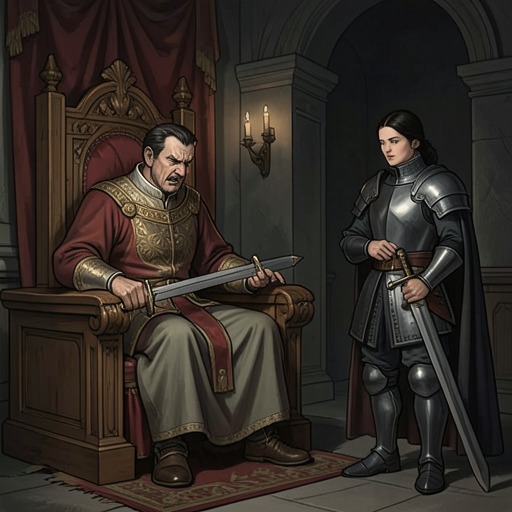
Marhaus’s decisive contest arises from a dispute over Cornwall’s tribute to Ireland. Cornwall had paid the levy for many years, but King Mark was seven years in arrears. Mark and his barons refused the Irish demand and proposed that each kingdom appoint a champion to fight for its claim. King Anguish, angered by the refusal, called upon Marhaus, his sister’s brother and a proven knight of the Round Table. Marhaus accepted the mission as service to his king and country, while also welcoming the chance to increase his reputation by facing one of the Round Table’s best knights.
Sir Tristram fought Marhaus on an island for the tribute claim. The combat left both knights badly wounded, but Tristram eventually prevailed. A blow to Marhaus’s head forced him to withdraw toward his ships; Tristram challenged the retreat, but Marhaus escaped to Ireland. His withdrawal ended the contest on the field, not its consequences: when his wounds were examined there, a piece of Tristram’s sword was found lodged in his head, and the surgeons could not remove it. Marhaus died from the wound. His sister, the queen of Ireland, kept the sword fragment, hoping that she might one day avenge him.
The tribute dispute’s personal aftermath extends beyond Marhaus’s death. Tristram later names himself to Sir Bleoberis as the knight who slew Marhaus in single combat over Cornwall’s tribute, and Bleoberis recognizes him by that deed. The encounter thus establishes Tristram’s fame while leaving a token of the loss in the hands of Marhaus’s sister. Later, when King Mark asks Tristram to travel to Ireland for La Beale Isoud, the narrator presents the mission as a scheme to destroy him, making the earlier combat and the Irish royal family’s connection to Marhaus part of the danger surrounding Tristram’s journey.
Legacy and Narrative Function
Marhaus’s death remains active in the story through the remembered terms of his defeat. Sir Tristram identifies himself to Sir Bleoberis as the knight who slew Marhaus in single combat on an island over Cornwall’s tribute, and Bleoberis recognizes the deed as part of Tristram’s reputation. The episode gives Marhaus’s career a double consequence: it establishes Tristram’s prowess, while the sword fragment retained by Marhaus’s sister preserves a personal grievance that has not been answered.
The tribute dispute also casts Marhaus as a figure at the intersection of royal obligation and individual honour. He accepts combat on behalf of King Anguish and Ireland, but the contest is also an opportunity to advance his own reputation. His story ends not with an immediate death on the field but with his return to Ireland and the later discovery that Tristram’s sword has left an incurable wound. That delayed outcome turns a seemingly concluded encounter into a lasting political and familial consequence.