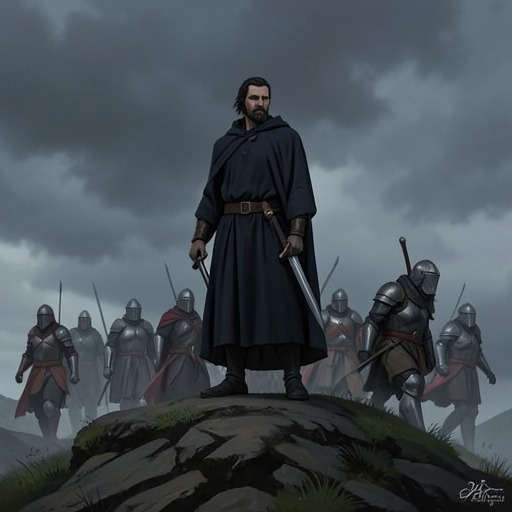
Sir Sadok
Le Morte d'ArthurSir Sadok is a loyal knight whose most consequential actions oppose the treachery of King Mark: he protects the orphaned Alisander le Orphelin after Mark murders the boy’s father, then helps free Sir Tristram from Mark’s prisons. His allegiance is demonstrated not by a single act of rescue but by a repeated willingness to defy the king, endure the risks of that defiance, and assist others in resisting Mark’s rule.
Identity and First Intervention
Sir Sadok first appears in the account of Prince Boudwin’s death and the escape of Boudwin’s wife, Anglides, with their young son. After committing the murder, King Mark searches for Anglides and Alisander and orders Sadok to bring them back, threatening him with death if he fails. Sadok overtakes Anglides within ten miles and initially tells her to return. But rather than carry out the king’s command, he offers her a way to leave: she must take her son out of the country, raise him until he is old enough to avenge his father, and remember the promise.
Anglides accepts. She pledges that, if Alisander lives to become a knight, he will have his father’s blood-marked doublet and shirt and will be charged to remember the murder. Sadok then returns to Mark and falsely reports that he drowned the child. The lie secures the fugitives’ immediate safety: Mark believes Alisander dead, while Anglides travels south and reaches Magouns, later called Arundel, where she and her son are received. Sadok’s first service to the family is therefore both practical and political—he protects the heir by concealing his survival from the very king who ordered his capture.
Defiance and the Heir’s Survival
Years later, news reaches Mark that Alisander has been made a knight and that his mother has told him of Sadok’s part in saving him. Mark, who had believed the boy dead, takes up a sword and searches for Sadok. Sadok does not deny what he did: he says he saved Alisander’s life and does not regret it, accusing Mark of having killed Boudwin treacherously despite the prince’s good deeds. He invokes Christ’s aid for Alisander’s revenge and warns Mark that the young knight is alive and armed with the status of knighthood.
Four of Mark’s knights draw their swords against Sadok. He defeats them in Mark’s presence, then goes to his chamber, takes his horse and equipment, and rides away. His escape makes the limits of Mark’s authority visible: the king can issue commands and threaten punishment, but cannot reliably compel the obedience of a knight who judges those commands unjust. Sadok’s protection of Alisander has also helped preserve a future instrument of vengeance, a consequence made explicit by the charge Anglides gave her son and by Sadok’s warning to Mark.
Mark responds by plotting against both Alisander and Sadok. He offers land to the knight who brought him the news and tells him to remain in the country; Sadok later encounters and kills that informant. Mark then seeks assistance from Morgan le Fay and the Queen of Northgalis, asking them to set the country in turmoil with enchantresses and dangerous knights so that Alisander will be captured or killed. The account thus places Sadok within a widening contest: Mark’s attempt to eliminate the heir recruits political and magical allies, while Sadok’s resistance helps keep the threat alive rather than quietly disappear.
Resistance to Mark and Tristram’s Imprisonment
Sadok’s role extends from protecting Alisander to opposing Mark’s treatment of Sir Tristram. After Mark secretly carries the injured Tristram away from a tournament, gives him a drink that puts him to sleep, and confines him, La Beale Isoud asks Sadok to discover where Tristram has been taken. Sadok investigates and learns that Mark has imprisoned him. With two cousins, Sadok lies in ambush near Tintagil Castle. When Mark rides by with four nephews and associates from Magouns, Sadok attacks; Mark flees, and the encounter leaves Sadok’s party and Mark’s companions in conflict.
Sadok then goes to Liones and reports Mark’s treachery to Sir Dinas the seneschal. Dinas rejects Mark’s conduct and says he will give up the lands he holds from him. The knights follow his lead, and, on Dinas’s and Sadok’s advice, towns and castles in Liones are provisioned and the people gathered. Sadok’s action transforms an individual rescue effort into organized resistance: he brings news of the imprisonment to a local power-holder, and that disclosure prompts a broader preparation against the king.
Mark subsequently promises Sir Percivale that he will not harm Tristram, then uses a false account of a planned campaign to induce Dinas to disperse the people he has raised. Once they have gone home, Mark has Tristram imprisoned again, in breach of his promise. When La Beale Isoud learns what has happened, she sends word to Tristram and seeks Sadok’s and Dinas’s help. Tristram proposes that he and Isoud escape to Logris by ship; Isoud agrees to prepare the vessel and asks Dinas and Sadok to imprison Mark until the couple have departed. Dinas promises that Mark will be confined, and the plan is carried out: Tristram is released, and he and Isoud prepare to leave.
Character and Narrative Role
Across these episodes, Sadok is defined by constancy under pressure. He first deceives Mark to save a child, later openly defends that choice when challenged, and then takes action against the king’s repeated betrayals of Tristram. His loyalty is not simply obedience to a sovereign: he judges Mark’s orders and promises against their consequences for those under threat, siding with the endangered heir and the imprisoned knight instead.
The two strands of his story also show how private acts of protection acquire wider effects. Saving Alisander preserves the possibility of his father’s vengeance; helping Dinas mobilize Liones turns the discovery of Tristram’s confinement into collective opposition; and supporting Isoud’s plan contributes to Tristram’s release and the couple’s intended departure from Cornwall. Sadok is not presented as a claimant to power. His importance lies in the action he makes possible: where Mark relies on secrecy, false promises, and coercion, Sadok supplies warning, shelter, armed resistance, and practical assistance.