Sir Tristram
Le Morte d'ArthurSir Tristram’s story brings together inherited identity, public duty, and private attachment. Born in sorrow and named for the death that accompanied his birth, he becomes a knight through his decision to answer Ireland’s demand for tribute from Cornwall. His later service to King Mark leads him to seek Isoud as the king’s bride, but the two drink a love potion, entangling Tristram’s loyalty to his uncle with a bond that repeatedly draws him into conflict. The surrounding episodes place his career within the wider world of King Arthur’s court, where knighthood is measured through both combat and allegiance.
Birth and Early Identity
Tristram’s birth is marked by loss: his mother dies when he is born, and she names him Tristram. The opening of his story thus makes grief part of his identity from the outset, before he has any opportunity to establish himself through his own actions. His name and his early history connect personal inheritance to the consequences of family circumstance.
The larger account of Arthur’s household supplies a further family connection. Queen of Orkney is Arthur’s maternal half-sister, and her sons include Gareth; Mordred is also born through her. This episode places the Orkney family within Arthur’s kinship network, though it does not establish a specific kinship tie between Tristram and the members of that family. It is a reminder that Tristram’s adventures unfold in a court where family identity and political allegiance are closely interwoven.
Knighthood and the Cornwall Challenge
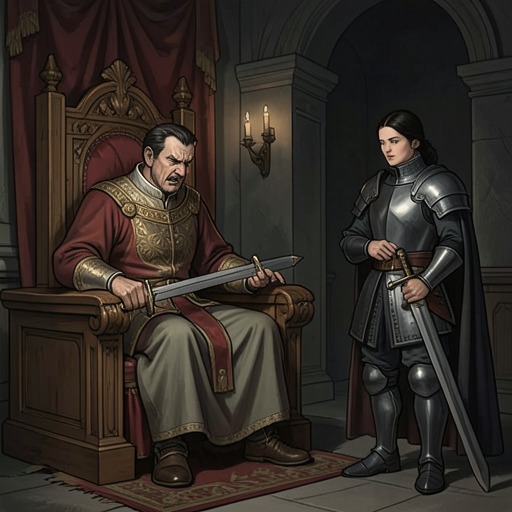
Tristram enters the public life of chivalry when Sir Marhaus comes from Ireland to demand tribute from Cornwall, threatening to fight if the demand is refused. Tristram undertakes the combat on Cornwall’s behalf, turning a dispute over the kingdom’s obligations into a personal test of knightly service. Before he proceeds to meet Marhaus, he is made a knight. The sequence links his new status directly to the duty he has accepted: his knighthood is not simply a title but a commitment expressed through a dangerous challenge.
The fight with Marhaus is presented as a contest Tristram undertakes and completes. Marhaus eventually flees to his ship, while Tristram’s own later account establishes that he was badly wounded and required half a year to recover at a nunnery. The episode therefore gives his achievement a cost and consequence: he succeeds in the encounter, but recovery removes him from active combat for an extended period.
Service to King Mark and the Love Drink
Tristram’s connection to Isoud develops through a request made on behalf of King Mark. He asks for La Beale Isoud for the king, carrying out a role that joins his service to Mark with the arrangement of the king’s marriage. During the journey, Tristram and Isoud drink the love drink. This changes the meaning of the mission: what began as service to Mark becomes the beginning of a bond between the envoy and the woman he was seeking for his king.
The resulting conflict does not remain private. In a later episode, Palamides claims Queen Isoud, and Tristram rides after him. When the two meet, they fight, but Isoud intervenes and the battle ends. Tristram then brings her home, after which a dispute arises between him and King Mark. The sequence shows the recurring pressure within Tristram’s position: he acts to recover Isoud, yet that action sharpens his disagreement with the king whose marriage he had helped arrange.
Place Among Arthur’s Knights
Tristram’s story intersects with the wider history of the Round Table. After Sir Pelleas and Sir Marhaus distinguish themselves at a feast, the two are made Knights of the Round Table to fill places left vacant by knights killed during the year. The narrative then looks ahead to Tristram’s later combat with Marhaus on an island, where Tristram kills him. The account links a public recognition of Marhaus’s standing to the later encounter in which Tristram defeats him, giving their conflict a place in the continuing record of Arthurian knighthood.
The court’s customs offer a broader measure of the ideals against which Tristram’s deeds can be read. King Arthur requires the Knights of the Round Table to avoid outrage and murder, flee treason, show mercy to those who ask for it, and help ladies and gentlewomen on pain of death. He also forbids them to undertake battles for wrongful causes. The knights swear to these obligations, and renew their oath each year at Pentecost. Tristram’s combat and his efforts concerning Isoud belong to a world where personal honor and private attachment operate under a formally renewed code of collective conduct.
Loyalties and Narrative Significance
Tristram’s actions repeatedly place service and personal attachment in tension. He accepts a combat on Cornwall’s behalf, then undertakes the task of seeking Isoud for King Mark. After the love drink binds him and Isoud, he pursues her when Palamides takes her and brings her back, provoking conflict with Mark. These episodes make loyalty more than obedience: each action intended to fulfill one obligation creates pressure on another.
His story also sits within a court shaped by inherited status, public judgment, and political bonds. Arthur’s own history includes a hidden account of his birth and upbringing, while the court’s rules turn mercy, loyalty, and the protection of women into explicit duties. Tristram’s trajectory—from a birth defined by loss, through a knighthood undertaken in answer to a political challenge, to the divided loyalties surrounding Isoud—adds an intimate and personal strand to that broader chivalric order.