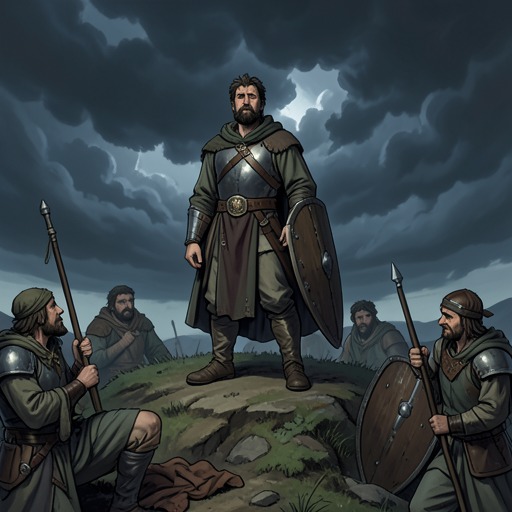
Sir Ulfius
Le Morte d'ArthurSir Ulfius is a loyal knight and royal officer who serves first Uther Pendragon and then Arthur. His most consequential early service is arranging Merlin’s intervention in Uther’s pursuit of Igraine; later, he fights in Uther’s campaign at St. Albans and serves Arthur as chamberlain and battlefield commander. His career gives continuity to a kingdom otherwise marked by contested succession and rebellion.
Service to Uther Pendragon
When Uther, besieging the Duke of Cornwall’s stronghold, falls ill from anger and love for Igraine, Sir Ulfius asks what troubles him and offers to seek Merlin. He encounters Merlin disguised as a beggar, and brings him back to the king. Merlin promises to satisfy Uther’s desire on the condition that Uther swear to grant Merlin’s request; Ulfius assures him that the king will agree.
Uther swears on the four Gospels. Merlin then requires that the child born of Uther and Igraine be handed over to him to raise. He outlines the disguise by which Uther can enter Tintagil as the Duke, Ulfius can appear as one of the Duke’s knights, and Merlin can take another knight’s identity. Ulfius’s role is practical and essential: he makes the encounter possible, though the arrangement also binds Uther to surrender the child who will become Arthur.
A Knight in Battle and at Court
During Uther’s later illness, enemies attack his people. Merlin insists that the king must join the campaign even if he has to travel in a litter. At St. Albans, Ulfius and Sir Brastias distinguish themselves in the fighting, and Uther’s forces defeat the northern host. Uther returns to London victorious, but falls gravely ill again soon afterward.
Ulfius is present at the public recognition of Arthur as Uther’s heir. When the dying king is asked whether Arthur should succeed him, Uther gives his son his blessing and commands him to claim the crown. After Uther’s death, the succession remains unsettled and powerful lords contend for the realm; the narrative thus places Ulfius’s earlier service to the royal household against the disorder that follows.
Once Arthur draws the sword and is crowned, he appoints Ulfius chamberlain. The appointment gives formal shape to a relationship already established through Ulfius’s service to Uther: he remains close to the center of royal authority as the new king restores wrongfully taken lands and begins consolidating his rule.
Counsel and Allegiance Under Arthur
When eleven kings join forces against Arthur, Ulfius fights in the battle alongside Sir Brastias. In Merlin’s plan, a small force is sent to engage the enemy at a passage while King Ban and King Bors wait concealed nearby. Ulfius and Brastias lead three thousand men into the fighting. Ulfius’s horse is killed beneath him, but he continues bravely on foot while the enemy presses him; Brastias then strikes down the Duke of Cambenet, who had been attacking Ulfius. The episode makes his courage a visible part of the tactics that help Arthur’s smaller force withstand a much larger host.
Ulfius also belongs to Arthur’s political and military fellowship when Roman ambassadors demand tribute. At the king’s feast, the ambassadors claim that Britain owes obedience and payment to the Roman emperor. Arthur refuses to let the young knights harm them, hears their demand, and later announces that he recognizes no earthly ruler as entitled to tribute from him. Ulfius is included among those who promise support for the Roman campaign. His allegiance has therefore passed from helping Uther secure his desire to helping Arthur assert the sovereignty of the kingdom.
Character and Narrative Role
The evidence presents Ulfius chiefly through acts of service rather than private history. He recognizes the need for Merlin’s help, carries the appeal to him, participates in battle, and accepts an office in Arthur’s household. These actions make him a connective figure across reigns: he helps establish the circumstances of Arthur’s birth, witnesses the succession crisis after Uther’s death, and then stands among the officers and knights supporting Arthur’s government.
His loyalty is practical rather than merely ceremonial. At St. Albans he fights beside Brastias; in the war against the eleven kings he endures the loss of his horse and keeps fighting; in Arthur’s Roman dispute he joins the promised aid. The pattern places him within the narrative’s account of how personal service, military action, and allegiance sustain royal authority, even as the legitimacy and stability of that authority are repeatedly challenged.