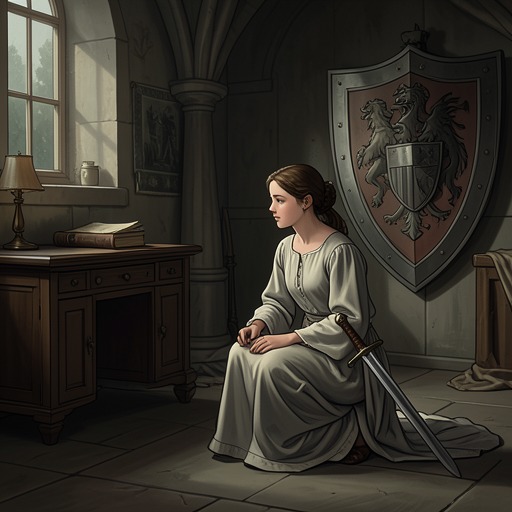
The lover-knight ideal
Le Morte d'ArthurThe lover-knight ideal makes love for a lady more than a private attachment: it presents devotion as a motive for deeds of arms and, in some characters’ view, a condition of true knightly prowess. Sir Tristram defends the principle; Sir Dinadan disputes it with comic bluntness; and Sir Palamides’s feats at a tournament reveal both its power and its cost. The contrast is not simply between a lover and a non-lover, but between competing accounts of what a knight owes to love, honor, and other people.
Love and Knightly Prowess
When Sir Tristram meets Sir Dinadan while hunting, Dinadan refuses to identify himself as a lover and mocks a knight he had seen lying by a well. Tristram answers that a knight cannot achieve prowess unless he is a lover. Their disagreement quickly turns into a practical challenge: Dinadan presses Tristram to disclose his name and threatens to fight when he will not. Tristram declines to fight merely on demand, then points Dinadan toward Sir Epinegris, whom he identifies as a great lover. Dinadan accepts the challenge and is unhorsed. Tristram uses the result to tease him about whether the lover has fared better, though he does not fight Dinadan himself. The episode gives the ideal a playful demonstration, but not a simple proof: Dinadan’s defeat follows a challenge Tristram has steered him into, while Tristram himself keeps control of when he will fight.
At Joyous Gard, the disagreement becomes a question of service. Sir Dinadan says that love’s joy is brief while its sorrow and consequences endure. La Beale Isoud counters with the example of Sir Bleoberis, who fought three knights for a damsel and won her before the King of Northumberland. She then asks Dinadan to fight three knights on her behalf. He praises her beauty but refuses, and Isoud laughs at his response. Her invitation makes the lover-knight ideal concrete: a lady’s appeal calls for action, while Dinadan’s refusal separates courtesy in speech from willingness to undertake the demanded combat. Tristram, who is present but concealed, has arranged for Dinadan to be welcomed without revealing himself, allowing Isoud to question the very attitude that Tristram had argued for on the road.
The Ideal Put to the Test
The tournament offers a more forceful image of love as a source of prowess. Disguised in red armor, Sir Tristram returns to the field after being unhorsed and performs great deeds, at one point knocking down five knights with a spear. He also helps Sir Palamides, Sir Gareth, and Sir Dinadan back onto their horses; because the red armor conceals his identity, the men he assists do not recognize him. When La Beale Isoud sees Tristram mounted again, she is glad and laughs. Palamides notices her response and, moved by love for her, fights with such vigor that onlookers give him the prize as the best knight of the day, surpassing Sir Launcelot and Tristram in their judgment.
The scene gives the ideal its strongest visible confirmation: Palamides’s change in performance is linked to his seeing Isoud’s pleasure. Yet the book also complicates that apparent triumph. Sir Dinadan privately understands why Palamides is fighting so well, but does not tell Tristram. Tristram praises Palamides’s endurance and skill, while noting that he has never seen him do so much in a day. The tournament’s outward verdict rewards Palamides, but the hidden emotional cause makes the victory part of a love rivalry. Love increases his prowess in the arena without resolving the conflict that attaches him to Isoud.
Fellowship, Courtesy, and Rivalry
Sir Dinadan’s teasing is not simply contempt for valor. He provokes Tristram by calling him a coward after Tristram appears inactive, intending to rouse his spirits so that Palamides will not win the next day’s prize. Tristram answers with strong praise for Sir Launcelot, describing his prowess alongside his courtesy, generosity, bounty, and gentleness. The exchange places the lover-knight ideal within a wider measure of knightly worth: force in combat matters, but so do restraint and courtesy. Dinadan’s strategy also makes the tournament’s display less straightforward, since one knight’s taunting is intended to alter another’s performance and the contest for the prize.
Palamides, in turn, recognizes courtesy as an essential part of the same code. He says that Sir Launcelot treated him courteously after Palamides himself had acted discourteously, and declares that he will be Launcelot’s knight for the rest of his life. The kings, lords, and knights praise Launcelot and Tristram for prowess, strength, bounty, and courtesy, and the narrator reports that their deeds exceed those of many other knights. Thus the lover-knight ideal does not stand alone: the narrative places love-driven action alongside fellowship and reciprocal conduct, and it judges a knight by how he treats rivals as well as by how he fares against them.
Palamides’s Love and Its Cost
Later, Palamides tells Sir Epinogris that he loves La Beale Isoud, the wife of King Mark of Cornwall, and knows that Sir Tristram loves her too. Palamides has recently shared Tristram’s fellowship, but now believes he has lost both that companionship and Isoud’s love, and that he and Tristram are mortal enemies. He admits that Isoud never gave him reason to think she loved him as she loved the world; she has rebuked him, and he says he deserved the rebuke because he had not acted knightly. The gap between his devotion and her response is central to the ideal’s cost: love can inspire deeds without earning reciprocation.
Palamides also credits Isoud with having caused him to win worship through his deeds. Now that he has lost her and Tristram’s fellowship, he fears that he has lost the honor he won and will never again perform with the prowess he displayed alongside Tristram. His account revisits the tournament’s pattern from the inside. There, Isoud’s visible pleasure accompanies his exceptional performance; here, separation from her and the loss of fellowship leave him doubtful of his former strength. The ideal is therefore both a spur to action and a vulnerable dependence: the knight may gain renown through love, yet neither renown nor service can compel love in return.
What the Ideal Reveals
The episodes preserve more than one judgment of love. Tristram treats love as a source of prowess; Dinadan sees its sorrow and long consequences, and refuses to make every lady’s request a reason to fight. Isoud’s challenge exposes the difference between praising ladies and serving them in arms, while the tournament shows that love may visibly intensify a knight’s performance. Palamides’s confession then sets the public prize against private disappointment: the deeds are real, but their emotional reward is neither certain nor lasting.
The lover-knight ideal consequently joins chivalric achievement to an unstable personal attachment. Its strongest examples depend on distinctions the book keeps in view: love may motivate action without guaranteeing victory in love; prowess may win a tournament without settling a rivalry; and knightly excellence includes courtesy toward other knights, not merely success against them. Through Tristram, Dinadan, Isoud, and Palamides, the ideal appears at once as an energizing account of valor and as a source of conflict whose costs persist after the contest ends.