A twelvemonth and a day
Le Morte d'ArthurA twelvemonth and a day is a recurring period of obligation in Malory’s world: a term that makes a promise measurable, yet long enough to redirect a knight’s course. Its most fully developed use comes in the imprisonment of Sir Alisander by Morgan le Fay. There, the duration turns healing into a bargain, and a spoken promise into a barrier between the knight and his declared purpose of avenging his father. Elsewhere, the same span marks the duration of a quest undertaken by Sir Launcelot and his companions, underscoring how time in the narrative is often counted through vows and service rather than through abstract chronology.
A Term Bound to Promises
The period is not presented merely as a unit for dating events. It has force because a knight gives his word for its duration. In Sir Alisander’s story, the promise is made by his knighthood, and its limits are explicit: he is not to pass beyond the compass of Morgan le Fay’s castle for a twelvemonth and a day. The condition makes the term a practical restriction on movement, not simply a waiting period.
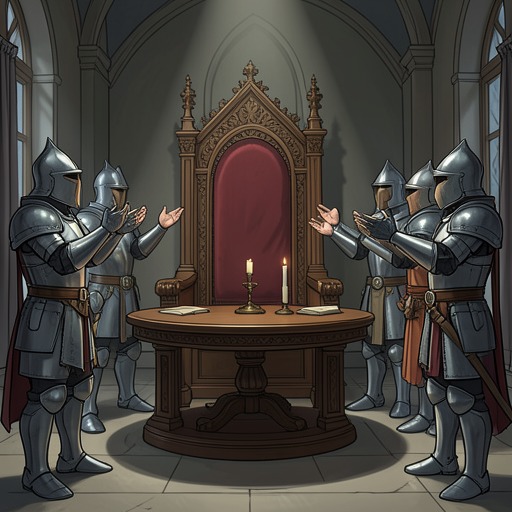
A related pledge appears in Sir Launcelot’s effort to find Sir Tristram. After King Arthur laments that Tristram has been lost to the court, Launcelot declares that ten knights will not rest two nights in the same place during a twelvemonth until they find him. He swears that, if he meets Tristram, he will bring him back by fair means or foul, or die in the attempt. The span here organizes a sustained search: a set length of time gives form to the companions’ promise, while their travelling fellowship and divided search routes make the commitment an active undertaking rather than passive waiting.
Morgan le Fay’s Bargain with Sir Alisander
After Sir Alisander is wounded, Morgan le Fay first gives him an ointment that worsens his condition, then another that relieves it. Once he is recovering, she arranges for him to agree to a year and a day within the bounds of her castle, promising that he will readily be healed if he keeps the term. Alisander assents, and his recovery follows. The bargain therefore joins care to confinement: the period begins as the price of being made whole.
The promise immediately conflicts with Alisander’s purpose. He had undertaken to avenge his father, whom King Mark killed, after his mother disclosed the killing and charged him to seek retribution. At the knighting feast, she showed him his father’s bloodstained doublet and shirt, and Alisander pledged himself to revenge. Once healed under Morgan’s terms, he regrets his oath because it keeps him from acting against King Mark. The period thus holds two obligations in tension: his promise to Morgan and the charge laid upon him by his mother.
Release Without Breaking the Oath
Alisander’s release is arranged by a damsel who is Morgan’s cousin and says that the castle should rightfully belong to her. She warns him that Morgan keeps him there for her own purposes, and offers a plan to free him while preserving his honour. The castle is to be destroyed by the damsel’s uncle, the Earl of Pase; Alisander is to leave through a private postern and wait in the garden. He accepts the plan and recognizes that remaining in the grounds for the agreed period will not violate his promise.
When the appointed day arrives, the earl comes with four hundred knights and burns the castle, leaving no stone standing. Alisander has already escaped to the garden, where his horse and armour have been placed for him. The earl then claims the ground for a twelvemonth and a day, barring other knights from it. The same duration consequently appears again, this time as the term of an asserted possession rather than a healing bargain. In both instances, the period is made consequential by the conditions attached to it: first it confines Alisander, and then it regulates who may claim the cleared site.
Narrative Function
Across these episodes, the interval links time to conduct. Launcelot’s search pledge makes it the measure of collective service to a missing companion; Morgan’s bargain turns it into a limit on a knight’s freedom; and the claim to the castle site gives it a role in contesting possession. The specific circumstances differ, but the term repeatedly asks what a promise requires of the person who makes it, and how that obligation may be kept while circumstances change.
The Alisander episode makes the period especially revealing because the oath is neither forgotten nor casually discarded. His regret does not erase his promise; instead, the damsel’s plan creates a route out that lets him preserve his word while escaping Morgan’s control. The interval therefore carries narrative pressure beyond the passage of time itself: it tests the relationship between a knight’s pledge, his freedom of action, and the duties that compete for his allegiance.