Castle Dangerous
Le Morte d'ArthurCastle Dangerous, also called Castle Perilous, is the stronghold of Dame Liones and the focus of Gareth’s defining adventure as Beaumains. Besieged by the Red Knight of the Red Lawns, the castle becomes both the object of a rescue quest and the setting for a test of knightly worth: even after reaching Liones, Gareth is told that his labor has not yet secured her love, and must continue to prove himself.
The besieged stronghold
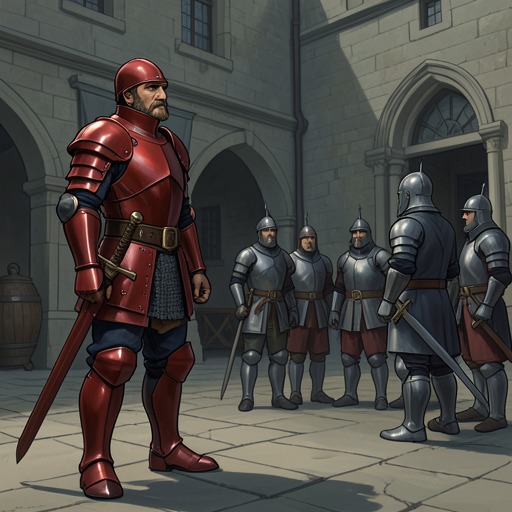
At Arthur’s Pentecost feast, a damsel asks for help for a noble lady whose castle is held under siege by a tyrant. She withholds the lady’s name and dwelling, so Arthur initially declines to send a knight. Gawaine identifies the adversary as the Red Knight of the Red Lawns, a perilous fighter reputed to possess the strength of seven men. The appeal presents the castle as a place of danger and confinement, but also as a cause for which the knights of Arthur’s court may be called to act.
The damsel is Linet, and the besieged lady is her sister, Dame Liones. Sir Persant explains that the Red Knight has maintained the siege for nearly two years. Though he has had opportunities to take Liones, he has prolonged the conflict in hope of fighting one of the celebrated knights—Launcelot du Lake, Tristram, Lamorak, or Gawaine. The castle’s danger is therefore prolonged not only by the attacker’s strength but by his chosen purpose: the siege is also a challenge aimed at drawing a famous opponent into combat.
The quest and the name of the lady
Gareth reaches the adventure under the name Beaumains, the identity by which he first appears at Arthur’s court. After asking for the battle and receiving permission to undertake it, he asks to be knighted by Launcelot. The episodes leading toward the castle thus connect his concealed identity with a public trial of ability: before he can be known as Gareth, son of King Lot and brother of Gawaine, he must establish himself through the work of the quest.
On the way, Persant offers to knight Beaumains before he faces the Red Knight. Beaumains declines because Launcelot has already made him a knight; Persant calls Launcelot the foremost of knights and says that Launcelot, Tristram, and Lamorak share the highest renown. Beaumains says that he wants good fame and knighthood. He then entrusts Persant and Linet with his parentage, asking them to keep it secret: Arthur and Gawaine do not yet know who he is. The castle quest consequently proceeds under an identity that conceals a royal and Arthurian family connection.
The closed gate and Liones’s test
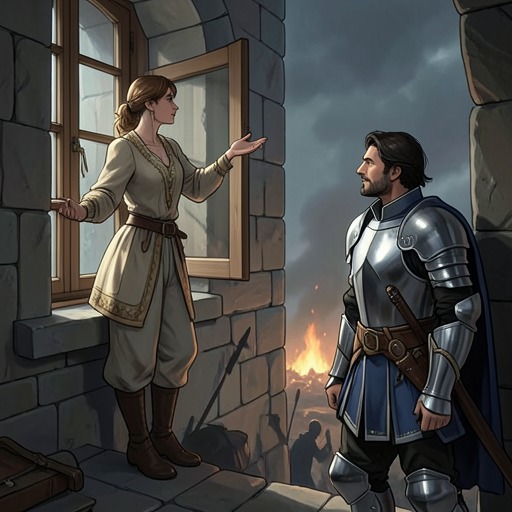
When Beaumains rides to the castle, its armed defenders close the gate, raise the drawbridge, and shut the entrance against him. Liones speaks from a window rather than admitting him. She tells him that he will not yet have her love until he has been counted among the worthy knights, and sends him away to labor in worship for a year before expecting further news. The physical barrier makes her judgment immediate: arrival at the castle and service to its lady do not, by themselves, complete his claim.
Beaumains protests that he has not deserved such a reception and has already paid for his love with some of his best blood. Liones answers that his labor, goodness, and devotion will not be lost, and promises that she will remain true to him and love no other until her death. Her refusal is therefore not a rejection of the knight or a withdrawal of affection. It makes recognition conditional on further achievement, while assuring him that his effort and loyalty have been seen.
Disclosure and significance
After Beaumains departs in grief, he wanders without knowing where he is going and spends a restless night away from the castle. Later, Liones tells her brother, Sir Gringamore, that Beaumains is a good knight of noble house and that she is deeply indebted to him for the labor and dangerous passages he has endured for her. Gringamore carries her promise to Beaumains; the two are reunited, and Liones promises to love him alone for the rest of her life.
Liones then discloses the concealed connection between the castle and the original appeal: she is the very lady for whom Beaumains fought, and she is lady of Castle Perilous. She also explains that, with her consent, her brother had taken Beaumains’s dwarf away. The disclosure brings the rescue quest, the courtship test, and the concealed identity of the lady together in one place. Castle Dangerous is not merely the destination of a siege narrative; its gate and window stage a further test in which service must be followed by patience, and the lady’s identity is withheld until the knight’s labor and her own judgment can be joined.