Castle of Maidens
Le Morte d'ArthurThe Castle of Maidens is a tournament setting where the prowess of Sir Tristram is recognized before his identity is known, and where a black shield turns a contest of arms into a public challenge to King Arthur and Queen Guenever. The castle is also called the Castle of the Hard Rock and Roche-dure. Across its tournament episodes, it brings together rival kings, Arthur’s knights, and the concealed designs of Morgan le Fay; its contests test both martial reputation and the meanings others attach to a knight’s emblems.
Setting and Tournament
The narrative places a major tournament at the castle between the forces of King Carados of Scotland and the King of North Wales, with Arthur’s party also taking part. The castle is the destination of knights sought for the contest, and the tournament draws a wide field: at a later gathering Sir Tristram sees five hundred tents. In one account, Sir Launcelot and thirty-two knights of his blood have prepared shields of Cornwall for the event. The tournament is therefore not a private encounter but a public arena in which rival groups compete before kings and assembled spectators.
The contest unfolds over several days. Arthur watches from a scaffold and, with the other kings and lords, judges the knights’ achievements. The changing awards and the observers’ debate over the black-shielded knight make the tournament more than a sequence of individual combats: it is a forum where reputation is made, disputed, and deliberately redirected.
Tristram’s First-Day Victory
Sir Tristram rides to the tournament with Sir Persides, taking the side of King Carados. He wears a black shield without any identifying device. When Sir Persides is brought down amid a force of more than forty horsemen, Tristram intervenes: he unhorses Sir Gaheris and then Sir Bleoberis, and continues to hold the opposing knights at bay. He also strikes Sir Dinadan so hard that Dinadan swoons in his saddle.
Afterward, Dinadan recognizes Tristram and gives his word that he will never again come against him in arms. Arthur and the other judges award Tristram the first day’s prize, though they know him only as the knight with the black shield. Some spectators recognize him but keep silent. The anonymity is consequential: the contest establishes his public worth before it supplies a name, allowing the achievement itself to precede the court’s knowledge of who performed it.
The Prize and Launcelot’s Recognition
On the following day, Sir Tristram leaves the field, and Arthur awards the prize to the King of North Wales because Tristram had been fighting on Carados’s side. Sir Launcelot, who has been watching for a chance to join company with Tristram, searches for him after he disappears. Arthur laments that the unknown knight was allowed to escape without being brought to him with courtesy.
On the third day, Launcelot fights so successfully that the field acclaims him. He refuses to claim the prize, however, and instead insists that Sir Tristram deserves the tournament’s honour: Tristram began the fighting and endured through the first, second, and third days. Arthur likewise praises Tristram as an exceptionally skilled and courteous fighter, noting how he struck Sir Palamides three times while calling each blow a stroke for Tristram. The third-day prize thus becomes a public act of recognition as much as a victory. Launcelot’s refusal to keep it elevates his honour, while confirming Tristram’s achievement even in his absence.
Launcelot had earlier unhorsed Palamides in a joust and was then attacked by twelve knights who sought to prevent him from winning the tournament. He escaped, but rested on the first day rather than compete. Later, while pursuing fellowship with Tristram, he missed him again as Tristram, Dinadan, and Gouvernail rode away into the forest. The divided and shifting action reinforces the tournament’s central tension: the knights repeatedly seek one another, yet identity, allegiance, and circumstance keep separating them.
Morgan le Fay’s Shield and Its Message
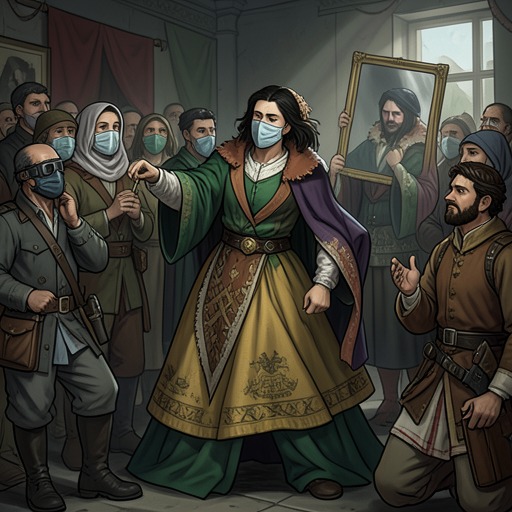
Morgan le Fay later asks Tristram to carry a shield to another tournament at the Castle of the Hard Rock. The shield is goldish and depicts a king and queen with a knight standing above them, one foot on each ruler’s head. Morgan explains that the king and queen represent Arthur and Guenever, while the knight signifies someone holding them in bondage. She does not identify that knight to Tristram. Tristram agrees to bear the shield without knowing that it was designed as an attack on Launcelot and Guenever.
When Tristram appears at Roche-dure carrying it, he performs remarkable deeds before Arthur. The king wonders what the shield means; Guenever understands its implication and is troubled. A damsel associated with Morgan declares in the court that the device was made to expose Arthur and the queen to shame and dishonour, then secretly departs before anyone can identify her. Guenever tells Sir Ector de Maris that she believes Morgan made the shield out of spite toward her and Launcelot, and fears that she may be destroyed. Arthur, meanwhile, keeps his attention on the shield and wonders who the knight carrying it might be.
The emblem makes the castle’s tournament a vehicle for accusation. Tristram’s skill brings the shield directly before the court, but he carries a meaning devised by someone else; the public contest turns an ambiguous image into a pointed disclosure about the court’s private tensions. The castle therefore joins martial spectacle to political exposure: a knight may win honour in the lists while unknowingly lending his presence to another person’s hostile message.