Dover
Le Morte d'ArthurDover is a coastal entry point and a strategic stronghold in Le Morte Darthur, where the story’s final conflict with Sir Mordred meets the delayed return of Sir Launcelot. Its narrative force comes from that convergence: King Arthur arrives to reclaim his land, while Launcelot later reaches the town only after the king and the fellowship he served have been lost. Dover and Dover Castle frame a passage from military confrontation to grief, remembrance, and separation.
Setting and Strategic Role
Dover is named as the place where Sir Mordred meets King Arthur on the king’s return and attempts to prevent his landing. The town’s position on the coast makes it a point of entry into Britain and a natural site for a contest over who controls the realm. In this episode, the landing is not a peaceful return: Mordred’s resistance makes the shore the threshold of the final conflict.
The book’s index separately identifies Dover and Dover Castle, associating the town with several references and the castle with others. In the closing narrative, the castle has a more specific role than a geographical marker: it holds the tomb of Sir Gawaine, which gives Dover a place in the story’s memorial landscape as well as its military one.
Arthur’s Return and the Final Conflict
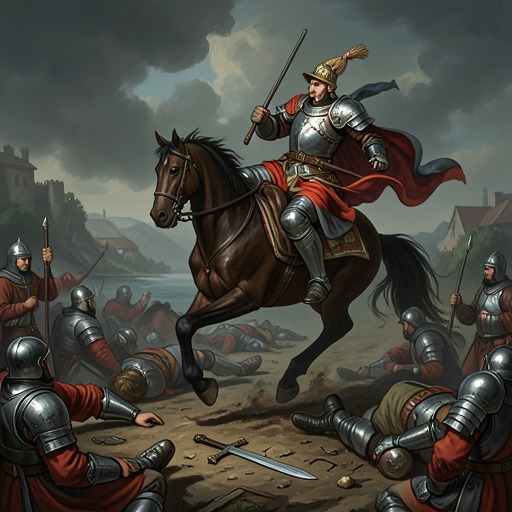
In the account of the last war, Sir Mordred meets King Arthur at Dover to stop him landing. The chapter sequence then moves from this confrontation to Sir Gawaine’s death and, after a warning associated with Gawaine’s ghost, to the battle that begins through the chance encounter with an adder. Sir Mordred is killed, and King Arthur is mortally wounded. Dover thus marks the opening of a sequence whose outcome is the collapse of the old order, rather than a lasting recovery of the kingdom.
The episode makes control of the landing inseparable from the struggle for kingship. Mordred’s attempt to bar Arthur from the country turns arrival into an armed test of authority. The next stage of the account carries the conflict onward to Barham Down, where Launcelot later hears that Mordred fought Arthur again and was defeated. Dover is therefore the first named setting in the returned king’s final campaign, not the site of its complete resolution.
Launcelot at Dover Castle
Launcelot reaches Dover after the decisive events. The people there tell him that Arthur has been slain and that Sir Mordred and a great multitude died in the fighting; they also recount Gawaine’s death in the first battle at Arthur’s landing. Launcelot responds first by asking to be shown Gawaine’s tomb in Dover Castle. He kneels there, weeps, and prays for his soul, turning the castle into the setting for a personal act of mourning within the larger catastrophe.
His observance extends beyond the visit to the tomb. Launcelot arranges a public dole, distributing food and drink and giving twelve pence to each man or woman who comes; he personally hands out the money while dressed in mourning and asks those present to pray for Gawaine. The following day, priests and clerks gather for a Requiem Mass. Launcelot offers one hundred pounds, seven kings contribute forty pounds each, and a thousand knights each offer a pound. The offering lasts from morning until night, and Launcelot remains at the tomb for two nights in prayer and weeping. These acts give the place a communal as well as private dimension of remembrance.
From Mourning to Departure
On the third day, Launcelot thanks the assembled leaders and knights for coming with him, but says that they have arrived too late and that he will regret it for the rest of his life. He then announces that he will ride in search of Queen Guenever, whom he has heard is suffering and has fled west. He asks the company to wait for him, but to leave by ship if he has not returned within fifteen days. Dover is thus where grief becomes a new, solitary undertaking: the gathering that came with Launcelot is left behind as he sets out after the queen.
That departure also establishes a contrast between the town’s two functions in the final narrative. Dover first receives Arthur as he attempts to land against Mordred’s opposition; afterward it receives Launcelot, who can no longer alter the outcome and instead honors the dead. The sequence turns a coastal stronghold into a hinge between the kingdom’s last battle and the survivors’ acts of mourning, penitence, and separation.