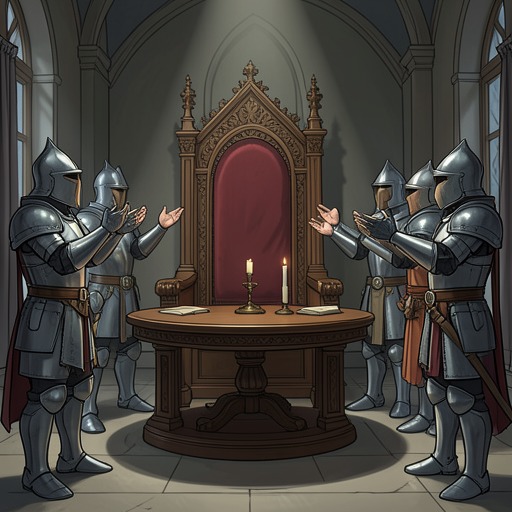
Fortune and the mutability of life
Le Morte d'ArthurFortune and the mutability of life is the story’s insistence that status, security, and even apparent victory cannot be counted on to endure. The theme is stated directly when Sir Launcelot, departing from the realm where he had won honor, describes fortune as changeable and its wheel as ever in motion. It returns in another form in King Arthur’s dream of a wheel turning him down into danger, and in the last battle, where a truce collapses through a chance event. Together these moments make mutability more than a proverb: it is the principle that connects personal exile, political reversal, and the destruction of the kingdom’s remaining fellowship.
Launcelot and the Wheel of Fortune
As he prepares to leave the realm, Sir Launcelot mourns the loss of a country he says he loved above all others and in which he had gained much of his honor. His departure feels to him undeserved and without cause. The contrast between his past standing and his present banishment gives the theme its sharpest personal expression: the knight who believes he and his kin helped increase the honor of the whole Round Table must now go into exile from the court.
Launcelot explains the reversal by appealing to the examples of Hector, Troilus, and Alexander, who, he says, fell from their highest condition when they were most exalted. Their remembered rises and falls place his own change of fortune within a larger historical pattern. He does not claim that his former honor never existed; rather, he measures how quickly it has become precarious. His reflection gives the wheel a social as well as personal meaning: rank and reputation may be accumulated through service, yet neither guarantees a secure place in the realm.
His answer to Sir Gawaine also shows that a fall in fortune does not erase his ability to act. Launcelot says he can live on his lands as well as any knight, and that if the king and Gawaine make war on him there, he will endure it as best he can. He distinguishes that possible conflict from an accusation of treason or felony, which he says he would have to answer. Exile has stripped him of his position at court, but not of his land, his capacity to defend himself, or his sense of what charges he must meet.
Arthur’s Dream and the Warning
The theme shifts from Launcelot’s retrospective explanation to a vision of impending political ruin. On the night before the appointed encounter with Sir Mordred, Arthur dreams that he sits in rich clothing on a chair fastened to a wheel. Far below him lies a black depth filled with serpents, worms, wild beasts, and birds. The wheel turns upside down, and he falls among them. The image turns the general idea of reversal into a precise threat: the king’s elevated position is not firm, and the same wheel that bears him upward can cast him down.
In the dream, Sir Gawaine appears with women for whom he had fought while alive. He warns Arthur not to fight the next day, predicting that Arthur, Mordred, and most of both armies will die if they meet as agreed. Gawaine urges Arthur to seek a month’s delay, offering land and goods if necessary; he says that within that time Launcelot and his knights will come to Arthur’s rescue. The warning binds remembered service, present danger, and hoped-for rescue together, but it cannot make the outcome secure. Arthur wakes shaken, tells his lords and bishops what he has seen, and sends Sir Lucan and Sir Bedivere to negotiate.
Mordred accepts a settlement under which he is to have Cornwall and Kent during Arthur’s lifetime and all England after Arthur’s death. The agreement appears to defer battle, but its terms already expose the uncertainty beneath it: peace is negotiated in the shadow of the king’s eventual death, and neither side trusts the other. Arthur tells his host to attack if a sword is drawn; Mordred gives his own army a matching order. Thus the attempt to avert disaster contains the condition that will ignite it.
The Truce Broken by Chance
The armies agree that Arthur and Mordred will meet between their hosts with fourteen companions apiece. They reach an accord and drink wine, a brief outward sign that the confrontation may have been postponed. Then an adder emerges from a small heath bush and stings a knight. The knight draws his sword to kill it, intending no harm to either army. But both hosts see a drawn blade and take it as the signal to attack. The turn from negotiation to battle is caused not by a deliberate order to break the agreement, but by a chance incident interpreted through mutual suspicion.
The battle lasts through the day. Arthur rides repeatedly through Mordred’s forces and fights with the steadfastness expected of a king; Mordred also commits himself to the struggle. By near night, one hundred thousand lie dead on the down. The scale of the loss turns the threatened reversal into public devastation: the armies that had gathered around rival claims to rule are almost wholly destroyed, and Arthur finds that only Sir Lucan and Sir Bedivere remain alive among his knights, both badly wounded.
Arthur sees Mordred leaning on his sword among the dead and resolves to strike him, though Lucan urges restraint. Lucan recalls Gawaine’s warning and argues that Arthur has already won the field: Mordred has no living men with him, and the king may yet survive the day if he stops. Arthur refuses the safer course, saying that Mordred will not escape him now and invoking the resolve to face life or death. The moment places victory and danger side by side. Arthur has prevailed militarily, but the apparent success tempts him into the final encounter that makes his own death unavoidable.
Reversal, Recognition, and the End of Certainty
Arthur drives his spear through Mordred’s body. Mortally wounded, Mordred thrusts himself along the spear and strikes Arthur on the head with his sword; Mordred dies, and Arthur falls unconscious. The conclusion completes the wheel’s reversal in the most literal political sense: the king defeats his enemy, but the same encounter that kills Mordred leaves Arthur wounded to the death. Victory cannot be separated from loss, and the destruction of the rival does not restore the kingdom.
After the battle, Arthur asks Lucan to discover the meaning of the noise from the field. Lucan finds people pillaging the fallen knights and killing those who are not quite dead in order to take their armor and valuables. Even after the armies’ defeat, disorder and danger continue; the conclusion does not present the end of combat as a return to safety. Lucan advises that Arthur be taken to a town, but the surviving king is already gravely wounded.
Across these episodes, fortune operates not as a simple explanation that makes every reversal deserved, but as a measure of how unstable worldly honor and political power are. Launcelot’s exile follows a career he recalls as a source of honor; Arthur receives a warning but cannot turn it into lasting security; a truce is undone by an accident because both armies are already prepared to distrust it. The wheel’s movement is therefore both personal and collective: it changes a knight’s place in the court, overturns a king’s expectation of safety, and leaves a battle won at the cost of the realm it was meant to defend.